
10-06-2026 13:41
 François Freléchoux
Bonjour à nouveau, Voici une trouvaille d'hier.
10-06-2026 11:53
Steve ClementsBonjour, This disco is abundant on dead stems of
10-06-2026 12:54
Steve ClementsBonjour encore, Pouvez-vous m'aider, s'il vous pl
10-06-2026 10:45
François Freléchoux
Bonjour à nouveau, Encore une détermination qui
08-06-2026 10:16
 Spooren Marco
I don`t have a clou about this fungus,it is not in
10-06-2026 09:24
François Freléchoux
Bonjour, J'imagine que cette détermination ne do
09-06-2026 18:32
Camille MertensSur morceau de roseau immergé 0,5 - 0,7 mm de dia
08-06-2026 17:00
François BartholomeeusenGood day everyone, On June 5 2026, I collected de
07-06-2026 15:10
 William Slosse
Hello everyone,On 05-06-26, I found following asco
Yellow longneck...
Martin Bemmann,
19-12-2009 22:49
 Hello,
this one I found last weekend before it started to freeze... meanwhile we have here -14 C.
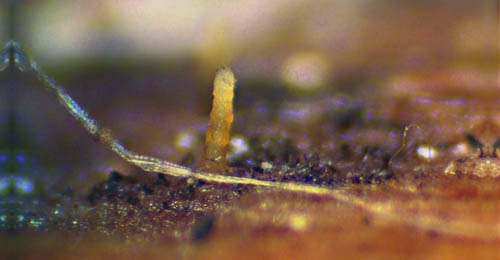
I collected a dead twig of Prunus avium observing some apothecia with the hand loupe that turned out to be Neodasyscypha cerina. But under the bino I found some other fungi upon it, among them this one I can't determin.
By habitus it reminds me to the Natantiella I found recently, immersed in the soft decaying wood on decorticated part of the twig, with a "long" (< 1mm) ostiole neck and bunshes of asci at the bottom when excavated. ( I didn't manage yet to prepare a complete specimen but I belive it would have the same shape as a Natantiella or Eutypella.
But the colour of the outer wall and the ostiole is yellow and it is not crusty at all but gelatinous. Shape and appearance of the spores is also very differrent.
Can somebody show me the way?
Best regards,
Martin
Martin Bemmann,
19-12-2009 22:52
Re:Yellow longneck...
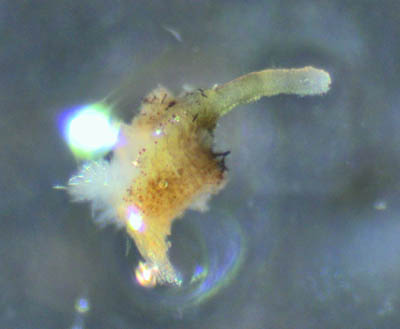
another view in water showing the cluster of asci to the left:
Martin Bemmann,
19-12-2009 22:54
Re:Yellow longneck...
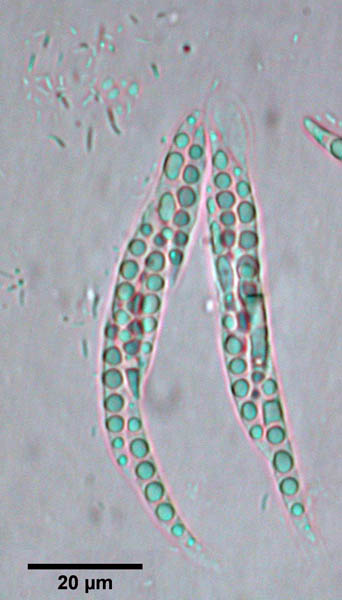
Asci (81-91x8,4-11 µm):
Martin Bemmann,
19-12-2009 22:54
Re:Yellow longneck...
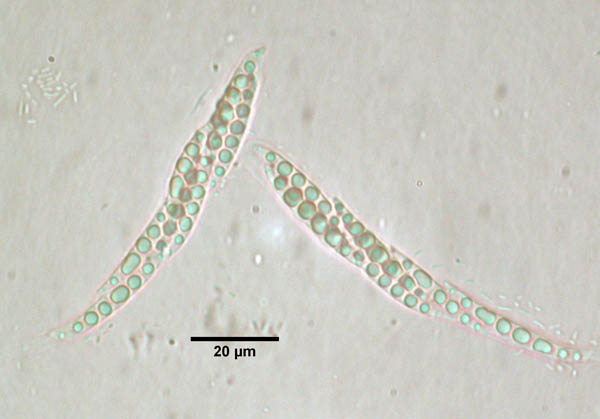
more asci:
Martin Bemmann,
19-12-2009 22:55
Re:Yellow longneck...
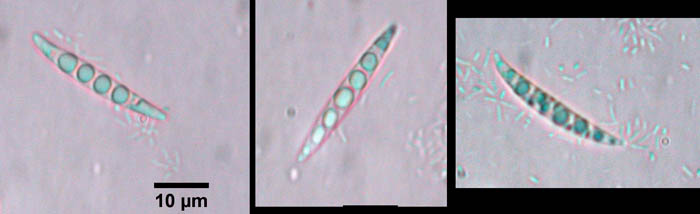
and spores: (27,6-31,9 x 3,7-4,3 µm):
Martin Bemmann,
19-12-2009 23:02
Re:Yellow longneck...
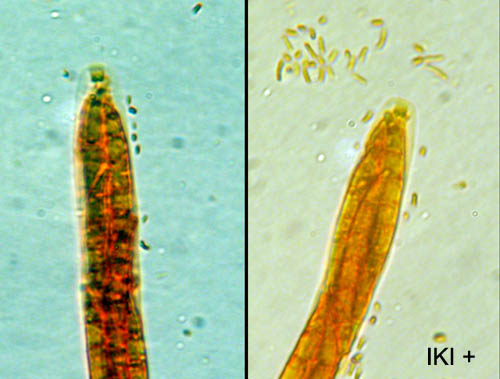
Finally, the apical apparatus stained slightly blue in IKI:
Martin Bemmann,
20-12-2009 15:18
Re:Yellow longneck...
Hi again,
during my search I came across the genus Pseudohalonectria that shows morphological similarities. But the taxa descibed by Shearer (1989) do not fit well to my collection (much larger dimensions of asci and ascospores), not to mention that P. is found generally on submersed wood which wasn't the case with my find.
On this stick are 2-3 ascocarps more. I don't want to slaughter them until I see a direction what to search for.
Any suggestions welcome!
Best regards,
Martin
Edited: Pseudohalonectria
during my search I came across the genus Pseudohalonectria that shows morphological similarities. But the taxa descibed by Shearer (1989) do not fit well to my collection (much larger dimensions of asci and ascospores), not to mention that P. is found generally on submersed wood which wasn't the case with my find.
On this stick are 2-3 ascocarps more. I don't want to slaughter them until I see a direction what to search for.
Any suggestions welcome!
Best regards,
Martin
Edited: Pseudohalonectria
Martin Bemmann,
20-12-2009 23:14
Re:Yellow longneck...
PS: I am not sure about IKI+... maybe the apical apparatus contains only refractive bodies...
Jacques Fournier,
21-12-2009 15:56

Re:Yellow longneck...
Hi Martin,
I agree Pseudohalonectria is a possible lead, but noy very convincing because of the different ecology. Yellow waxy necks and fusiform spores also indicate possible relationships with Ceratosphaeria but in this genus the ascomatal wall is much thicker. I suggest you first manage to find more material, or try to incubate your branch of Prunus outdoor and be patient! If it works Martina Réblova could perhaps help you. Or just ask her now at reblova@ibot.cas.cz.
Cheers,
jacques
I agree Pseudohalonectria is a possible lead, but noy very convincing because of the different ecology. Yellow waxy necks and fusiform spores also indicate possible relationships with Ceratosphaeria but in this genus the ascomatal wall is much thicker. I suggest you first manage to find more material, or try to incubate your branch of Prunus outdoor and be patient! If it works Martina Réblova could perhaps help you. Or just ask her now at reblova@ibot.cas.cz.
Cheers,
jacques
Martin Bemmann,
21-12-2009 16:13
Re:Yellow longneck...
Thank you Jaques,
I will try to contact her. The branch lies in my garage covered with a damp tissue. Outside it is some degrees below zero...
Best regards,
Martin
I will try to contact her. The branch lies in my garage covered with a damp tissue. Outside it is some degrees below zero...
Best regards,
Martin