
29-05-2026 15:35
daniel FERREBonjour à tous,Je voudrais votre aide pour cette
28-05-2026 16:15
James MitchellHello,Does anyone have the original publication of
28-05-2026 11:06
Thomas Læssøehttps://svampe.databasen.org/observations/10596750
23-05-2026 11:44
 Charles Grapinet
Hello, I am having trouble identifying this copro
25-05-2026 16:44
François BartholomeeusenHi forum members,During an excursion organised by
26-05-2026 21:25
Dirk GerstnerHello everyone, I'm completely stumped by this li
26-05-2026 22:44
Ethan CrensonHi all, I think I have Incrucipulum capitatum her
22-05-2026 14:44
 Lothar Krieglsteiner
in unripe condition citrine yellow, then soon fadi
25-05-2026 16:35
 Bernard CLESSE
Bonjour à toutes et tous,J'ai trouvé récemment,
22-05-2026 13:29
Gernot FriebesHi,I am curious to hear your opinion on this mater
Protounguicularia/Olla transiens
Martin Bemmann,
13-12-2009 12:19
 Hello,
in my last posting I showed in the end some hairs, that had been identified by Zotto as belonging to an Olla transiens. Meanwhile I did some more documentation of it.
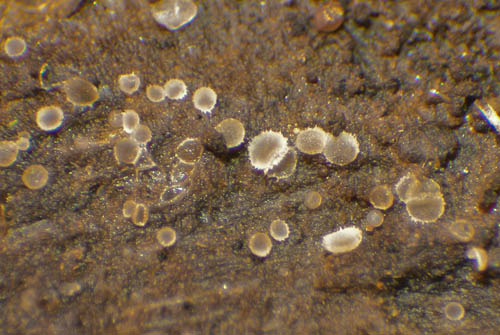
I found this fungus last week in Heidelberg, Germany in the castle's park. Substrate is a dead twig of Prunus avium lying on the ground. The apothecia appear on decorticated parts of it.
Size of the apothecia is c. 200-250 µm, urceolate when young, older specimen more disk shaped.
Martin Bemmann,
13-12-2009 12:20
Re:Protounguicularia/Olla transiens
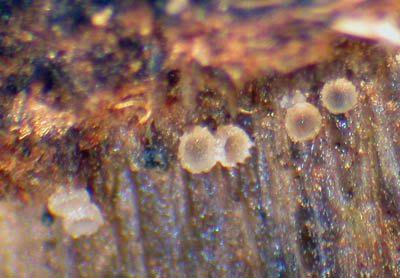
another macro:
Martin Bemmann,
13-12-2009 12:25
Re:Protounguicularia/Olla transiens
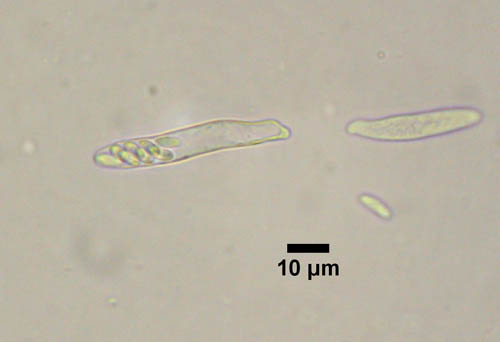
The asci are cylindrical (never with a "stalk" ), 38,9-50,5 x 6,8-8,2 µm in size. Reaction of the apex in IKI is hemiamyloid.
The paraphyses are filiforme with some septa
The paraphyses are filiforme with some septa
Martin Bemmann,
13-12-2009 12:29
Re:Protounguicularia/Olla transiens
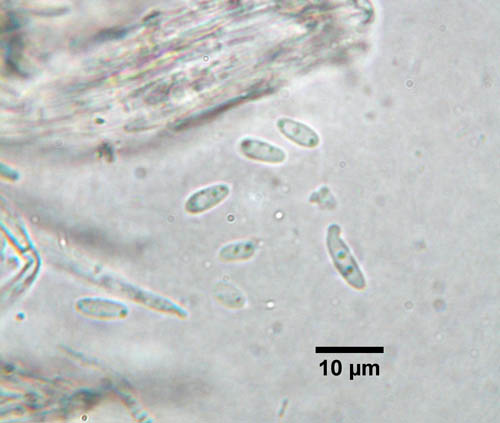
The spores are elongated ovoid (don't know a better term), hyaline with some oildrops.
6,2-7,6x2,5-3 µm in size. I saw no septated ones.
The big one to the lower right is germinating(?). Its size is 9,8x2,8 µm.
6,2-7,6x2,5-3 µm in size. I saw no septated ones.
The big one to the lower right is germinating(?). Its size is 9,8x2,8 µm.
Martin Bemmann,
13-12-2009 12:35
Re:Protounguicularia/Olla transiens
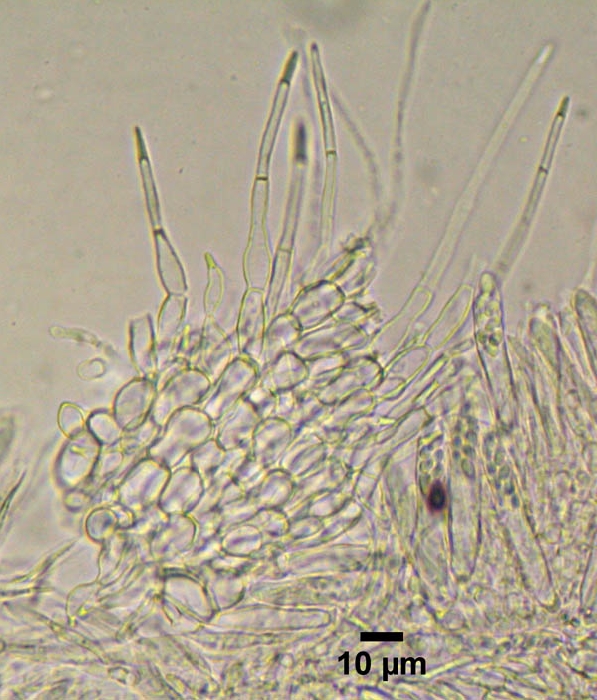
The hairs vary in length and shape (49-81x3,2-6,6 µm) with a conspicuous glassy tip, that varies in size and shape as well. They have 0-3 septa.
Martin Bemmann,
13-12-2009 12:36
Re:Protounguicularia/Olla transiens
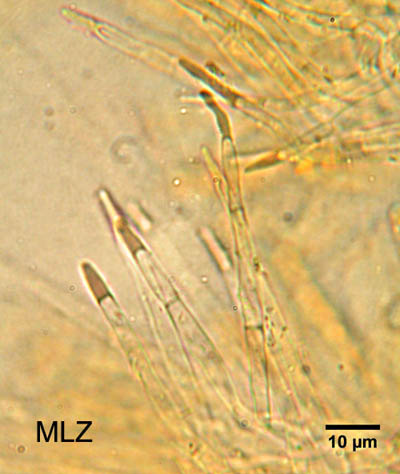
Reaction of the tip with MLZ seems to be +:
Martin Bemmann,
13-12-2009 12:37
Re:Protounguicularia/Olla transiens
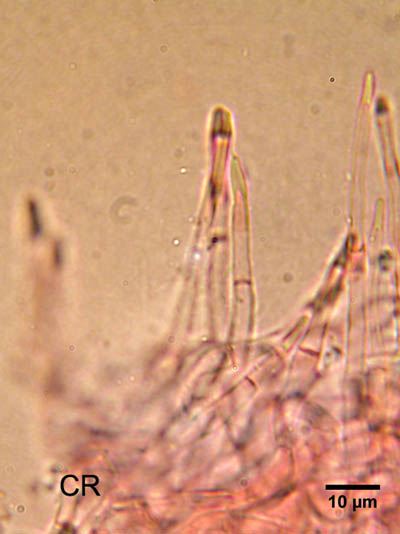
The inner part of the hairs is stained with CR:
Hans-Otto Baral,
13-12-2009 12:45

Re:Protounguicularia/Olla transiens
I can only confirm Protounguicularia/Olla transiens
Martin Bemmann,
13-12-2009 12:46
Re:Protounguicularia/Olla transiens
When I compare my find with the documentations on Zotto's DVD Olla transiens fits very well. But going into the paper by Huhtinen/Hawkswoth/Ihlen 2008 who combined O.t. to Protounguicularia I don't feel comfortable. For instance form and size of spores are different and asci are "stalked".
How should I name my find?
Best regards
Martin
How should I name my find?
Best regards
Martin
Hans-Otto Baral,
13-12-2009 12:52
Re:Protounguicularia/Olla transiens
Hi Martin
I do not find P./O. transiens described in this paper. It is only combined there, isn't it? By the way, your ascus is turgescent and therefore less stalked than a dead ascus would be.
Zotto
I do not find P./O. transiens described in this paper. It is only combined there, isn't it? By the way, your ascus is turgescent and therefore less stalked than a dead ascus would be.
Zotto
Martin Bemmann,
13-12-2009 12:53
Re:Protounguicularia/Olla transiens
Hi Zotto,
you allready answered before I asked ;-)
So do you think it would fit into the concept of P.t. sensu Huhtinen?
regards,
martin
you allready answered before I asked ;-)
So do you think it would fit into the concept of P.t. sensu Huhtinen?
regards,
martin
Martin Bemmann,
13-12-2009 12:57
Re:Protounguicularia/Olla transiens
yes, maybe I misunderstood the article as thinking transiens differs from nephromatis by the chemical reaction of the hairs only (p.555). I will have to find a copy of Huhtinens monograph!
Thank you
Martin
Thank you
Martin
Stip Helleman,
13-12-2009 17:13

Re:Protounguicularia/Olla transiens
Hi Martin,
Here you get a good descriptive article:
cheers Stip
Here you get a good descriptive article:
cheers Stip
 9832.pdf
Martin Bemmann,
13-12-2009 20:24
Re:Protounguicularia/Olla transiens
Thank you Stip for providing this article on the type species of Protounguicularia. It gave me more insight and presents convincing features of this genus.
The bitter pill is that my last fungus Hyaloscypha quercicola/quercina showing almost no hairs should be the same as the featured P. barbata.
I have to learn much about variability...
Cheers,
Martin
The bitter pill is that my last fungus Hyaloscypha quercicola/quercina showing almost no hairs should be the same as the featured P. barbata.
I have to learn much about variability...
Cheers,
Martin
Hans-Otto Baral,
13-12-2009 21:00
Re:Protounguicularia/Olla transiens
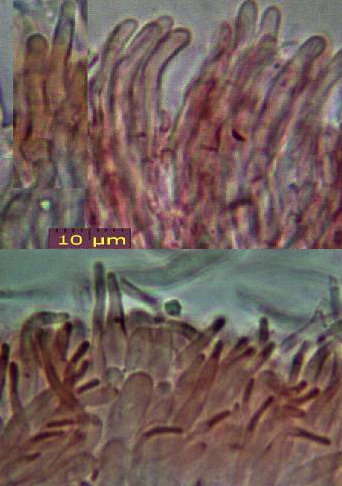
It's also a mystery for me that Hyaloscypha may have rather distinct glassy hair apices very similar to Protounguicularia. Here is a photo by Ingo Wagner of what we believe is Hyaloscypha intacta. The upper hairs were also found in this population. Generic limits are very very difficult sometimes.
Zotto
Zotto
Martin Bemmann,
13-12-2009 21:52
Re:Protounguicularia/Olla transiens
Thank you Zotto for sharing my unease!
I knew Ingo's collection (and the following discussion), but I didn't take it into consideration, the hairs beeing so different to my find.
Maybe this genus has season now and I will try to make more collections to compare.
Cheers,
Martin
I knew Ingo's collection (and the following discussion), but I didn't take it into consideration, the hairs beeing so different to my find.
Maybe this genus has season now and I will try to make more collections to compare.
Cheers,
Martin