
19-05-2026 10:27
Patrice TANCHAUDBonjour, récolte récente sur terre retournée i
04-06-2026 18:39
Gernot FriebesHi,I collected this species in two different locat
22-05-2026 13:29
Gernot FriebesHi,I am curious to hear your opinion on this mater
04-06-2026 10:50
 François Freléchoux
Bonjour, J'ai trouvé hier un petit asco observé
04-06-2026 07:02
François Freléchoux
Bonjour, Voici la description d'une espèce qui p
04-06-2026 13:34
Gernot FriebesHi,I am interested to hear your opinion on this Le
04-06-2026 11:36
Gernot FriebesHi,found on Vaccinium myrtillus.Asci: IKI –, 8-s
18-10-2022 00:12
Valencia Lopez Francisco JavierHola amigos/asRecientemente encontré esta colecci
Hymenoscyphus dans P. lentiscus
Javier Ormad,
06-12-2009 20:21
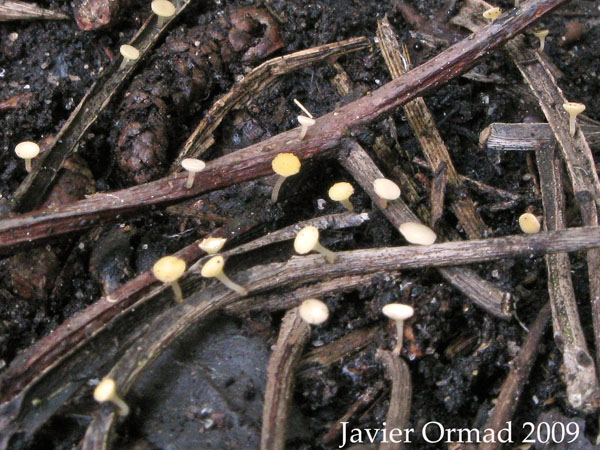
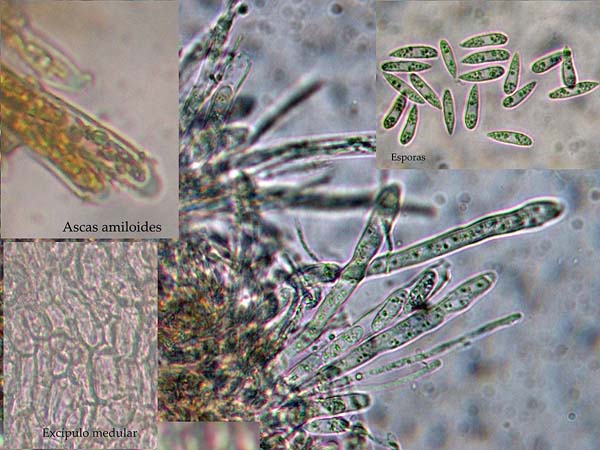
Je présente une possible Hymenoscyphus sur tiges morts de Pistacia lentiscus. Le plus grand diamètre de 1,5 mm à pied jusqu'à 2 mm. Les spores n'ont pas de cils ni cloisons et mesurée 14-21 x 3.5-4.5 microns. Suite à la clé de Ellis & Ellis, je pense que pour obtenir à H. vitellinus, mais sont un peu étroit des spores.
Avec les variétés de H. scutula, et leur tendance s'observe aussi loin de spores, mais je ne vois ni cils, ni cloisons, pourrait écarter cette espèce?
Merci d'avance
Javier Ormad,
06-12-2009 20:21
Re:Hymenoscyphus dans P. lentiscus
Micro
Hans-Otto Baral,
06-12-2009 20:35

Re:Hymenoscyphus dans P. lentiscus
Dear Javier
clearly a Hymenoscyphus. Are you sure the substrate is twigs? It looks like it could also be petioles? Then your fungus could be H. caudatus s.l. Important is to look for the ascus base. If you still have the fungus fresh you should also look for the living paraphyses for their contents. The asci you figure are dead, perhaps you find living ones which are much larger.
H. scutula has likewise aseptate spores when mature, the septa develop later.
clearly a Hymenoscyphus. Are you sure the substrate is twigs? It looks like it could also be petioles? Then your fungus could be H. caudatus s.l. Important is to look for the ascus base. If you still have the fungus fresh you should also look for the living paraphyses for their contents. The asci you figure are dead, perhaps you find living ones which are much larger.
H. scutula has likewise aseptate spores when mature, the septa develop later.
Javier Ormad,
06-12-2009 22:37
Re:Hymenoscyphus dans P. lentiscus
Petiole not proper, but the stems that attach to the leaves. But the color of the apothecia becomes yellow and not white or cream as described in Ellis & Ellis. The spores believe mature and I think the content of paraphyses is greenish with vacuoles, septa and without terminal enlargement.
H. caudatus is a good choice and P. lentiscus could be another host, but did not rule H. scutula if the septa and the cilia are very mature spores. I have a fresh specimen ........
Thanks
H. caudatus is a good choice and P. lentiscus could be another host, but did not rule H. scutula if the septa and the cilia are very mature spores. I have a fresh specimen ........
Thanks