
12-06-2026 14:50
 François Freléchoux
Bonjour, Voici la brève description d'une Mollis
10-06-2026 21:16
François Freléchoux
Bonsoir,Le dernier du jour, en attendant votre avi
11-06-2026 19:01
 William Slosse
Hello all,In an attempt to make a culture of a sus
11-06-2026 19:03
 Nicolas VAN VOOREN
Chers membres d'Ascofrance,Le site sera placé en

09-06-2026 18:32
Camille MertensSur morceau de roseau immergé 0,5 - 0,7 mm de dia
10-06-2026 12:54
Steve ClementsBonjour encore, Pouvez-vous m'aider, s'il vous pl
10-06-2026 21:07
François Freléchoux
Toutes les tiges de gentianes jaunes de l'an passÃ
10-06-2026 13:41
François Freléchoux
Bonjour à nouveau, Voici une trouvaille d'hier.
Hymenoscyphus macroguttatis
Yannick Mourgues,
16-10-2009 23:03
 Hi.
Hi.I found this hymenoscyphus on died branches from Salix caprea, at the edge of a peat bog in 1300m of height in Lozère (48) France.
Micro :
Asci arrising from croziers, IKI+ strongly blue in Lugol, 110-140x8-10 um
Paraphyses septates, filiform with rounded apex, with many refractives guttules (apos becoming red when hurted), width = 2-3 um.
Spores cylindrical, not scuttuloid, filled with many small guttules at each side, not septate, 15,4-17,2x5,1-5,9 um Q=2,7-3,2 N=30
With keys I have, I arrive to H. macroguttatis. But I'm not convinced.
What do you think about it ???
Yannick Mourgues
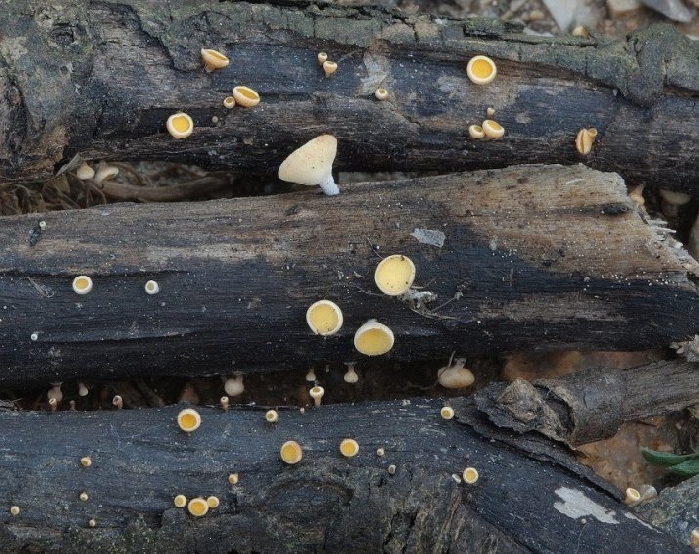
Yannick Mourgues,
16-10-2009 23:04
Re:Hymenoscyphus macroguttatis
Other view... One day later.
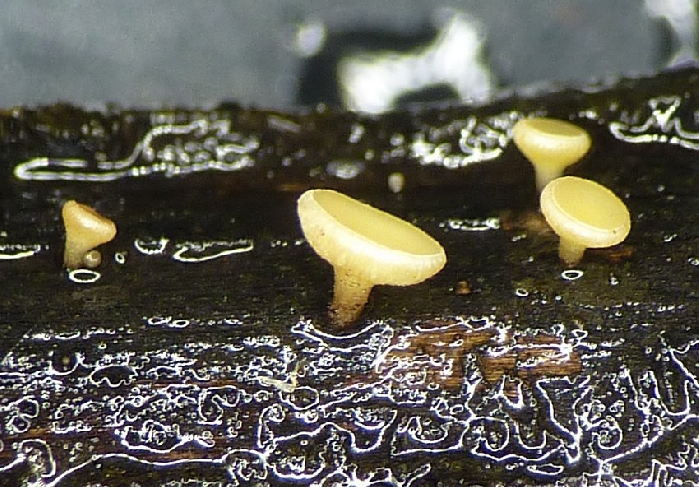
Yannick Mourgues,
16-10-2009 23:04
Re:Hymenoscyphus macroguttatis
LAst view...
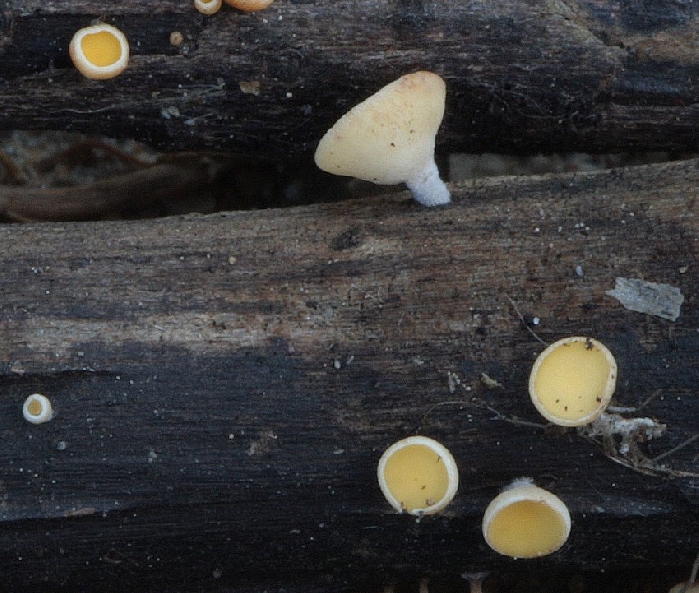
Yannick Mourgues,
16-10-2009 23:06
Re:Hymenoscyphus macroguttatis
spores in H2O
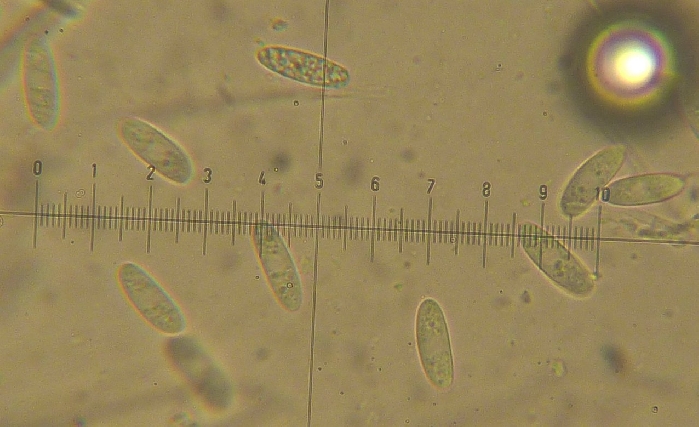
Hans-Otto Baral,
16-10-2009 23:18

Re:Hymenoscyphus macroguttatis
Hi Yannick
no, its of the calyculus group. In a broad sense it is calyculus. I found this frequently when in the alps. I think it is H. subferrugineus, a name referring to the colour change from whitish to red-brown due ti the VBs. The spores are shorter than in calyculus.
On the DVD HB 3118 could be conspecific although more yellow and at 400 m alt. The type is HB 5984, by Nylander.
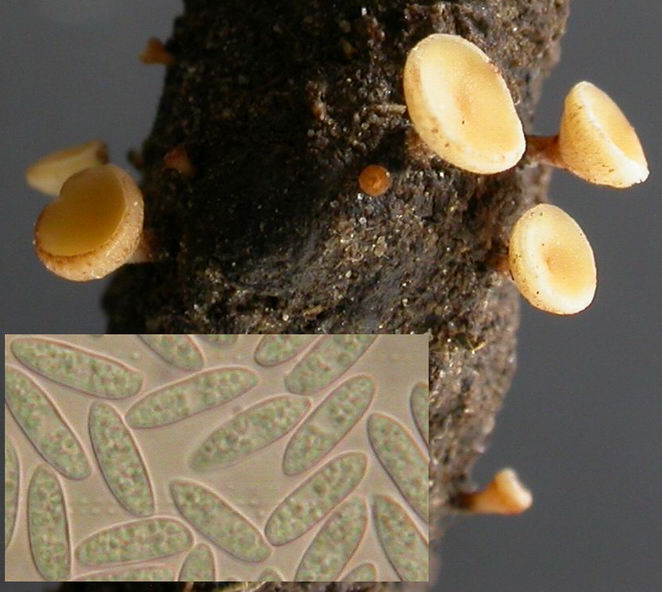
Here I attach an example from Luzern, on Corylus.
Zotto
no, its of the calyculus group. In a broad sense it is calyculus. I found this frequently when in the alps. I think it is H. subferrugineus, a name referring to the colour change from whitish to red-brown due ti the VBs. The spores are shorter than in calyculus.
On the DVD HB 3118 could be conspecific although more yellow and at 400 m alt. The type is HB 5984, by Nylander.
Here I attach an example from Luzern, on Corylus.
Zotto
Yannick Mourgues,
16-10-2009 23:35
Re:Hymenoscyphus macroguttatis
Thank's a lot Zotto.
So table 1 in Declercq's key. But for H. calyculus, spores must be scutuloid ? It's not clear for me. In my picture, I don't see scutuloid spores. I saw all of them rounded at each side.
What is your opinion about that ?
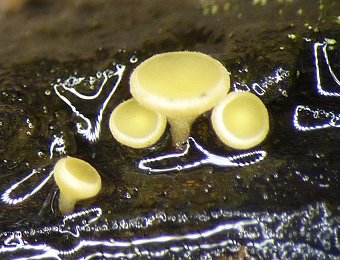
Here are new pictures, one week later in the fridge...
Yannick
So table 1 in Declercq's key. But for H. calyculus, spores must be scutuloid ? It's not clear for me. In my picture, I don't see scutuloid spores. I saw all of them rounded at each side.
What is your opinion about that ?
Here are new pictures, one week later in the fridge...
Yannick
Yannick Mourgues,
16-10-2009 23:35
Re:Hymenoscyphus macroguttatis
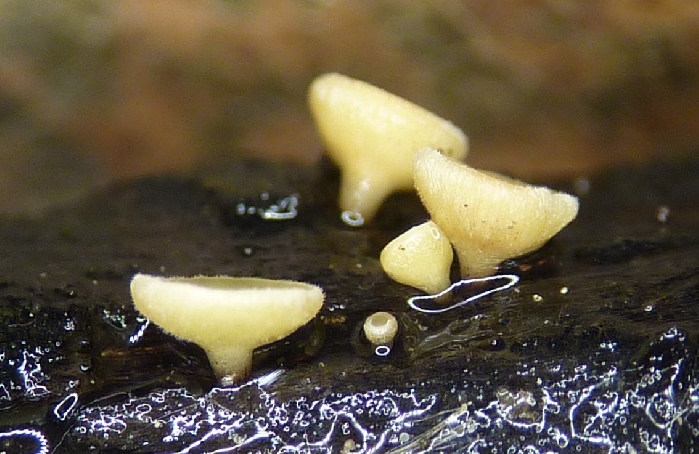
Other pict
Yannick Mourgues,
16-10-2009 23:36
Re:Hymenoscyphus macroguttatis
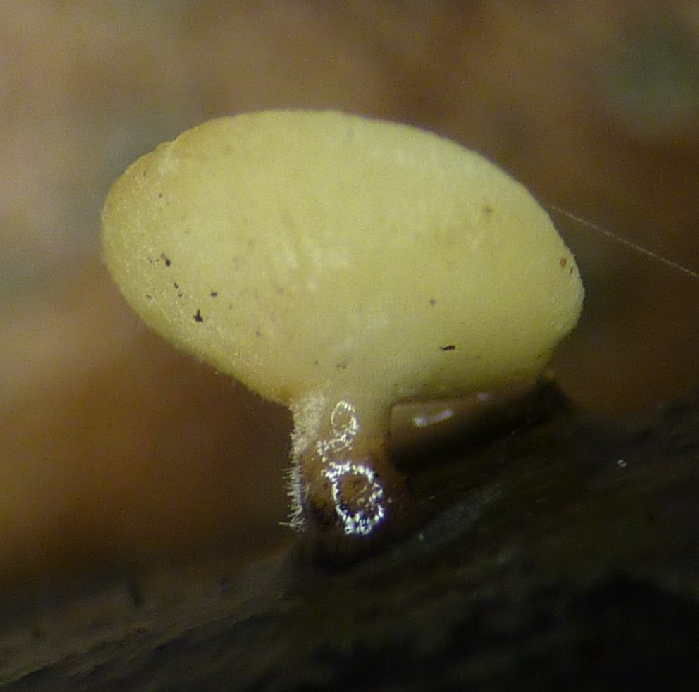
Last one !
Hans-Otto Baral,
16-10-2009 23:40
Re:Hymenoscyphus macroguttatis
you are right, it is hardly visible that they are scutuloid. But look at my photo, the upper spore end is somewhat asymmetrical, and that is not seen from any view. make a test and try to find out the upper and lower end of the spores. If this is possible in many spores they are scutuloid.
In H. conscriptus it is similar, and this taxon is only tentatively different from subferrugineus.
Zotto
In H. conscriptus it is similar, and this taxon is only tentatively different from subferrugineus.
Zotto
Yannick Mourgues,
17-10-2009 00:03
Re:Hymenoscyphus macroguttatis
So yes, they are scutuloid as you said.
H. conscriptus could be a good candidate, but here, are spores not too wide ?
Considering that the guttules of my spores does not exceed 1 um of diameter, I shall tilt rather for H. conscriptus.
Except for the diameter of guttules, is there really a difference between H. conscriptus and H. calyculus ?
Yannick
H. conscriptus could be a good candidate, but here, are spores not too wide ?
Considering that the guttules of my spores does not exceed 1 um of diameter, I shall tilt rather for H. conscriptus.
Except for the diameter of guttules, is there really a difference between H. conscriptus and H. calyculus ?
Yannick
Hans-Otto Baral,
17-10-2009 09:41
Re:Hymenoscyphus macroguttatis
Don't ask me so difficult questions :-( Originally I was convinced that calyculus (mainly on Alnus) and consriptus (?only on Salix) are easy to distinguish by spore size and oil drop size. But I was unaware of these montane forms which i now identified as subferrugineus and which are somewhat intermediate. There is also some variation in typical calyculus and conscritpus. Long ago I wrote a paper about that, i.e. a part of the paper on H. menthae and macroguttatus, which is still unpublished. I fear that the present version does not yet contain all of my latest results, and I must first work through this all to be able to give any comments. So I finally cannot fully reject Dennis' statement who wrote that he tried in vain to separate between calyculus from conscriptus over many years.
The only thing that helps is to make as many documentations of collections as possible. So if yu have the chance please make more microphotos of your spores.
Zotto
The only thing that helps is to make as many documentations of collections as possible. So if yu have the chance please make more microphotos of your spores.
Zotto
Yannick Mourgues,
17-10-2009 12:45
Re:Hymenoscyphus macroguttatis
I'll do it !
Thank's a lot again.
Yannick
Thank's a lot again.
Yannick