
10-06-2026 13:41
 François Freléchoux
Bonjour à nouveau, Voici une trouvaille d'hier.
10-06-2026 11:53
Steve ClementsBonjour, This disco is abundant on dead stems of
10-06-2026 12:54
Steve ClementsBonjour encore, Pouvez-vous m'aider, s'il vous pl
10-06-2026 10:45
François Freléchoux
Bonjour à nouveau, Encore une détermination qui
08-06-2026 10:16
 Spooren Marco
I don`t have a clou about this fungus,it is not in
10-06-2026 09:24
François Freléchoux
Bonjour, J'imagine que cette détermination ne do
09-06-2026 18:32
Camille MertensSur morceau de roseau immergé 0,5 - 0,7 mm de dia
08-06-2026 17:00
François BartholomeeusenGood day everyone, On June 5 2026, I collected de
07-06-2026 15:10
 William Slosse
Hello everyone,On 05-06-26, I found following asco
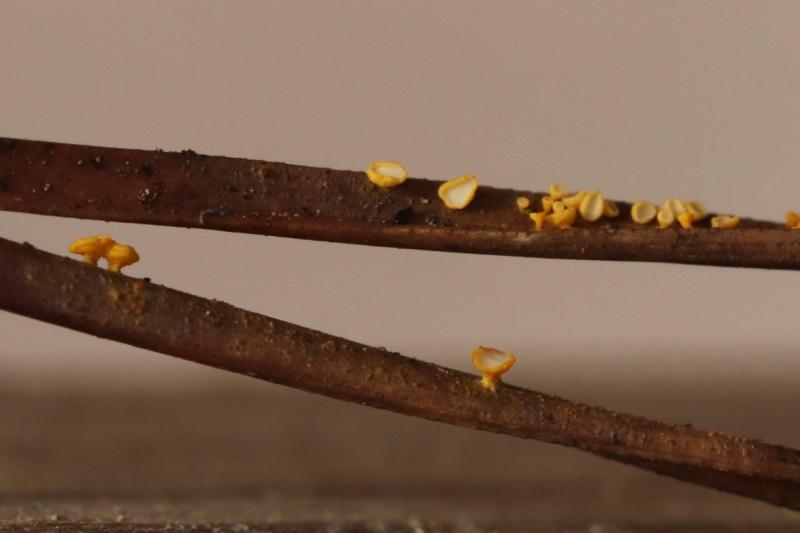
Antinoa pulchella?
Edvin Johannesen,
20-03-2023 19:25
 Hi!
Hi!Can Antinoa pulchella be this yellow on the outside (excipulum) and stipe? Growing of Pinus sylvestris needles. A very preliminary microscopic study shows asci ca. 30 x 4 micr. and spores ca. 5-6 x 1-1.5 micr., ellipsoid-fusiform, somewhat narrower at one end. I am of course ready to do further studies, if necessary, but difficult to take good photos. Bright yellow pigment seen in excipulum. Thanks.
Hans-Otto Baral,
20-03-2023 21:28

Re : Antinoa pulchella?
I am quite convinced it is. I know it with longer, more slender stalk but in my folder are also such like yours. In one collection (1.XI.2019) I see hair-like elements almost like in Hyaloscypha, in others more cylindrical and not tapering. I am not sure how A. acuum can safely be delimited.
Edvin Johannesen,
20-03-2023 22:10
Re : Antinoa pulchella?
Thanks a lot! Yes, I did see your 1.XI.2019 photos before I posted, which gave me hope that this could be A. pulchella. I see the same yellow "hair-like" structures in some of our apos, especially the smaller ones. Second find in Norway (previous reported as Pezizella pulchella).