22-05-2026 21:35
Steve ClementsBonjour, I expected this find on old wood on our
22-05-2026 18:12
 Lothar Krieglsteiner
... in moist chamber from Portugal.As the fungus s
22-05-2026 20:08
Ethan CrensonHello all, Yesterday in NYC I was visiting an e
11-01-2022 16:36
 Jason Karakehian
Hi does anyone have a digital copy of Raitviir A (
20-05-2026 17:47
Margot en Geert VullingsWe found this Mollisia on dead Juncus stems mown l
22-05-2026 14:47
Gernot FriebesHi,superficial ascomata collected on bark of a liv
22-05-2026 14:44
Lothar Krieglsteiner
in unripe condition citrine yellow, then soon fadi
22-05-2026 13:29
Gernot FriebesHi,I am curious to hear your opinion on this mater
22-05-2026 10:59
 Nicolas VAN VOOREN
Trouvé sur Phragmites, ce que je pense être un L
20-05-2026 21:49
Margot en Geert VullingsWe found this Lachnum on Juncus stems mown last ye
Dumontinia ulmariae ?
bernard BOUSQUET,
07-04-2009 11:16
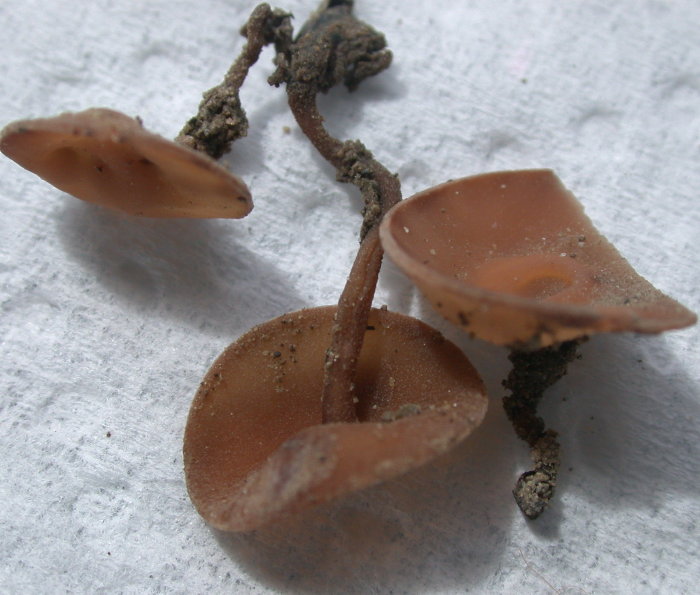
Tous les printemps, début avril, en prospectant la saligue du gave de Mauléon, au niveau de Tardets , je rencontre un petit asco en forme de coupe (0.5 à 1 cm de diamètre) dont le stipe se termine par un sclérote noir, faisant penser à Dumontinia tuberosa. En l’absence d’Anémones sylvie sur la station, je me demande si ce champignon ne serait pas Dumontinia ulmariae. Les spores, qui mesurent en majorité 12 (de 10 à rarement jusqu’à 15) sur 6-7.5 microns, semblent assez bien coller avec cette hypothèse.
Merci d’éclairer ma lanterne.
Bernard BOUSQUET
bernard BOUSQUET,
07-04-2009 11:18
Re:Dumontinia ulmariae ?
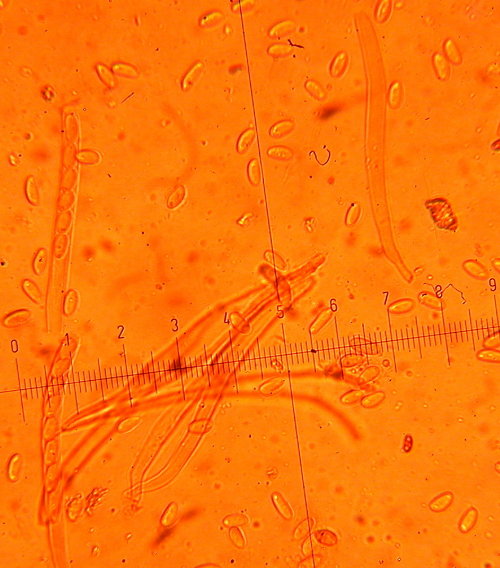
photo des spores
Hans-Otto Baral,
07-04-2009 11:21

Re:Dumontinia ulmariae ?
dear Bernard
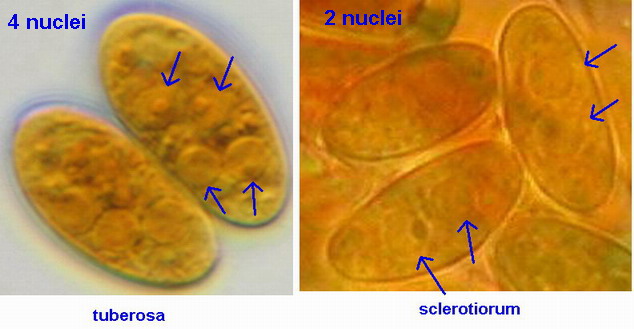
In my opinion, you should provide much larger spore photos to clarify your fungus. With oil immersion it is then usually possible to see the nuclei in the spores. Typical D. tuberosa has 4-nucleate spores, while Sclerotinia sclerotiorum has 2-nucleate spores. Perhaps also a macrophoto would help. I do not know D. filipendulae personally. Were the 8 spores all of the same size within the asci?
Zotto
In my opinion, you should provide much larger spore photos to clarify your fungus. With oil immersion it is then usually possible to see the nuclei in the spores. Typical D. tuberosa has 4-nucleate spores, while Sclerotinia sclerotiorum has 2-nucleate spores. Perhaps also a macrophoto would help. I do not know D. filipendulae personally. Were the 8 spores all of the same size within the asci?
Zotto
bernard BOUSQUET,
07-04-2009 11:49
Re:Dumontinia ulmariae ?
Merci pour votre réponse rapide.
La majorité des spores observées sont biguttulées. est-ce un bon indice ?
BB
La majorité des spores observées sont biguttulées. est-ce un bon indice ?
BB
Hans-Otto Baral,
07-04-2009 12:09
Re:Dumontinia ulmariae ?
The guttules (oil drops, LBs) are much more distinct than the nuclei. You need to look with oil immersion and to close a bit the aperture. Often helps vital staining with Lugol or Cresyl blue. But this is difficile because the spores may finally die, and then the nuclei are not further visible.
Zotto
Zotto
bernard BOUSQUET,
07-04-2009 15:16
Re:Dumontinia ulmariae ?
Désolé ! je ne dispose pas d'un matériel micro suffisamment performant pour voir ces détails.
Hans-Otto Baral,
07-04-2009 17:28
Re:Dumontinia ulmariae ?
What is your equipment? To see this needs only a 100x oil immersion objective of medium quality, a 10x widefield ocular and living material.
Zotto
Zotto
Michel Hairaud,
11-04-2009 18:41

Re:Dumontinia ulmariae ?
Bonjour Bernard et Zotto,
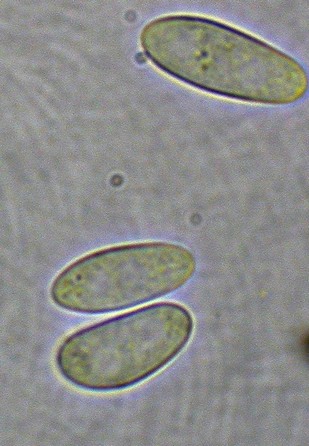
La réception d'une partie de la récolte m'a permis de constater que les spores sont bien binucléées.
Un autre élément plaide en faveur de Slerotinia slerotiorum : la réaction positive de l'excipulum à l'iode (lugol).
Amitiés à tous
La réception d'une partie de la récolte m'a permis de constater que les spores sont bien binucléées.
Un autre élément plaide en faveur de Slerotinia slerotiorum : la réaction positive de l'excipulum à l'iode (lugol).
Amitiés à tous
Hans-Otto Baral,
12-04-2009 22:56
Re:Dumontinia ulmariae ?
Thanks, Michel. I wish to add that the idea of Dumontinia ulmariae is not that bad, the diagnosis in the key by Holst-Jensen would fit quite well (except for the spores being "uniguttulate"), but the number of nuclei is not mentioned. Moreover, with the key of Schumacher & Holst-Jensen (http://biologi.uio.no/bot/ascomycetes/Sclero.key.html) the present find keys as a Sclerotinia:
Dumontina: Apothecial outer excipulum composed of brick-shaped cells (textura prismatica) and an inner zone of loose hyphae embedded in a gelatinous matrix.
Sclerotinia: Apothecial outer excipulum of globose to hexagonal cells.
However, I am generally unable to confirm this key because the excipula of my collections of D. tuberosa (spores 4-nucleate) do not at all fit to that key, and I therefore prefer to merge the two genera.
Zotto
Dumontina: Apothecial outer excipulum composed of brick-shaped cells (textura prismatica) and an inner zone of loose hyphae embedded in a gelatinous matrix.
Sclerotinia: Apothecial outer excipulum of globose to hexagonal cells.
However, I am generally unable to confirm this key because the excipula of my collections of D. tuberosa (spores 4-nucleate) do not at all fit to that key, and I therefore prefer to merge the two genera.
Zotto
Michel Hairaud,
13-04-2009 09:10
Re:Dumontinia ulmariae ?
Merci Zotto pour ces nouvelles précisions et commentaires.
Nothing is easy, then , which I had already guessed! :-P
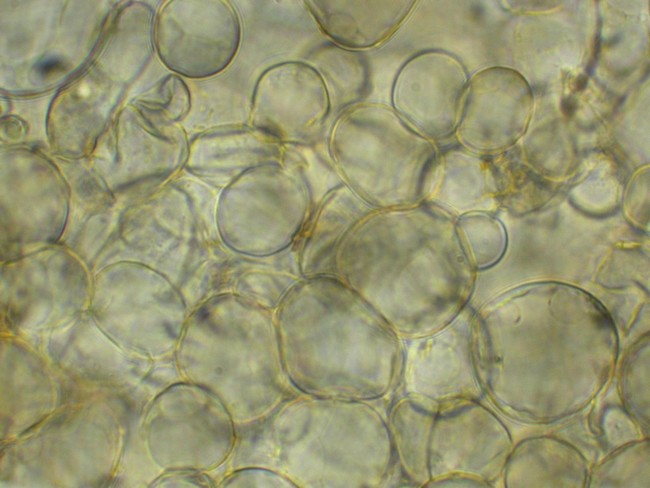
As for Bernard's find, the ectal excipulum is a quite perfect textura globulosa and I did not notice any gelatinous matrix embedding loose hyphae.
Amitiés
Michel
Nothing is easy, then , which I had already guessed! :-P
As for Bernard's find, the ectal excipulum is a quite perfect textura globulosa and I did not notice any gelatinous matrix embedding loose hyphae.
Amitiés
Michel
Hans-Otto Baral,
13-04-2009 20:54
Re:Dumontinia ulmariae ?
I collected today fine D. tuberosa (with Anemone, Ficaria and Aegopodium around) but I have no microscope here in Bavaria.
Will to have drying it and examine when at home.
Zotto
Will to have drying it and examine when at home.
Zotto