
10-06-2026 11:53
Steve ClementsBonjour, This disco is abundant on dead stems of
10-06-2026 13:41
 François Freléchoux
Bonjour à nouveau, Voici une trouvaille d'hier.
10-06-2026 12:54
Steve ClementsBonjour encore, Pouvez-vous m'aider, s'il vous pl
10-06-2026 10:45
François Freléchoux
Bonjour à nouveau, Encore une détermination qui
08-06-2026 10:16
 Spooren Marco
I don`t have a clou about this fungus,it is not in
10-06-2026 09:24
François Freléchoux
Bonjour, J'imagine que cette détermination ne do
09-06-2026 18:32
Camille MertensSur morceau de roseau immergé 0,5 - 0,7 mm de dia
08-06-2026 17:00
François BartholomeeusenGood day everyone, On June 5 2026, I collected de
07-06-2026 15:10
 William Slosse
Hello everyone,On 05-06-26, I found following asco
Phaeosphaeria cf. berlesei, in english
Alain GARDIENNET,
22-01-2009 07:17
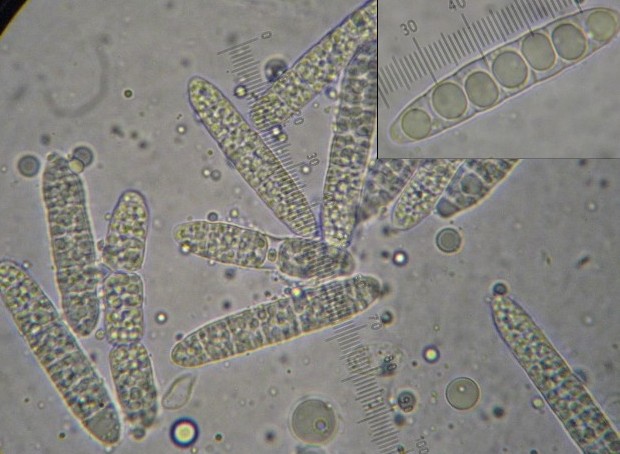
 I'm looking for someone who works on the genus Phaeosphaeria.
Because I've recolted, one of them on Equisetum telmateia. The spores are those of the subgenus Vagispora and look like berlesei’s spores. The problem follows :
P. berlesei : 33-45 x 5-7 µm, 7-11 septs ,
My recolt : 45-51 x 8.5-9.5 (10) µm 5-7 septs.
I join a photo.
Contact me for more details,
Alain
Erwin Gruber,
25-01-2011 22:28
Re:Phaeosphaeria cf. berlesei, in english
Salut Alain,
I am not specialised on Phaeosphaeria at all, but studied Stamnaria for some time and realised, that Equisetum spp. are regularly misidentified.
If the host is E. hyemale, i would not doubt this fungus to be P. berlesei which seems to occur on no other host (some "Equisetum-fungi" appear to be higly host-specific due to co-evolution).
If the host is truly E. temateia, i bet that it is not P. berlesei - but who knows?
Maybe you should proof the host once again.
Friendly Greetings
Erwin
I am not specialised on Phaeosphaeria at all, but studied Stamnaria for some time and realised, that Equisetum spp. are regularly misidentified.
If the host is E. hyemale, i would not doubt this fungus to be P. berlesei which seems to occur on no other host (some "Equisetum-fungi" appear to be higly host-specific due to co-evolution).
If the host is truly E. temateia, i bet that it is not P. berlesei - but who knows?
Maybe you should proof the host once again.
Friendly Greetings
Erwin
Alain GARDIENNET,
26-01-2011 15:56
Re:Phaeosphaeria cf. berlesei, in english
Hi Erwin
Yes, it's not always easy to identify correctly Equisetum. I have a guide for that but there are hybrids, so it's sometimes difficult.
But in that case, I was sure, sure at 100%, it wasn't E. hyemale. It was the big one, Equisetum telmateia. I verified it in summer.
So my recolt has not yet a name. Next week, I will return on the site in order to look for this Phaeosphaeria.
I'm happy to see you interesting by Equisetum. Personnaly, I'm lookink for Phaeosphaeriaceae but I like to look at other species like the little Ijuhya or the beautiful Stamnaria (found both on E. hyemale with P. berlesei in the same site).
Cheers,
Alain
Yes, it's not always easy to identify correctly Equisetum. I have a guide for that but there are hybrids, so it's sometimes difficult.
But in that case, I was sure, sure at 100%, it wasn't E. hyemale. It was the big one, Equisetum telmateia. I verified it in summer.
So my recolt has not yet a name. Next week, I will return on the site in order to look for this Phaeosphaeria.
I'm happy to see you interesting by Equisetum. Personnaly, I'm lookink for Phaeosphaeriaceae but I like to look at other species like the little Ijuhya or the beautiful Stamnaria (found both on E. hyemale with P. berlesei in the same site).
Cheers,
Alain
Erwin Gruber,
26-01-2011 19:43
Re:Phaeosphaeria cf. berlesei, in english
Hi Alain
Concerning Stamnaria, please take a look at the forum-item "Stamnaria plus Titaeospora", it is in English since i cannot speak french (very sorry!).
Yesterday i collected a lot of dead parts of Equisetum hyemale which are crowded with some different fungi, especional pyrenomycetes, i informed Zotto at his item about Scirrhia castagnei.
Back to your Phaeosphaeria - I could try to have a look in my collection of literature about Equisetum-inhabiting Fungi. The literature is at Univ. in Graz, i have not been there for some years but will go there this week. I will meet Christian Scheuer who shall be the co-autor of the coming Publikation of 5! new Stamnaria spp.
On this occasion i will try to find a matching description to your Phaeosphaeria and Lept. on E. arvense - hope i get the chance for it.
Cheers,
Erwin
Concerning Stamnaria, please take a look at the forum-item "Stamnaria plus Titaeospora", it is in English since i cannot speak french (very sorry!).
Yesterday i collected a lot of dead parts of Equisetum hyemale which are crowded with some different fungi, especional pyrenomycetes, i informed Zotto at his item about Scirrhia castagnei.
Back to your Phaeosphaeria - I could try to have a look in my collection of literature about Equisetum-inhabiting Fungi. The literature is at Univ. in Graz, i have not been there for some years but will go there this week. I will meet Christian Scheuer who shall be the co-autor of the coming Publikation of 5! new Stamnaria spp.
On this occasion i will try to find a matching description to your Phaeosphaeria and Lept. on E. arvense - hope i get the chance for it.
Cheers,
Erwin
Erwin Gruber,
11-02-2011 11:38
Re:Phaeosphaeria cf. berlesei, in english
Bonjour Alain
I didn't find a matching description of any Phaeosphaeria on Equisetum. Your sample might be a "plurivorous" species as well as a truely specialised one to inhabit Equisetum(a).
Please let us know if you can identify your finding or come to decision that was unknown till now.
Amicalement
Erwin
I didn't find a matching description of any Phaeosphaeria on Equisetum. Your sample might be a "plurivorous" species as well as a truely specialised one to inhabit Equisetum(a).
Please let us know if you can identify your finding or come to decision that was unknown till now.
Amicalement
Erwin