12-06-2026 14:50
 François Freléchoux
Bonjour, Voici la brève description d'une Mollis
10-06-2026 21:16
François Freléchoux
Bonsoir,Le dernier du jour, en attendant votre avi
11-06-2026 19:01
 William Slosse
Hello all,In an attempt to make a culture of a sus
11-06-2026 19:03
 Nicolas VAN VOOREN
Chers membres d'Ascofrance,Le site sera placé en

09-06-2026 18:32
Camille MertensSur morceau de roseau immergé 0,5 - 0,7 mm de dia
10-06-2026 12:54
Steve ClementsBonjour encore, Pouvez-vous m'aider, s'il vous pl
10-06-2026 21:07
François Freléchoux
Toutes les tiges de gentianes jaunes de l'an passÃ
10-06-2026 13:41
François Freléchoux
Bonjour à nouveau, Voici une trouvaille d'hier.
Coryne sp. ?
Roland Labbé,
16-12-2008 04:56
Ou est-ce un autre Asco ?
Aussi, comment on arrive à identifier l'espèce si c'est un Coryne ?
Merci, Roland
Christian Lechat,
16-12-2008 06:26

Re:Coryne sp. ?
Bonjour Roland,
sans données mocroscopiques il est impossible de répondre
Amitiés,
sans données mocroscopiques il est impossible de répondre
Amitiés,
Alain GARDIENNET,
16-12-2008 08:04

Re:Coryne sp. ?
C'est vrai qu'il faut plus de données, même si cela ressemble fort au stade imparfait de Ascocoryne sarcoides (qu'il faut appeler Coryne dubia, je crois...)
Alain
Alain
Hans-Otto Baral,
16-12-2008 12:24

Re:Coryne sp. ?
yes, Alain, I agree
zotto
zotto
Roland Labbé,
05-01-2009 14:26
Re:Coryne sp. ?
Hi Alain and Zotto !
J'aimerais savoir comment identifier une forme imparfaite d'un Coryne ?
Quels sont les éléments à observer ?
Je sais qu'il n'y a ni asques, ni ascospores ni paraphyses. À part peut être les conidiophores et les conidies, quoi d'autres à observer et comment faire ?
De plus, existe-il des clés sur les Coryne ? Pourrais-je en prendre connaissance ?
Je vous remercie de votre support et vous souhaite une bonne année 2009.
Roland
J'aimerais savoir comment identifier une forme imparfaite d'un Coryne ?
Quels sont les éléments à observer ?
Je sais qu'il n'y a ni asques, ni ascospores ni paraphyses. À part peut être les conidiophores et les conidies, quoi d'autres à observer et comment faire ?
De plus, existe-il des clés sur les Coryne ? Pourrais-je en prendre connaissance ?
Je vous remercie de votre support et vous souhaite une bonne année 2009.
Roland
Hans-Otto Baral,
05-01-2009 18:15
Re:Coryne sp. ?
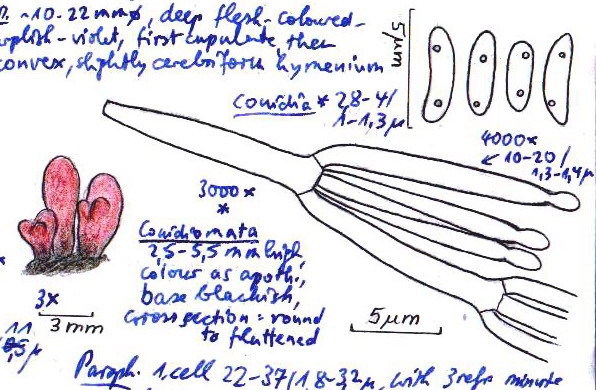
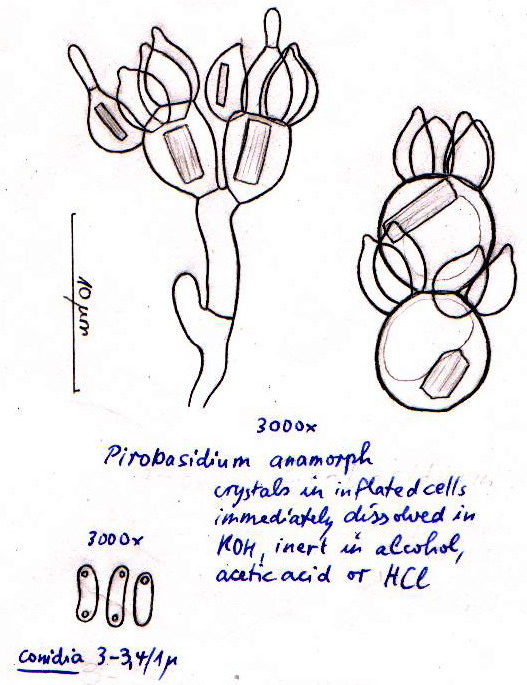
In the attach you can see the anamorphs of A. sarcoides and A cylichnium. The conidia are produced at the tip of the conidiogenous cells (phialides), which are narrow in sarcoides and strongly inflated in solitaria. In earlier times this solitaria anamorph which is very frequent, was believed to be a basidiomycete (Sirobasidum cerasi) because the phialides resemble sterigmata of heterobasidios. The phialides of sarcoides on my drawing you must think with the tips upwards.
I do not remember a key on Coryne.
Here sarcoides
Zotto
I do not remember a key on Coryne.
Here sarcoides
Zotto
Hans-Otto Baral,
05-01-2009 18:15
Re:Coryne sp. ?
here solitaria
Roland Labbé,
11-01-2009 03:43
Re:Coryne sp. ?
Hi Zotto !
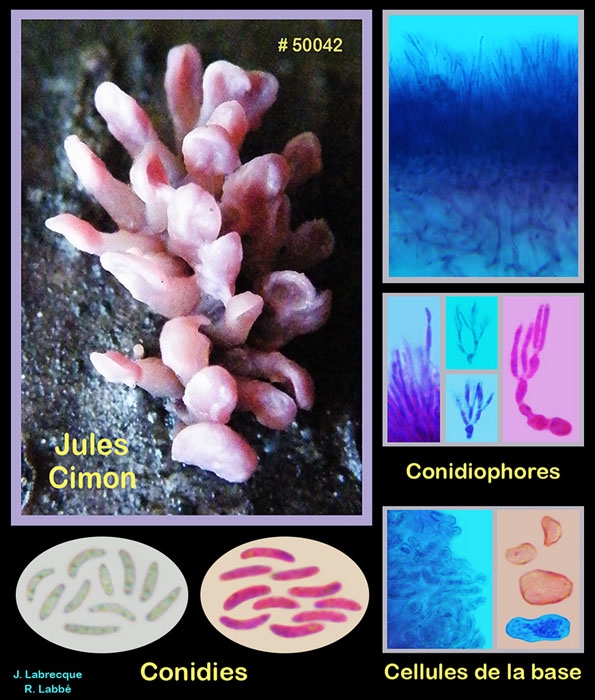
Herre is a plate of the Coryne sp.
Are the anamorphes sarcoides and cylichnium the same ?
If I compare with your two figures, I think it' s the first one.
Do you agree with me ?
How can differenciate them ?
And, what is the wright name of the anamorphe in the plate ?
The details :
Date de récolte: 2008 / 11 / 06
Habitat: forêt mixte
Hôte: écorce d'aulne
Conidies cylindro-allantoïdes, biguttulées, hyalines en NaCl iso., inamyloïdes, 4-5 x 1 µm, 4,7 x 1 µm en moyenne (15 spores), Q = 4,7
Thanks you, friendly ! Roland
Herre is a plate of the Coryne sp.
Are the anamorphes sarcoides and cylichnium the same ?
If I compare with your two figures, I think it' s the first one.
Do you agree with me ?
How can differenciate them ?
And, what is the wright name of the anamorphe in the plate ?
The details :
Date de récolte: 2008 / 11 / 06
Habitat: forêt mixte
Hôte: écorce d'aulne
Conidies cylindro-allantoïdes, biguttulées, hyalines en NaCl iso., inamyloïdes, 4-5 x 1 µm, 4,7 x 1 µm en moyenne (15 spores), Q = 4,7
Thanks you, friendly ! Roland
Hans-Otto Baral,
11-01-2009 12:00
Re:Coryne sp. ?
Hi Roland
yes, I think this is the anamorph of A. sarcoides, and it is called Coryne dubia.
A. cylichnium has no fruitbody-forming anamorph, I never saw one.
I do not understand your conidial measures, the width should be about 1 µm.
Zotto
yes, I think this is the anamorph of A. sarcoides, and it is called Coryne dubia.
A. cylichnium has no fruitbody-forming anamorph, I never saw one.
I do not understand your conidial measures, the width should be about 1 µm.
Zotto
Roland Labbé,
11-01-2009 20:57
Re:Coryne sp. ?
Zotto, thank you for your answer and figures.
I have made a mistake in measures of spores and I ajust them in my message.
Sorry, they are of course about 1 µm wided.
Roland
I have made a mistake in measures of spores and I ajust them in my message.
Sorry, they are of course about 1 µm wided.
Roland
Roland Labbé,
12-02-2009 03:45
Re:Coryne sp. ?
Hi Zotto !
Do the Ascocoryne may have a teleomorph and a anamorph on a same structure.
We have a specimen with asques + ascospores and conidiophores + conides.
Am I wright ?
I think it's Ascocoryne sarcoides.
I whait a answer before to place a plate on the forum.
Roland
Do the Ascocoryne may have a teleomorph and a anamorph on a same structure.
We have a specimen with asques + ascospores and conidiophores + conides.
Am I wright ?
I think it's Ascocoryne sarcoides.
I whait a answer before to place a plate on the forum.
Roland
Hans-Otto Baral,
12-02-2009 11:02
Re:Coryne sp. ?
I think so in sarcoides, that anamorph and teleomorph fruit-bodies may emerge from a common base.
zotto
zotto
Roland Labbé,
14-02-2009 16:08
Re:Coryne sp. ?
Hi Zotto !
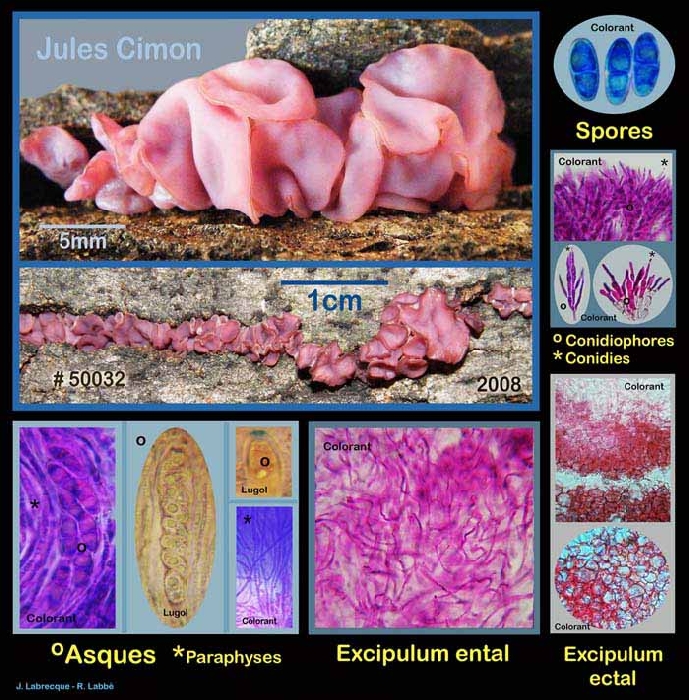
Here is the plate with the anamorph anf teleomorph of Ascocoryne sarcoides.
Do you think the same thing ?
Roland
Here is the plate with the anamorph anf teleomorph of Ascocoryne sarcoides.
Do you think the same thing ?
Roland
Hans-Otto Baral,
14-02-2009 16:46
Re:Coryne sp. ?
That part above th "5 mm" is obviously the anamorph from which you gained the phialides. But it is not clear if it is confluent with the ascomata or not. Wasn't this your question? To be sure about the species needs living spores and their size. I assume it is sarcoides. Apparentöly the spores are quite small and contain two large dops.
Zotto
Zotto
Roland Labbé,
14-02-2009 17:27
Re:Coryne sp. ?
Sorry Zotto, I forgot to place the details of the species.
Here they are.
Thank you ! Roland
Détails :
Date de récolte: 2008 / 10 / 27
Habitat: forêt de feuillus
Hôte: érable à sucre
Sporée non disponible
Spores cylindro-ellipsoïdes, à paroi épaisse, lisses, avec un septa, 11-14 x 4-5 µm, 12,1 x 4,8 µm en moyenne(10 spores), Q = 2,52
Asques à 8 spores uni à bisériées, avec appareil apical amyloïde, 100-130 x 8-10 µm
Paraphyses nombreuses, cylindriques, parfois un peu élargies à l’apex, souvent ramifiées à la base, septées, 100-120 x 1,5-2 µm, dépassant les asques de 10-15 µm
Excipulum ectal en textura globulosa, formé de cellules globuleuses
Excipulum ental (= medulla) abondamment gélatinisé, formé d’hyphes étroites
Conidiophores et phialioconidies présents sur des structures à la base ou près des ascomes
Here they are.
Thank you ! Roland
Détails :
Date de récolte: 2008 / 10 / 27
Habitat: forêt de feuillus
Hôte: érable à sucre
Sporée non disponible
Spores cylindro-ellipsoïdes, à paroi épaisse, lisses, avec un septa, 11-14 x 4-5 µm, 12,1 x 4,8 µm en moyenne(10 spores), Q = 2,52
Asques à 8 spores uni à bisériées, avec appareil apical amyloïde, 100-130 x 8-10 µm
Paraphyses nombreuses, cylindriques, parfois un peu élargies à l’apex, souvent ramifiées à la base, septées, 100-120 x 1,5-2 µm, dépassant les asques de 10-15 µm
Excipulum ectal en textura globulosa, formé de cellules globuleuses
Excipulum ental (= medulla) abondamment gélatinisé, formé d’hyphes étroites
Conidiophores et phialioconidies présents sur des structures à la base ou près des ascomes
Hans-Otto Baral,
14-02-2009 19:06
Re:Coryne sp. ?
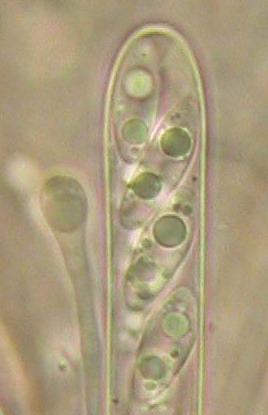
Spore size is at the lower limit but still o.k. Guttules are very important, however!
Here you see a vital ascus which distinctly protrudes beyond the paraphyses (contrary to the dead state which you describe), and the spores with two large guttules.
Zotto
Here you see a vital ascus which distinctly protrudes beyond the paraphyses (contrary to the dead state which you describe), and the spores with two large guttules.
Zotto