
23-05-2026 11:44
 Charles Grapinet
Hello, I am having trouble identifying this copro
25-05-2026 16:44
François BartholomeeusenHi forum members,During an excursion organised by
25-05-2026 16:35
 Bernard CLESSE
Bonjour à toutes et tous,J'ai trouvé récemment,
22-05-2026 13:29
Gernot FriebesHi,I am curious to hear your opinion on this mater
23-05-2026 18:57
Sylvie Le GoffBonjour à tousRécolté sur une branchette de Sal
22-05-2026 14:44
 Lothar Krieglsteiner
in unripe condition citrine yellow, then soon fadi
22-05-2026 21:35
Steve ClementsBonjour, I expected this find on old wood on our
22-05-2026 18:12
Lothar Krieglsteiner
... in moist chamber from Portugal.As the fungus s
22-05-2026 20:08
Ethan CrensonHello all, Yesterday in NYC I was visiting an e
Xylaria from ethiopia
Uwe Lindemann,
02-12-2008 21:38
 Hello Forum,
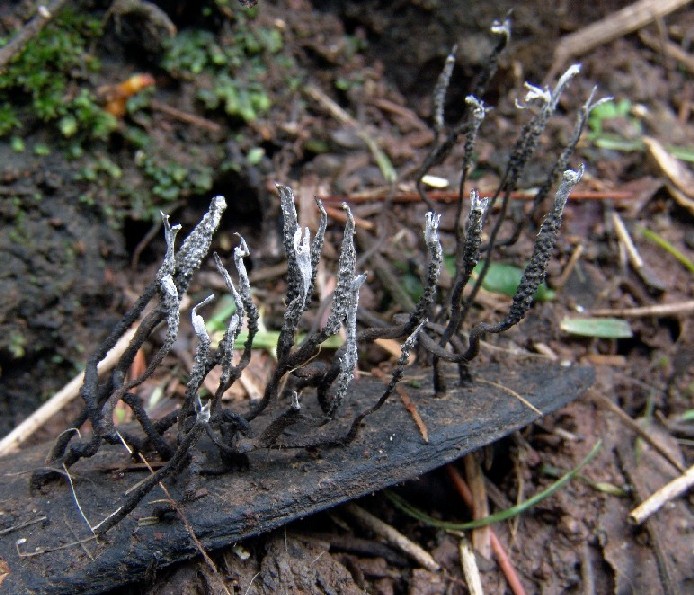
at the end of september 2008 I found in addis abeba (ethiopia) a Xylaria.
Macroscopic features:
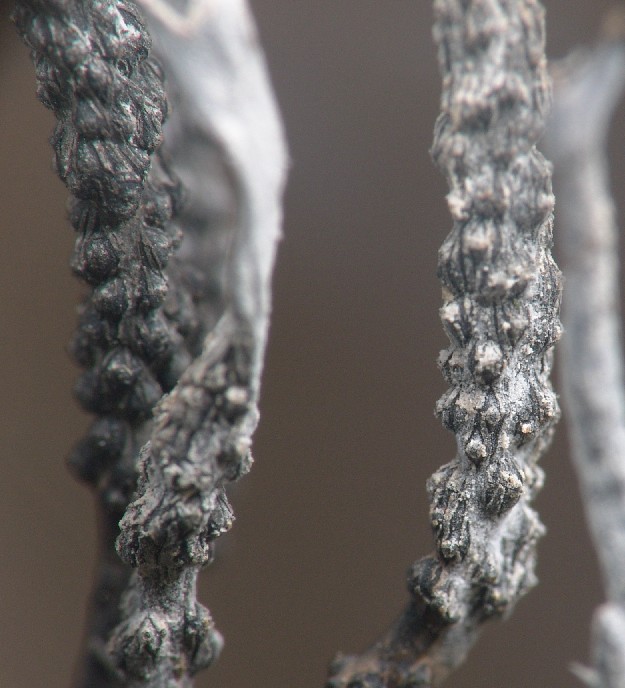
Stromata gregarious, unbranched, clavata narrow cylindric, 25-55 x 0,5-1 mm with sterile apices; stipe distinct, smooth, half of the clavata; subiculum sparseley setose, brown; perithecia , evident, globose, ostioles papillate
Microscopic features:
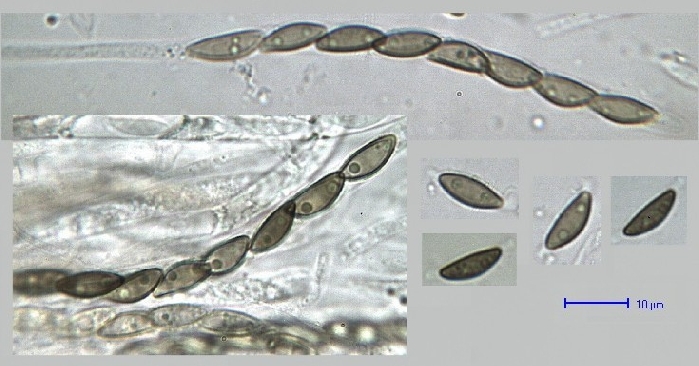
Ascus with 8 ascospores, 110-120 x 5,5-6,5 μm
Ascospores brown, germ slit straight, with hyalin appendage, elliptic to navicular with narrow ends, 10-11,5(13) x 4-4,8 μm (appendage: 1,5-2 x 1 μm)
In my opinion it is Xylaria gracillima. Could that be correct?
I used the following studies to determine the species:
DENNIS, R. W. G. (1961): Xylarioideae and Thamnomycetoideae of Congo. Bulletin du Jardin Botanique National de Belgique 31: 109-154.
DENNIS, R. W. G. (1962): Xylarioideae and Thamnomycetoideae. Flore Iconographique des Champignons du Congo. 11. Fasc.
HLADKI, A. I. & ROMERO, A. I. (2007): Primeras citas del género Xylaria (Ascomycota, Xylariaceae) para la república Argentina. Darwiniana 45(1): 28-44.
MARTIN, P. (1970): Studies in the Xylariaceae VIII: Xylaria and its allies. Journal of South African Botany 36: 73-138.
ROGERS, J. D. & CALLAN, B. E. & ROSSMAN, A. Y. & SAMUELS, G. J. (1988): Xylaria (Sphaeriales, Xylariaceae) from Cerro de la Neblina, Venezuela. Mycotaxon 31 (1): 103-153.
Thank you very much for your help!
Uwe
Uwe Lindemann,
02-12-2008 21:39
Re:Xylaria from ethiopia
macro
Uwe Lindemann,
02-12-2008 21:39
Re:Xylaria from ethiopia
micro
Jacques Fournier,
02-12-2008 22:23

Re:Xylaria from ethiopia
Hi Uwe,
nice to see people collecting Xylarias during their free time!
Your description is very accurate and allows a tentative answer. Xylaria gracillima is a controversial name and used in different senses by Dennis and Rogers.
According to the latter (Mycotaxon 34, pp 283-373, available on Cyberliber) X. gracillima lacks a white peeling outer layer as shown on your photos and has "naked" (superficial) perithecia scattered along a filiform rachis. Moreover, ascospores are not said to have cellular appendages.
In his description, Dennis (1961) illustrates a stroma resembling your fungus but does not mention a white coating and gives ascospores size range as 9-10.5 x 3-4, a bit small to match yours.
I think X. microceras (Mont.) Fr. might be a possible name for your fungus, known from neotropics. It is shortly described by Dennis (1956), but without mention of the cellular appendages. Otherwise it imight be an unknown taxon, which would not be surprising for Ethiopia!
I would love to see your collection, maybe I would get more inspiration. In return I can help you with literature on Xylaria.
Cheers,
Jacques
nice to see people collecting Xylarias during their free time!
Your description is very accurate and allows a tentative answer. Xylaria gracillima is a controversial name and used in different senses by Dennis and Rogers.
According to the latter (Mycotaxon 34, pp 283-373, available on Cyberliber) X. gracillima lacks a white peeling outer layer as shown on your photos and has "naked" (superficial) perithecia scattered along a filiform rachis. Moreover, ascospores are not said to have cellular appendages.
In his description, Dennis (1961) illustrates a stroma resembling your fungus but does not mention a white coating and gives ascospores size range as 9-10.5 x 3-4, a bit small to match yours.
I think X. microceras (Mont.) Fr. might be a possible name for your fungus, known from neotropics. It is shortly described by Dennis (1956), but without mention of the cellular appendages. Otherwise it imight be an unknown taxon, which would not be surprising for Ethiopia!
I would love to see your collection, maybe I would get more inspiration. In return I can help you with literature on Xylaria.
Cheers,
Jacques