
26-03-2026 15:31
 Åke Widgren
Hello,I found this one in October last year, on r
27-03-2026 15:23
Gernot FriebesHi,this Trichopezizella deviates from typical T. b
25-03-2026 10:35
Hulda Caroline HolteHello,I collected this species growing on a dead b
27-03-2026 15:08
Gernot FriebesHi,I'm looking for help with this coelomycete on C
27-03-2026 10:47
Åge OterhalsI have tentatively identified this Stictis to S. f
24-03-2026 21:37
Elisabeth StöckliBonsoir,Sur bois (tronc) très pourri de conifère


25-03-2026 22:23
 Marc Detollenaere
Dear Forum,On a debarked stem of Tilia, we found s
24-03-2026 15:44
Åge OterhalsI hope someone can confirm the name of this collec
Rosellinia literature
Chris Yeates,
26-08-2017 19:32
 Bonsoir tous
does anyone have a pdf of Petrini et al. Sydowia 41: 257, 1989?
cordialement
Chris
Jacques Fournier,
26-08-2017 19:57

Re : Rosellinia literature
Hi Chris, you can download it for free at Sydowia's website.
Cheers,
Jacques
Cheers,
Jacques
Chris Yeates,
26-08-2017 21:08
Re : Rosellinia literature
Thanks Jacques
I thought that was the case, and I'm sure I am being really foolish here, but I can't see how . . . . I know that vols up to 30 are available on Cyberliber http://www.cybertruffle.org.uk/cyberliber/59633/index.htm
But I can't see anything on the Sydowia homepage http://www.sydowia.at/index.htm
Chris
I thought that was the case, and I'm sure I am being really foolish here, but I can't see how . . . . I know that vols up to 30 are available on Cyberliber http://www.cybertruffle.org.uk/cyberliber/59633/index.htm
But I can't see anything on the Sydowia homepage http://www.sydowia.at/index.htm
Chris
Gernot Friebes,
26-08-2017 21:51
Re : Rosellinia literature
Hi, Chris,
this should work: https://www.zobodat.at/pdf/Sydowia_41_0257-0276.pdf
And see this page in case you need other Sydowia articles in the future: https://www.zobodat.at/publikation_series.php?id=7377
Best wishes,
Gernot
this should work: https://www.zobodat.at/pdf/Sydowia_41_0257-0276.pdf
And see this page in case you need other Sydowia articles in the future: https://www.zobodat.at/publikation_series.php?id=7377
Best wishes,
Gernot
Jacques Fournier,
26-08-2017 21:52
Re : Rosellinia literature
Chris,
try this link: http://www.zobodat.at/pdf/Sydowia_41_0257-0276.pdf
all issues are available until 2007.
Enjoy Rosellinia!
Jacques
try this link: http://www.zobodat.at/pdf/Sydowia_41_0257-0276.pdf
all issues are available until 2007.
Enjoy Rosellinia!
Jacques
Chris Yeates,
27-08-2017 18:59
Re : Rosellinia literature
Thanks both - worked fine
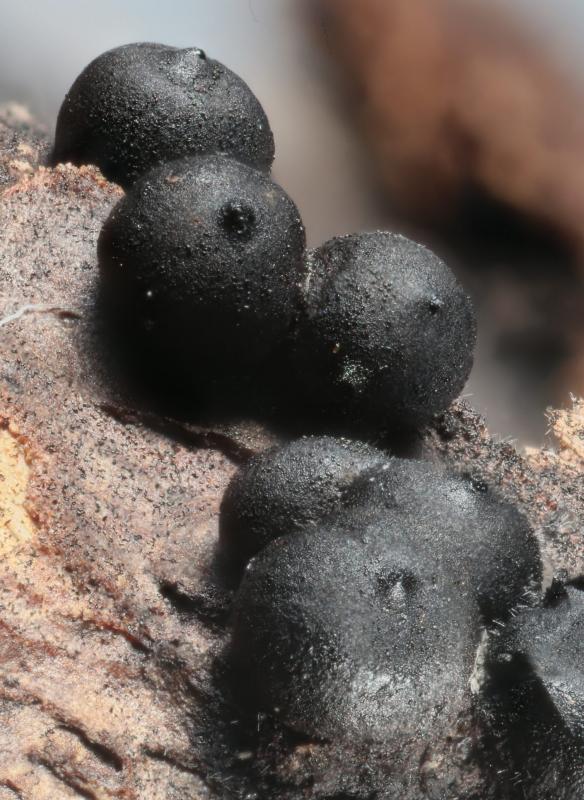
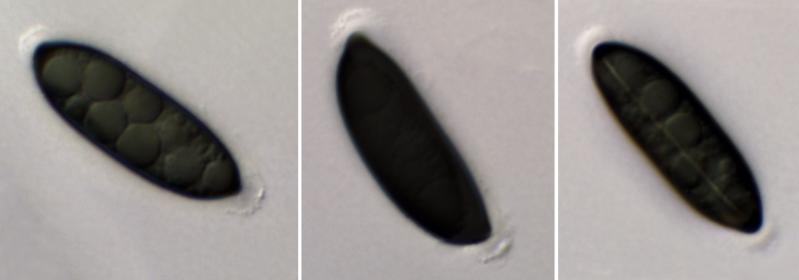
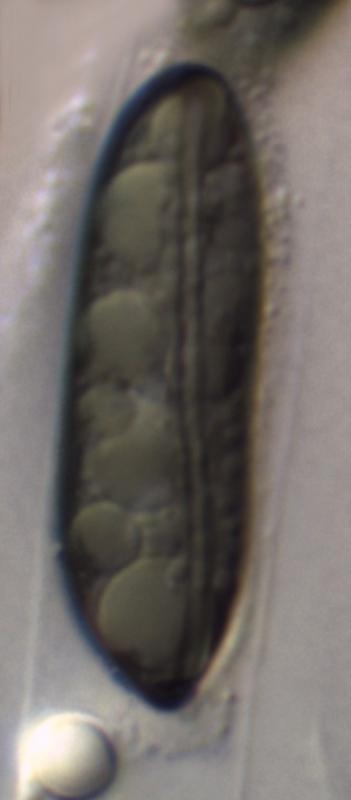
and it has confirmed that my collection is what would have been called Rosellinia britannica based on rather flattened perithecia, disappearing subiculum, straight, full length, germ slits, gel caps on spores, and size of spores and ascal tips.
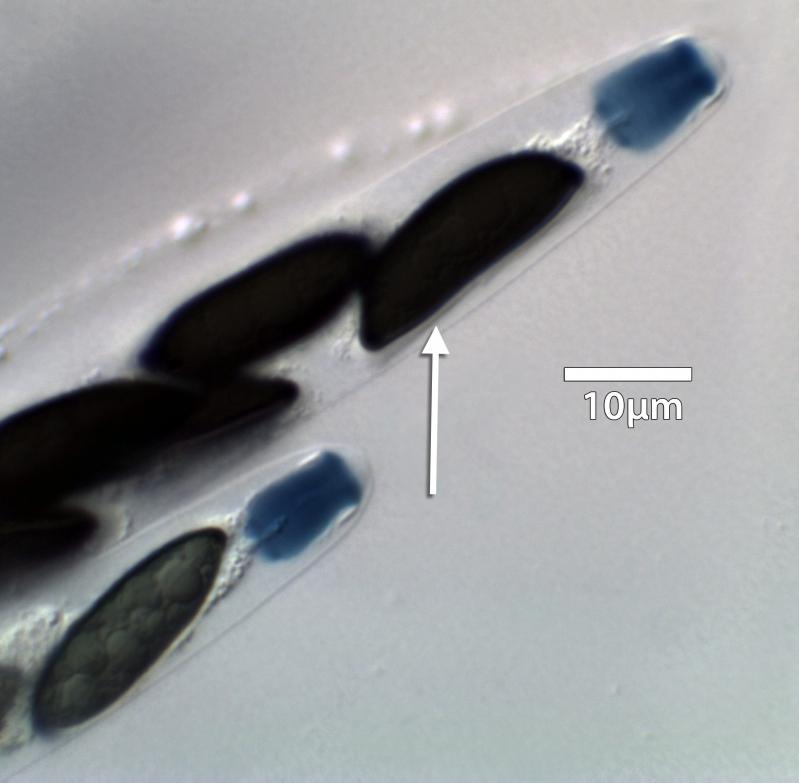
I notice from Jacques' comments on a different AscoFrance thread that there can also be a gel presence along the straighter side of the ascospores. In a number of spores in my collection this was continuous with one or both 'gel caps' (see arrow in accompanying images.
Interestingly in this collection the spores tended towards the shorter end of the range - 20.5-25.6µm - and the ascal tips were longer (often up to 9-10µm long, and I took care not to distort them by too much pressure).
I note also that "R. britannica" has disappeared as a synonym of R. marrucciana (happily not as a result of Brexit!). Presumably Petrini had the opportunity to examine the type, as the protologue http://www.librifungorum.org/Image.asp?ItemID=7&ImageFileName=SyllogeFungorum1-257.jpg implies spores too short).
Amitiés
Chris
and it has confirmed that my collection is what would have been called Rosellinia britannica based on rather flattened perithecia, disappearing subiculum, straight, full length, germ slits, gel caps on spores, and size of spores and ascal tips.
I notice from Jacques' comments on a different AscoFrance thread that there can also be a gel presence along the straighter side of the ascospores. In a number of spores in my collection this was continuous with one or both 'gel caps' (see arrow in accompanying images.
Interestingly in this collection the spores tended towards the shorter end of the range - 20.5-25.6µm - and the ascal tips were longer (often up to 9-10µm long, and I took care not to distort them by too much pressure).
I note also that "R. britannica" has disappeared as a synonym of R. marrucciana (happily not as a result of Brexit!). Presumably Petrini had the opportunity to examine the type, as the protologue http://www.librifungorum.org/Image.asp?ItemID=7&ImageFileName=SyllogeFungorum1-257.jpg implies spores too short).
Amitiés
Chris
Jacques Fournier,
28-08-2017 10:31
Re : Rosellinia literature
great images Chris, you got all the important details! and good to see you did not "brexit" the forum!
Best,
Jacques
Best,
Jacques