30-05-2026 21:12
Philippe PELLICIERSur branche de mélèze (Larix) près de la neige,
31-05-2026 10:35
Hulda Caroline HolteHello,I collected this species growing on a rather
25-05-2026 16:35
 Bernard CLESSE
Bonjour à toutes et tous,J'ai trouvé récemment,
29-05-2026 15:35
daniel FERREBonjour à tous,Je voudrais votre aide pour cette
28-05-2026 16:15
James MitchellHello,Does anyone have the original publication of
28-05-2026 11:06
Thomas Læssøehttps://svampe.databasen.org/observations/10596750
23-05-2026 11:44
 Charles Grapinet
Hello, I am having trouble identifying this copro
25-05-2026 16:44
François BartholomeeusenHi forum members,During an excursion organised by
26-05-2026 21:25
Dirk GerstnerHello everyone, I'm completely stumped by this li
Chaetosphaeria
Alain GARDIENNET,
24-06-2008 15:08
 Bonjour,
 Je vous demande une confirmation pour une détermination de Chaetosphaeria sur Ulex.
En trois étapes : macro, micro et anamorphe.
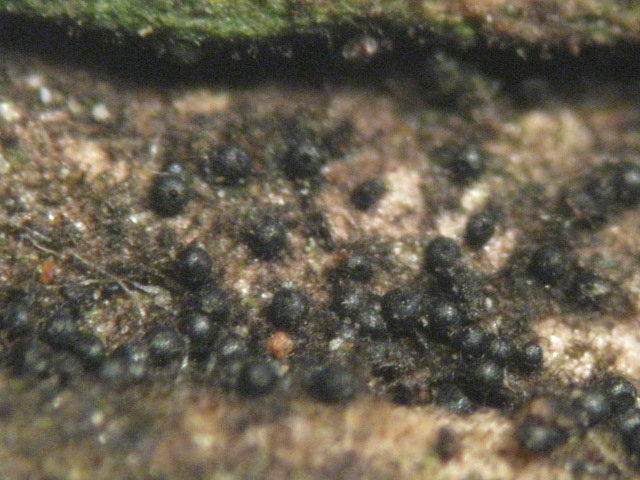
La macro va être rapide : des périthèces noirs ne dépassant pas 0.2mm, avec une papille visible noyés dans ce qui ressemble à un subiculum brun (l'anamorphe)
Je me suis orienté vers le genre Chaetosphaeria.
Alain GARDIENNET,
24-06-2008 15:12
Re:Chaetosphaeria
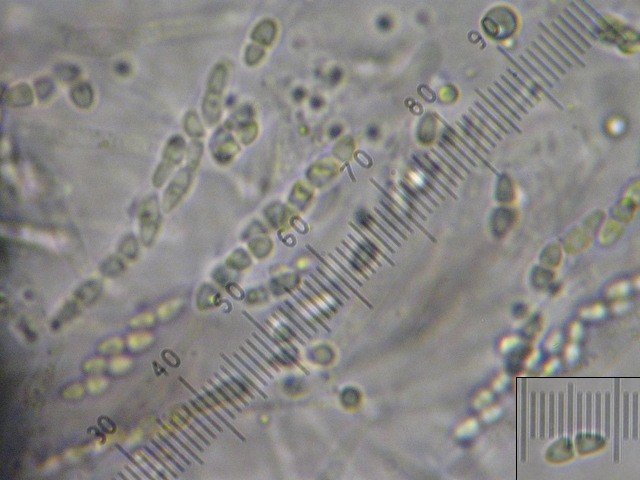
La micro m'a donné des asques des asques octosporés pouvant atteindre 75 x 4-5 µm, des ascospores de 6-7 x 1.8-2.1 µm se fragmentant en deux parties quasi égales de 2.5-3 x 1.5-2 µm.
Alain GARDIENNET,
24-06-2008 15:16
Re:Chaetosphaeria
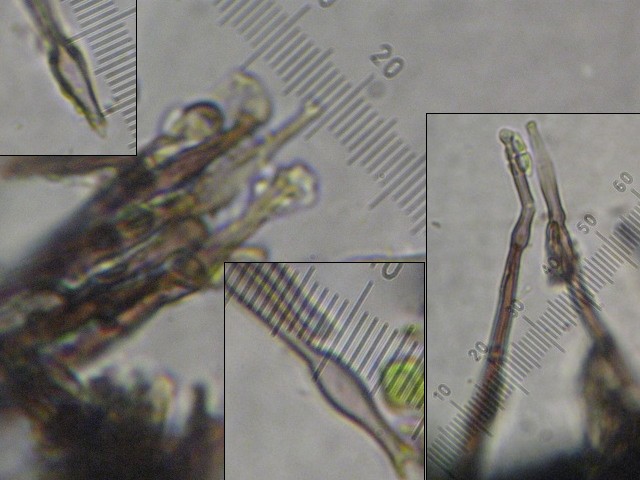
Comme la détermination ne peut se passer de celle de l'anamorphe (c'est Jacques qui me l'a dit ;)), j'ai examiné ce que j'ai appelé plus haut un pseudo subiculum.
Cet anamorphe me semble appartenir au genre Chloridium, plus précisément je pense à Chloridium preussii et donc à Chaetosphaeria preussii.
En espérant que mes éléments seront suffisamment satisfaisants pour pouvoir se prononcer, je vous souhaite une bonne fin de journée.
Alain
Cet anamorphe me semble appartenir au genre Chloridium, plus précisément je pense à Chloridium preussii et donc à Chaetosphaeria preussii.
En espérant que mes éléments seront suffisamment satisfaisants pour pouvoir se prononcer, je vous souhaite une bonne fin de journée.
Alain