
05-06-2026 12:10
 François Freléchoux
Capitotricha sp. sur Lonicea caerulea Caractères
05-06-2026 11:02
Thomas Læssøehttps://svampe.databasen.org/observations/10596691

04-06-2026 11:36
Gernot FriebesHi,found on Vaccinium myrtillus.Asci: IKI –, 8-s
19-05-2026 10:27
Patrice TANCHAUDBonjour, récolte récente sur terre retournée i
04-06-2026 18:39
Gernot FriebesHi,I collected this species in two different locat
22-05-2026 13:29
Gernot FriebesHi,I am curious to hear your opinion on this mater
04-06-2026 10:50
François Freléchoux
Bonjour, J'ai trouvé hier un petit asco observé
Possible Anthostomella on Carex pendula
Peter Thompson,
07-05-2016 21:17
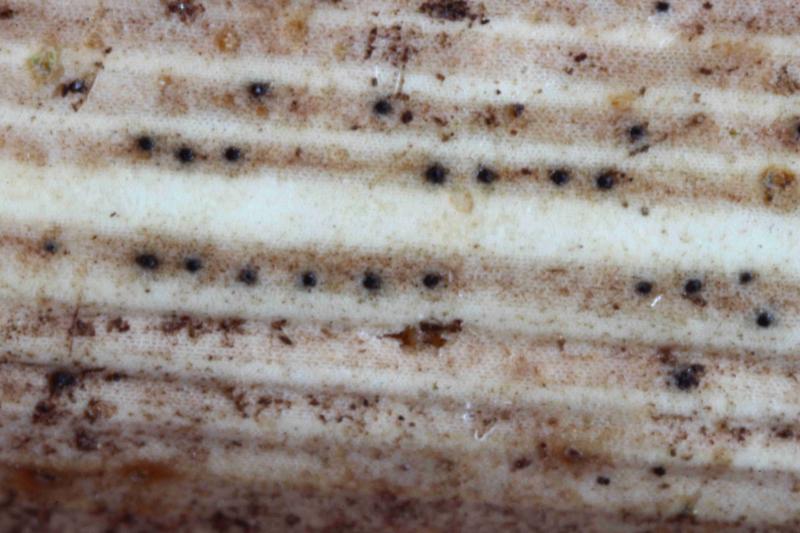
I have found fruit bodies of what I believe is an Anthostomella, immersed in dead leaves of Carex pendula.
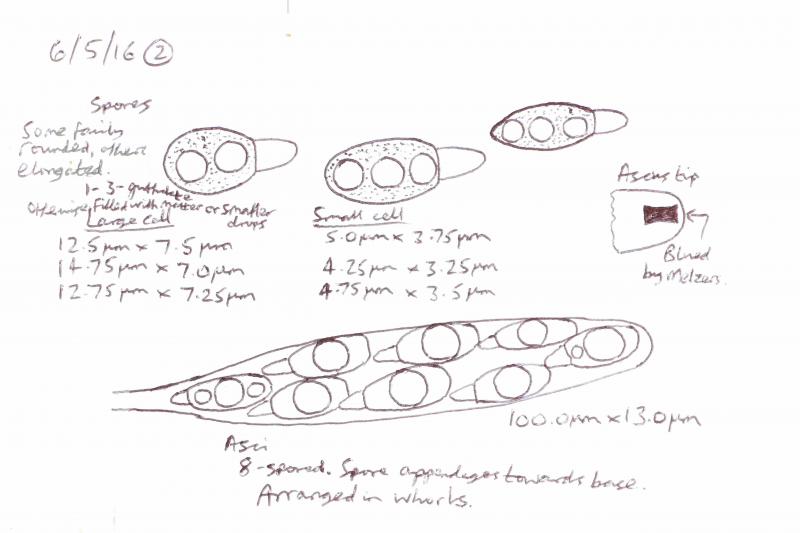
It seems that the species described in the literature as growing on this host do not fit well. In particular, the small basal cell is significantly larger than that of A. tomicoides - resembling that of the much larger A. rubicola.
I think that my material is still quite young, because the large cells of all spores are hyaline and guttulate, but I can not think of an alternative for the genus. My assumption is that the large cell will eventually become brown and the guttules harder to see.
I have attached a photo showing the ostioles at the surface of the host. The spheres containing the spores and asci are just below.
Also attached is a sketch of the microscopy, as seen. The ascus pore is distinctly blued by Melzers.
I wonder if anyone has an idea as to the species which would fit?
Thank you,
With Best Wishes,
Peter.
Jacques Fournier,
07-05-2016 22:55

Re : Possible Anthostomella on Carex pendula
Hello Peter,
First make sure whether you have fully mature or immature material, not so many species keep hyaline wall at maturity.
It cannot be ruled out that you are dealing with an immature A. tomicoides. The spores in this species are inequilateral in side view and have a short germ slit, unfortunately difficult to make out on a hyaline wall.
Another discriminant character you would need to know to use the key in Lu & Hyde's monograph (2000) is the presence/absence of a slimy sheath around the ascospore. Something to check in diluted india ink.
Good luck and good night!
Jacques
First make sure whether you have fully mature or immature material, not so many species keep hyaline wall at maturity.
It cannot be ruled out that you are dealing with an immature A. tomicoides. The spores in this species are inequilateral in side view and have a short germ slit, unfortunately difficult to make out on a hyaline wall.
Another discriminant character you would need to know to use the key in Lu & Hyde's monograph (2000) is the presence/absence of a slimy sheath around the ascospore. Something to check in diluted india ink.
Good luck and good night!
Jacques
Peter Thompson,
08-05-2016 14:42
Re : Possible Anthostomella on Carex pendula
Hello Jacques,
Thank you for your reply.
I am quite sure that my sample is immature, rather than being a mature, hyaline spored species. I was a bit surprised that the hyaline basal cell was as large as it turned out to be, and thought that A. tomicoides had been ruled out for that reason.
I will be revisiting the site in the next couple of months and will almost certainly collect more material. Hopefully, by then the fruit bodies will have matured.
With Best Wishes,
Peter.
Thank you for your reply.
I am quite sure that my sample is immature, rather than being a mature, hyaline spored species. I was a bit surprised that the hyaline basal cell was as large as it turned out to be, and thought that A. tomicoides had been ruled out for that reason.
I will be revisiting the site in the next couple of months and will almost certainly collect more material. Hopefully, by then the fruit bodies will have matured.
With Best Wishes,
Peter.