

19-05-2026 10:27
Patrice TANCHAUDBonjour, récolte récente sur terre retournée i
04-06-2026 18:39
Gernot FriebesHi,I collected this species in two different locat
22-05-2026 13:29
Gernot FriebesHi,I am curious to hear your opinion on this mater
04-06-2026 10:50
 François Freléchoux
Bonjour, J'ai trouvé hier un petit asco observé
04-06-2026 07:02
François Freléchoux
Bonjour, Voici la description d'une espèce qui p
04-06-2026 13:34
Gernot FriebesHi,I am interested to hear your opinion on this Le
04-06-2026 11:36
Gernot FriebesHi,found on Vaccinium myrtillus.Asci: IKI –, 8-s

Hi to everybody
I know Hypcopra is a very difficult genus but I'm surprising by this species growing on horse dung because their asci have a complex apical apparatus IKI r, IKI b or mixed red-blue at the same structure. Unicellular ascospores, more or less equilateral, with a germ slit 4/5 spore lenght, are surrounded by a broad gel sheath.
Blackish clypeate stromata content 1 to 4 perithecia up to 750 microns in diameter. Black papilate ostioles are encircled and have not tomentum.
Have you some idea for help me?
Thanks again
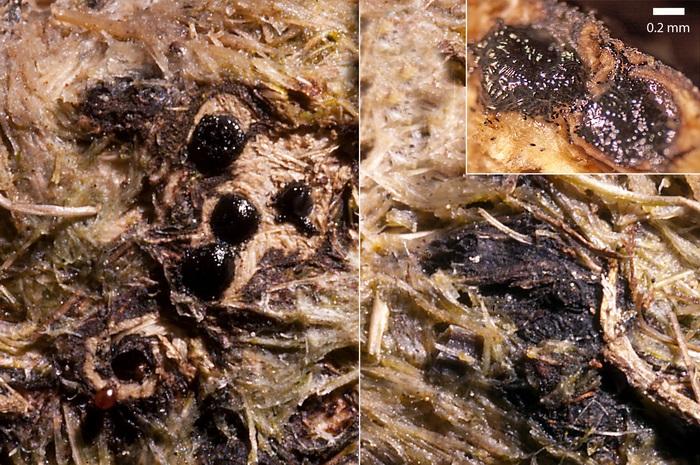
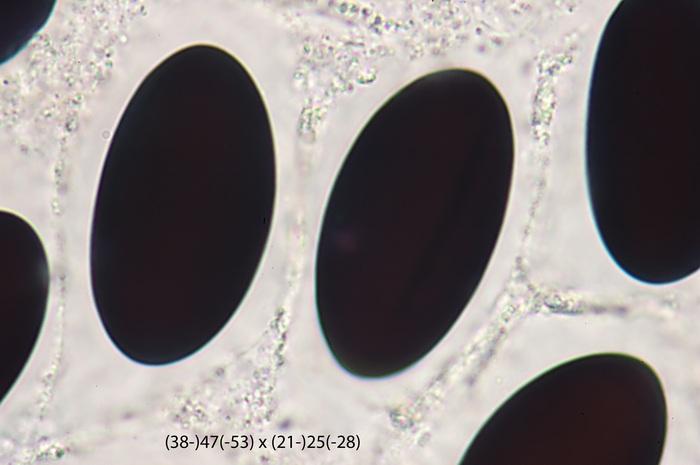
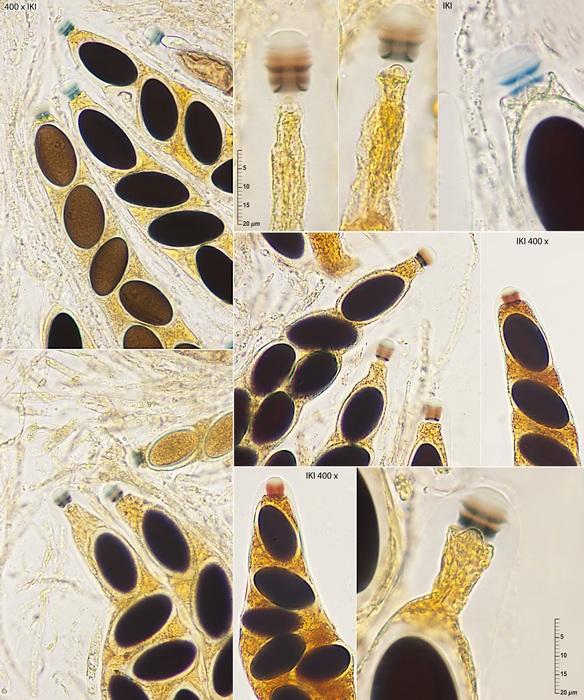
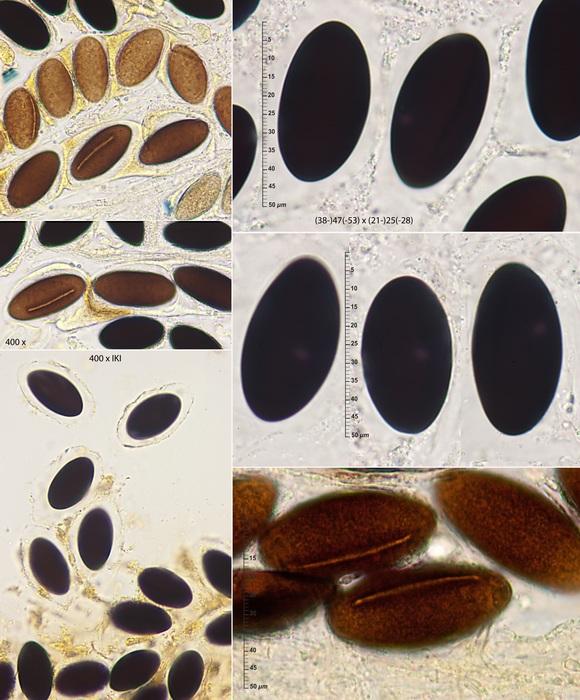

Encore une espèce difficile ! La taille des spores est importante et peut être pourrais tu chercher vers H.kansensis, H.stercoraria ou H.violacea. Je n'ai malheureusement pas les descriptions précises de ces champignons. As tu pu observer si l'appareil apical est bleu ( et reste bleu ), ou s'il change de couleur.
Amitiés.
Michel.
Bonsoir Michel
Comme tu purras voir sur mes photos l'appareil apical est bleu, rougeatre o il a une part d'un couleur et aussi de l'autre, melangé. Et il ne change pas avec le temps...
J'avais cherché sur stercoraria mais je suis desolé parce que Krug & Cain (1974) ne parlent pas d'elle...
Michel.

for me it seems Hypocopra stercoraria. I have found H. stercoraria recently on cow dung. For me, your fungus is like my. I have its description, based in my material. Hypocopra species is very hard to do its taxonomy, like Michel said. So, I hope to help you. Maybe it was your reagents contaminated or mixed with another one? All is possible, maybe some abnormal species or variety, because this genus is poorly studied. But, however, I'll write my description if you want to compare my with your material. I wish good luck.
DESCRIPTION: Stroma present, slightly spread over the substrate, whitish in color, becoming yellow to cream-colored with age. Perithecia immersed in stromatic tissue, pyriform, measuring up to 1 mm, dark, with peridium coriaceous, smooth, neck short and papillaceous and ostiolate, growing sparse to gregarious in the stroma. Paraphyses present, with a number of hyaline vacuoles. Asci cylindrical, pedicellate, measuring 250–300 × 35–40 µm, dextrinoid, with apical apparatus becoming blue in iodine reaction (I+), 8-spored. Ascospore uniseriate, dark, elliptical, with an easily visible gelatinous sheath, measuring 38.6–48(–50) × (18)18.9–22.2(–24) µm. The ascospores have a central, longitudinal germ slit measuring an average of 30 µm.
Hi Francisco and Michel
My IKI is well preserved and not contaminated. Francisco, your fungus likes very much with the mine, but I think the problem is to know a good description of Hypocpra stercoraria. Do you know a modern description of this fungus?
Saccardo's Sylloge Fungorum say us the ascospores are 30 microns long!