07-06-2026 15:10
 William Slosse
Hello everyone,On 05-06-26, I found following asco
07-06-2026 12:09
 François Freléchoux
Bonjour, Voici une brève description de ce qui m
05-06-2026 11:02
Thomas Læssøehttps://svampe.databasen.org/observations/10596691
07-06-2026 12:43
Steve ClementsBojour. This was a strange find on a stick on my
12-07-2015 00:05
 Nedim Jukic
This one from the same locality as the previous on
06-06-2026 17:44
Steve ClementsBonjour, This disco was on planed wood 3 x 1.5 cm
14-08-2016 23:15
 Alex Akulov
Dear friendsCan you help me to find the descriptio

04-06-2026 11:36
Gernot FriebesHi,found on Vaccinium myrtillus.Asci: IKI –, 8-s
 Hello all - lichenicolous fungus help needed this time please!
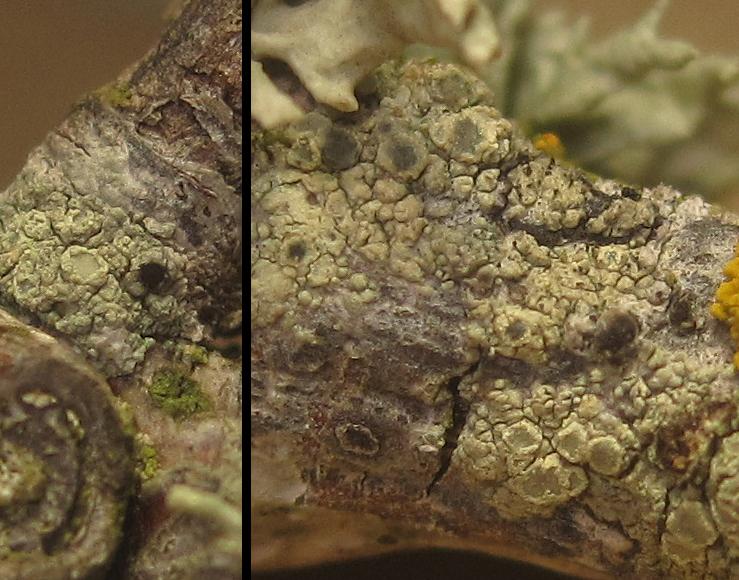
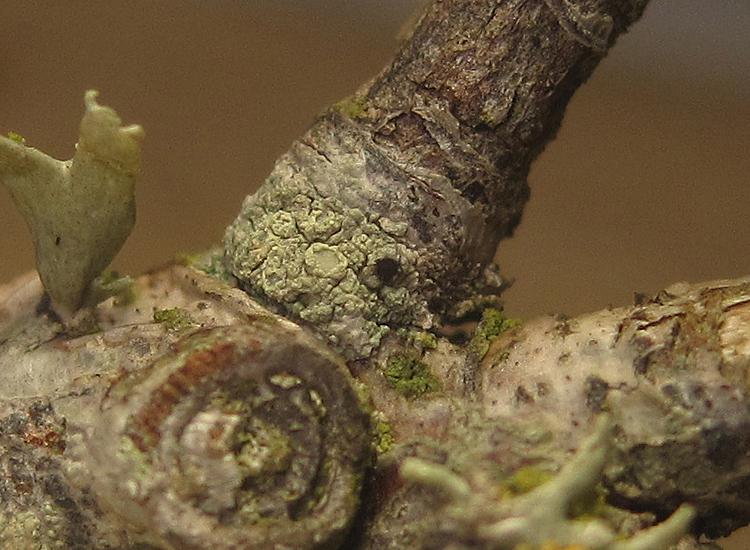
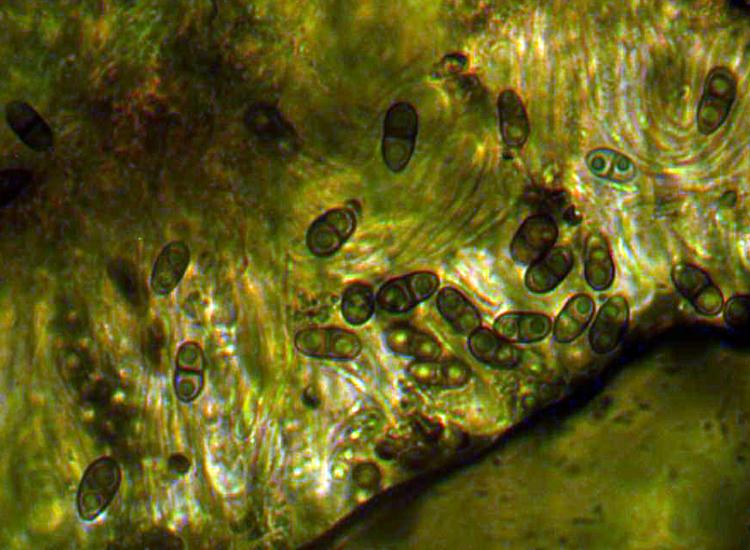
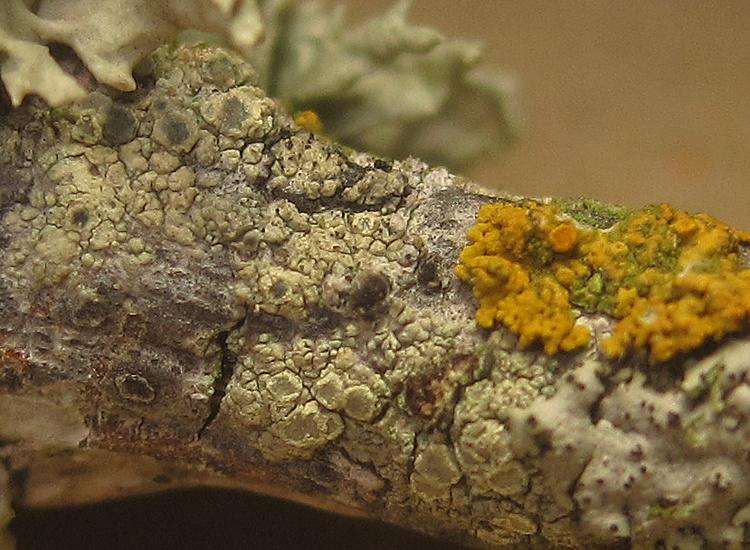
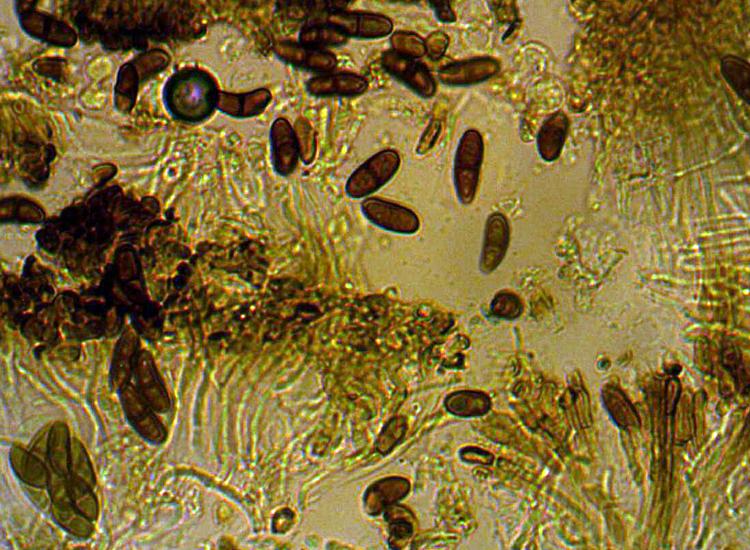
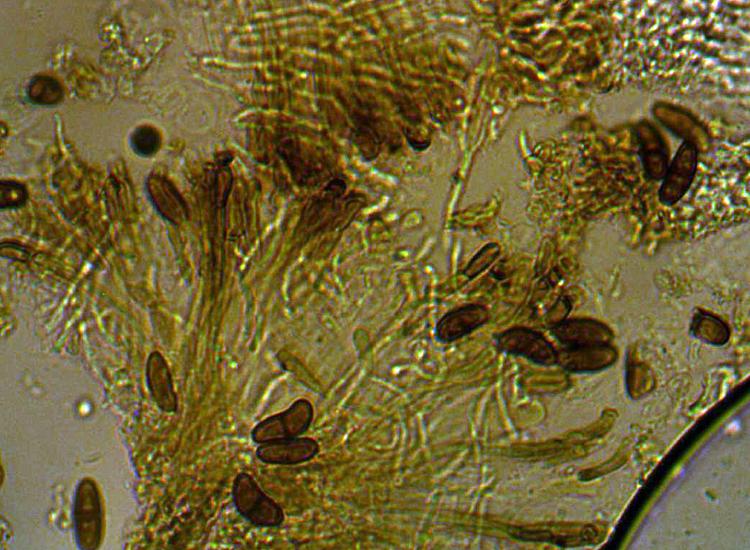
 Densely clustered very small black perithecia on the apothecia of Lecanora confusa, completely blackening the host apothecia. Spores 1-septate, brown (green-brown to brown in asci) (10) 12-13 (15) x (4)5-7 µm.
No host spores to be seen and I did a second section from a different apothecia just to be very certain that it wasn't just Amandinea punctata among the Lecanora.
Stigmidium congestum has just been confirmed (by BJC) from L. chlarotera in the same 1km square but the spores of my specimen are wider than the measurement of (2.5)3-4 µm given in the 2010 4th draft Key to Lichenicolous Fungi.
Spore width fits better with that given for S. squamariae but that is only included in the key on Lecanora polytropa........
With regards,
Jenny

Hi Jenny,
It can't be Stigmidium congestum, that has hyaline ascospores. Exit the genus Stigmidium.
How many ascopores in one ascus ? If more than 8, see the genus Muellerella. But apparently I see 8 ascospores.
It reminds me Endococcus s.l.
I will research and I'll give you news.
Alain
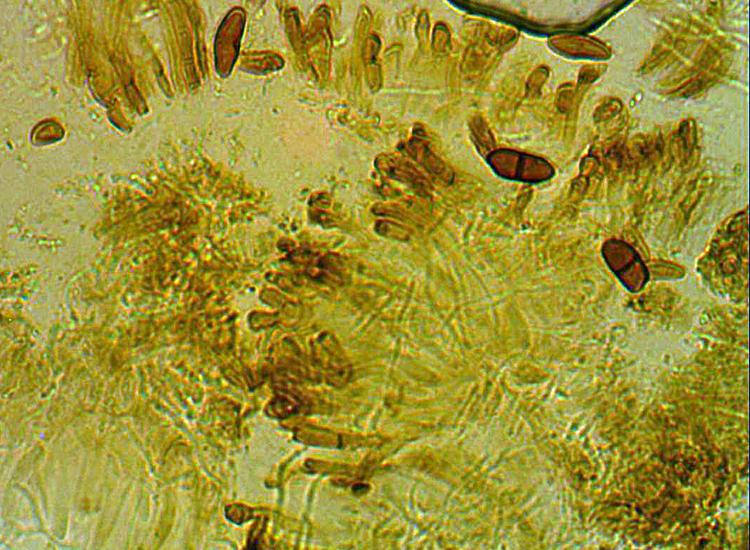
Yes, asci 8-spored and some paraphyses with swollen darker tips (further reminding me of Amandinea but the aps are definitely L. confusa)
Hi Jenny,
After researching, I haven't one name to propose.
Amandinea is excluded because you saw perithecias. It's probably a fungus in the Endococcus-complex, perhaps unknown.
Could you send me a piece of material, if you got enough, please ?
My postal adress :
14 rue roulette
21260 Véronnes (France)

Hello there,
I'm new here and don't have a broad knowledge of ascomycetes generally, but I am interested in lichens and lichenicolous fungi.
Sometimes you find more than one lichenicolous fungus on a single lichen specimen (I've seen up to three). I find the presence of brown tipped paraphyses intriguing... Is it remotely possible that the piece you sectioned was a lichenicolous discomycete like Dactylospora or Buelliella and not the same as the small dark perithecia you describe blackening the disks of the host apothecia? If the fungus is clearly perithecial and the interascal hyphae belong to the invading fungus and not the host, perhaps it is a species of Polycoccum.
When I can't pin down a genus from a key, I often refer to lichenicolous.net to look for possibilities based on host.
Good luck!
Kendra
Unfortunately none left ....... there were only two blackened apothecia and both got sectioned and squashed in my attempt to find Lecanora spores among the brown 1-septate spores.
As there seems nothing lichenicolous that fits I'm wondering again if it could have been stray Amandinea (or Rinodina sophodes) aps amongst the L. confusa. I was convinced I could see tiny black perithecia on the second specimen but perhaps I was mistaken.......
Ah well, no doubt there will be more somewhere!
Jenny
Sorry I missed your reply whilst posting mine - Polycoccum looks a good possibility worth checking, just wish I had more of the affected apothecia!
I must be missing something obvious but how do I access the section on lichenicolous.net with lichenicolous species by host?
With regards
Jenny
Hi Jenny,
There is no listing by host, but you can search any website or document for a word or phrase by hitting "Ctrl" and "F" simultaneously. Not quite as convenient as a list by host for that purpose, but worthwhile because the listing on lichenicolous.net is quite comprehensive and was just recently updated.
Kendra

nice page, I have saved it. Sometimes I do the same with substrate lists, e.g. from the sites of the Umea University (Eriksson).
regards,
björn
You're welcome!
Kendra
Renobales, G. 1996. Contribución al conocimiento de los líquenes calcícolas del Occidente de Vizcaya y parte oriental de Cantabria. Guineana. 2:1-310
Buellia would make sense of those dark-tipped paraphyses!
With regards,
Jenny
Hi,
I'm only coming back. So it would be apothecias and not perithecias, ok (paraphyses welle seen by Kendra, good job !). Probably a Buellia s.l. (Buellia, Bueliella, Dactylospora, Dactylosporum, Karschia ...)
You can perhaps see towards Buellia badia.
Alain
Yes Javier, of course.
Why did we forget to go back to this common species ?
I kept wondering if it might be just Amandinea punctata - that's why there's nothing left as I hoped to find some Lecanora spores among the brown, 1-septate ones!
A. punctata was present elsewhere on the twig but the two shown definitely appeared to be blackened Lecanora confusa apothecia with faint signs of a white thalline margin, supporting the Buellia possibility. (Additional image below)
However unless I can find more for someone more experienced to examine there is unfortunately no way of knowing......
With regards,
Jenny