
04-06-2026 11:36
Gernot FriebesHi,found on Vaccinium myrtillus.Asci: IKI –, 8-s
04-06-2026 07:02
 François Freléchoux
Bonjour, Voici la description d'une espèce qui p
04-06-2026 10:50
François Freléchoux
Bonjour, J'ai trouvé hier un petit asco observé
22-05-2026 13:29
Gernot FriebesHi,I am curious to hear your opinion on this mater
18-10-2022 00:12
Valencia Lopez Francisco JavierHola amigos/asRecientemente encontré esta colecci
03-06-2026 19:45
 Miguel Ángel Ribes
Good afternoonI'm completely baffled by this suppo
03-06-2026 14:39
Thomas FlammerApothecia yellow, glassy-transparent, 80 - 120 ymS

Salut à tous,
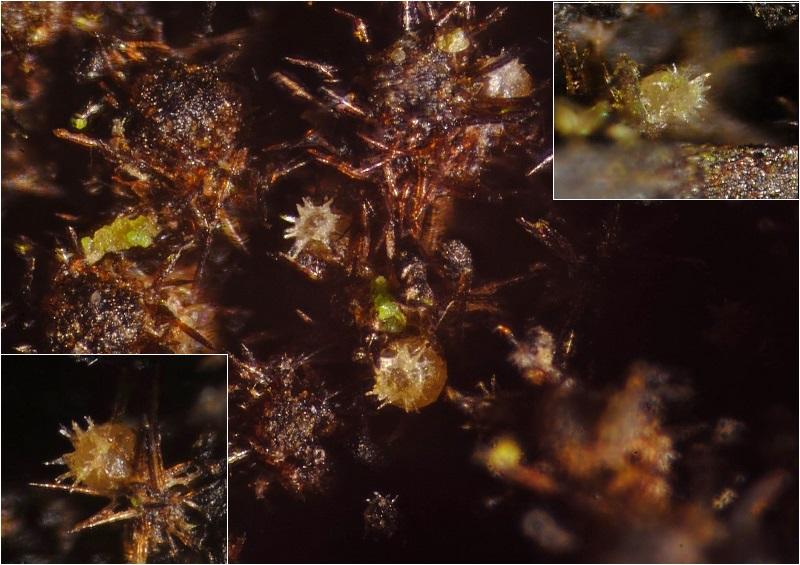
I have collected this species which I can't identify which grows sparsely on (living) ascomata of Echinosphaeria canescens in the South of England (June 8th 2014):
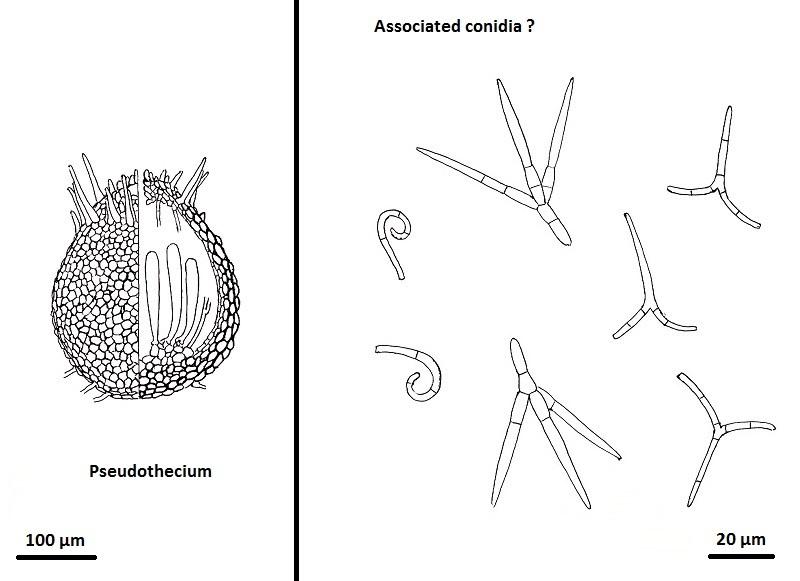
Pseudothecia pale orange to pink, to 270 µm diam.
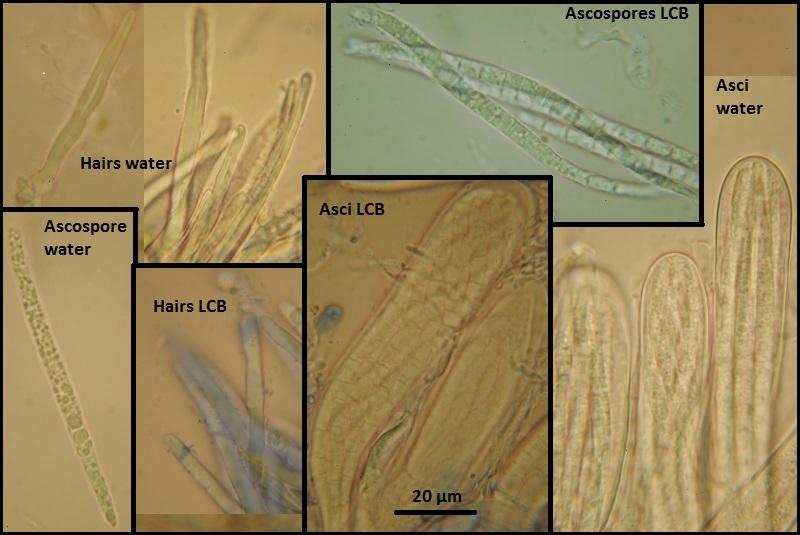
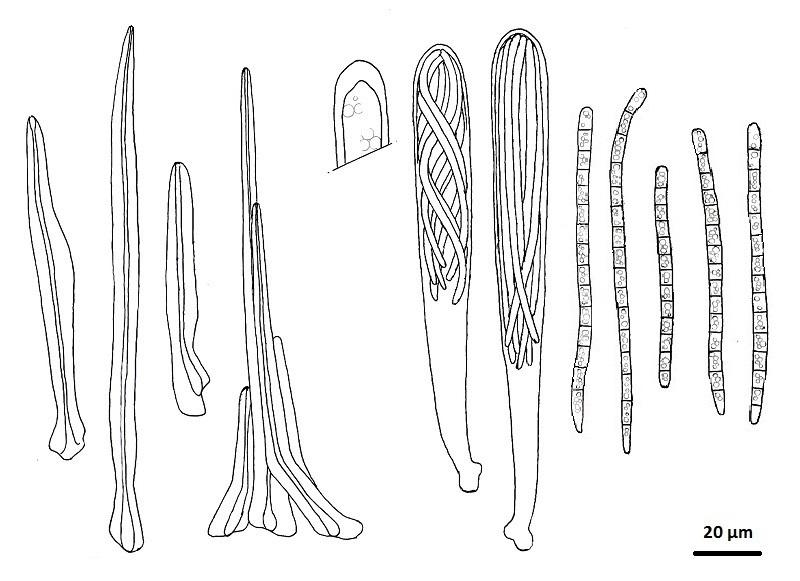
Ascospores 62-135 x 3.3- 4.7 µm, hyaline, multiguttulate, (11)-14-(16) septate, tending to be more cylindrical towards the apical end and more acute towards the basal end. Helicoidally twisted inside the ascus but seeming to 'unwind' as the ascus reaches full turgor.
Asci thick-walled (especially when dead), no apical apparatus.
Hairs encircling the ostiolar area, hyaline, aseptate, thick-glassy walled, sometimes aggregating into 'tufts', to 160µm long.
There were three types of conidia present that I thought might be of interest - Types of conidia I usually associate with aquatic habitats (particulaly the Articulospora-like ones) but this was collected in a dry place, well away from any water source.
I should perhaps add that I'm not sure if there is any material left on the branch I collected - Trying to find the tiny pseudothecia in amongst the Echinosphaeria spines is quite difficult!
I was quite unsatisfied with my photographs of the species, so I also prepared a sketch that may (or may not) make things clearer.
Can anyone help?
Amitiés,

http://www.ascofrance.fr/forum?id=30212
Spores shorter: 48-55 x 2.5-5.8 µm , with much less septa (3-5).
On Fagus bark in association with Tubeufia cerea.
The Trinacrium-like conidia you have observed belong to Orbiliaceae, but the curved ones might belong to the pyreno.
Zotto
Hi Zotto,
It took me a little while, but I found your post (the link takes me somewhere else) and I agree, our species are very close!
Trinacrium refers to the three-pronged conidia, right? There were few of these compared to the other two types - The Y-shaped conidia were the most abundant.
I have studied 'The Tubeuficeae & Similar Loculascomycetes' Rossman but got absolutely nowhere! If anyone has the key to genera included in this article I would be interested in seeing it (I picked up the article here on Ascofrance and it's missing a page or two...)
Nick