
01-05-2026 22:45
 Thierry Blondelle
Bonjour à tous, Une récolte sur bouse séchée d
28-04-2026 20:07
 Lothar Krieglsteiner
... on twig in the air at standing Ceratonia siliq
14-04-2026 05:32
Ethan CrensonHi all, A few weeks back a friend pointed out som
28-04-2026 20:33
Vitus SchäfftleinHello, I found Trochila ilicina on Ilex aquifoliu

30-04-2026 10:28
Rot BojanHello, by appearance I would say that I am dealing
27-04-2026 18:48
Tony MoverleyCollected 23rd April 2026, Norfolk, EnglandSwarms
27-04-2026 20:52
Lothar Krieglsteiner
Found on hanging tiwg of Olea europaea in dried-ou
28-04-2026 22:51
 Bernard CLESSE
Bonsoir à toutes et tous,Pourriez-vous m'aider à
29-04-2026 08:01
Lothar Krieglsteiner
... on twig attached to small tree of Citrus auran
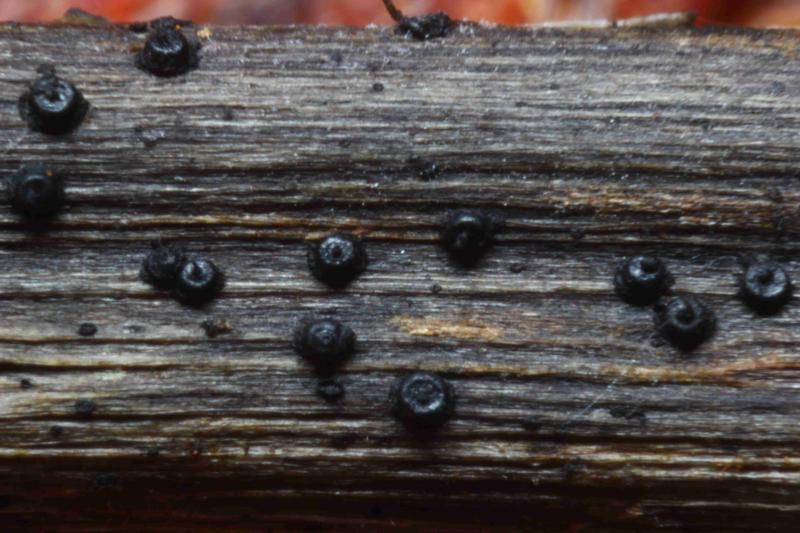
I have found fruit bodies of what I assume to be a species from the genus Ophiobolus. They were growing on a damp, dead, undetermined, thin herbaceous stem and on drying, the fruit bodies have collapsed noticably.
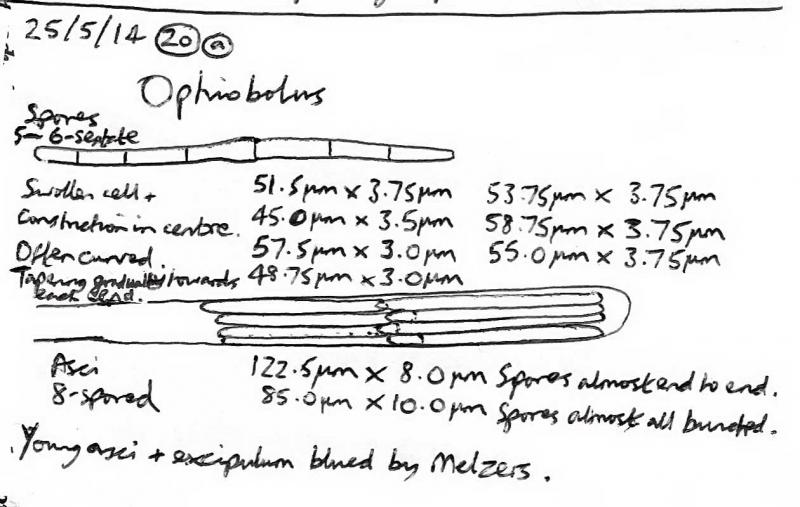
The Shoemaker 1976 paper does not seem to contain a species matching the characteristics of mine. I notice some clear similarities between the shape and structure of the spores of my sample and those of the 16th May 2012 forum post by Enrique Rubio, (which was concluded to be an undescribed species). In mine though, the partly swollen cell is at the centre of the much shorter spores.
I have attached an image of the fruit bodies and a sketch of the microscopy. I imagine that it will turn out to be another undescribed species, unless anyone can identify it.
Thank you,
With Best Wishes,
Peter.

Hi Peter
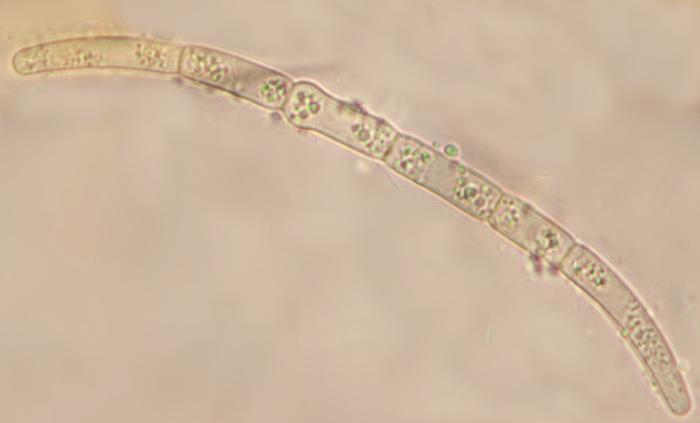
This Ophiobolus (?) is a very common species that I found regulary on herbaceous stems (this week end also on Euphorbia stems) at Somiedo (north of Spain). But at this moment the fungus remains uncertain.
Thanks for your reply.
I am wondering if my find is different, because of the position of the swollen cell right in the centre of the spore. I am seeing both 5-septate and 6-septate spores, which, I think are shorter than yours.
With Best Wishes,
Peter.