
11-05-2026 20:22
 Lothar Krieglsteiner
on attached twig of standing Ficus caricaquite uns
28-04-2026 20:07
Lothar Krieglsteiner
... on twig in the air at standing Ceratonia siliq
11-05-2026 12:32
 Bernard CLESSE
Pourriez-vous m'aider à identifier cette héloti
29-04-2026 10:44
Lothar Krieglsteiner
growing at moist, drying-out soil at the side of a
05-04-2026 22:46
Lothar Krieglsteiner
on wood of Ceratonia, Algarve, 3.4.2026.The color
10-05-2026 16:18
brigitte vignotbonjour trouvée en Ariège sur bois une petite
10-05-2026 23:17
 Andreas Gminder
Hello,today we found in a moist steep decidous for
27-04-2026 17:16
Lothar Krieglsteiner
.. Algarve, moist lying.The conidiomata look like
I have a Peziza sp., found growing on burnt ground, which does not seem to conform with any of the species on the British list.
Instead, I used two French keys to European Peziza species and arrived at P. pseudovesiculosa. Unfortunately, apart from the information given in the keys, I can find no species description.
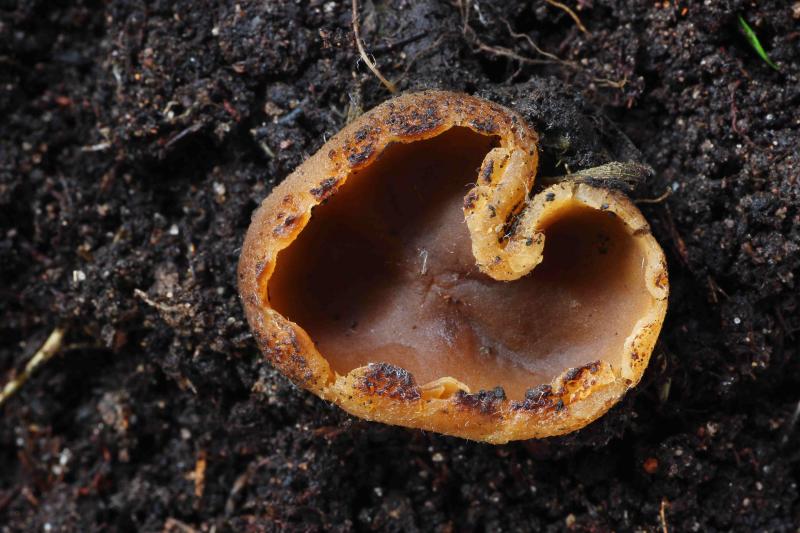
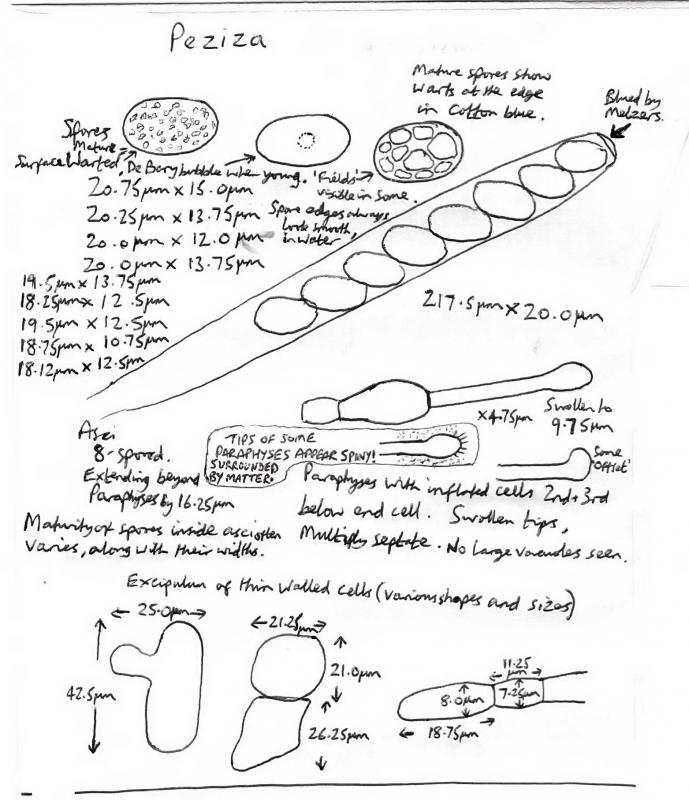
I have attached a photo of the fruit bodies and a sketch of the microscopy.
During microscopy, I noted that within the same ascus there were immature spores with a deBary bubble and also others which were developing surface warts. In all cases, the spore edges appear smooth, mounted in water. In cotton blue, the warts can be seen at the edges.
The width measurements of the mature spores are noticeably broader than those of the immature spores, but the length measurements do not vary as much.
The paraphyses are distinctly moniliform below the first septum. The swollen tips seem to be surrounded by matter, which in some cases actually makes the tips look spiny.
Cells of the excipulum are quite variable in shape and size. Some are almost perfectly spherical, whilst others are pyriform. The flesh has two differently coloured layers below the hymenium. The sap, when cut, is colourless.
I wonder if anyone can either confirm Peziza pseudovesiculosa, or suggest an alternative identification?
Thank you,
With Best Wishes,
Peter.
I think you have found only one apothecia, this does not help...!
With those moniliform paraphyses, the first idea for me should be Peziza varia, but P. pseudovesiculsa is not bad at all. A full description (sorry, in Italian) but with photos and micro drawings of Peziza pseudovesiculosa is on Fungi non delineati XII.
Let me know if you need it, I can send you a scan.
Regards
Mario
Thank you for your reply.
I did consider Peziza varia, but felt that its smaller, smooth spores were wrong for my sample, with spores covered in warts.
I do not have Fungi non delineati XII, so would be grateful for a scan of the images and text, please. In the mean time, I will find my Italian dictionary.
Thank you
With Best Wishes,
Peter.
It is important that you observe the different layer of the excipulum.
You should also take a look here
http://www.ambmuggia.it/forum/topic/6989-peziza-pseudovesiculosa/
with beautiful micro-photos.
If I remember well, the only other species of this group with ornamented spores should be Peziza arvernensis (if we accept they are 2 different species and not the same).
However your spores seem too long for P. pseudovesiculosa also.
Mario