
29-04-2026 10:44
 Lothar Krieglsteiner
growing at moist, drying-out soil at the side of a
28-04-2026 20:07
Lothar Krieglsteiner
... on twig in the air at standing Ceratonia siliq
11-05-2026 12:32
 Bernard CLESSE
Pourriez-vous m'aider à identifier cette héloti
05-04-2026 22:46
Lothar Krieglsteiner
on wood of Ceratonia, Algarve, 3.4.2026.The color
10-05-2026 16:18
brigitte vignotbonjour trouvée en Ariège sur bois une petite
10-05-2026 23:17
 Andreas Gminder
Hello,today we found in a moist steep decidous for
27-04-2026 17:16
Lothar Krieglsteiner
.. Algarve, moist lying.The conidiomata look like
10-05-2026 09:02
Buckwheat PeteHello everybody, ould this be Lachnum subvirgineu
08-05-2026 11:55
Gernot FriebesHi,found on a decorticated Picea abies branch stil
Hymenoscyphus
Salvador Tello,
06-01-2014 20:13
He encontrado este Hymenoscyphus sobre tallos secos de Sambucus ebulus. Pienso que podría ser Hymenoscyphus caudatus, pero creo que las esporas deberían ser más scutuloid y no se si es posible en este sustrato. ¿Que os parece?
Apotecios gregarios o solitarios, blancos, estipitados, hasta de 4 mm, con el borde revoluto de jóvenes y planos o convexos cuando están maduros, creciendo en tallos secos de Sambucus ebulus. Ascas de (112,46) 115,05 - 123,78 (129,31) x (11,88) 12,50 - 13,19 (13,36) µm; Me = 119,83 x 12,79 µm, inoperculadas, octospóricas, cilindrico-claviformes, generalmente curvadas, con el ápice amiloide, sin crozier en la base. Esporas de (15,20) 16,25 - 18,66 (19,48) x (5,36) 5,65 - 6,34 (6,50) µm; Me = 17,50 x 6,02 µm ; Qe = 2,91, biseriadas, lisas, hialinas, estrechadas ligeramente en el centro, con numerosas gotitas de aceite en su interior. Paráfisis cilíndricas, septadas en su parte inferior, con numerosas gotitas no muy refringentes en el segmento superior.
Gracias.
Saludos.
Salvador.
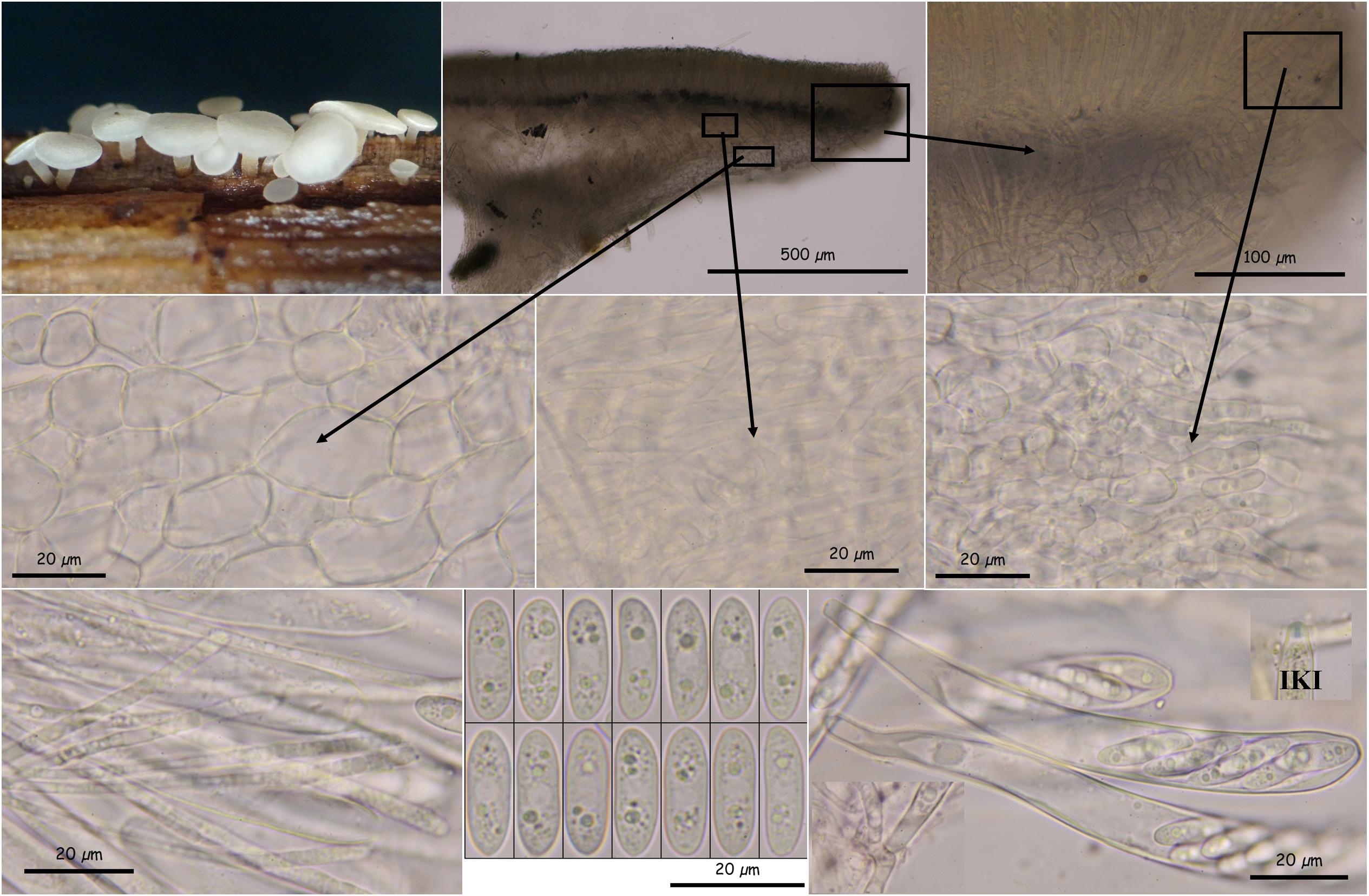 Imagen2-0020.jpg
Hans-Otto Baral,
06-01-2014 22:18

Re : Hymenoscyphus
Hi salvador
when neglecting the substrate then I would be sure this is H. sparsus. Typical is that the spores are practically not scutuloid, the internal guttules rather small, and the droplets in the paraphyses restricted to the apical part. But that species occurs on leaves, mainly of Quercus, also Fagus etc. But when growing on petioles of Robinia etc., why not on herbs? Hmmm. Also I know H, sparsus rarely exceeding 1 mm diam., have you a scale for your macro? 4 mm would be extreme.
Zotto
when neglecting the substrate then I would be sure this is H. sparsus. Typical is that the spores are practically not scutuloid, the internal guttules rather small, and the droplets in the paraphyses restricted to the apical part. But that species occurs on leaves, mainly of Quercus, also Fagus etc. But when growing on petioles of Robinia etc., why not on herbs? Hmmm. Also I know H, sparsus rarely exceeding 1 mm diam., have you a scale for your macro? 4 mm would be extreme.
Zotto
Salvador Tello,
06-01-2014 22:43
Re : Hymenoscyphus
Perdona Zotto, ha sido un error mio, acabo de medirlos y en realidad llegan hasta 1 mm, he confundido las medidas con otros H. scutula que he cogido en el mismo sustrato.
Hans-Otto Baral,
06-01-2014 22:45
Re : Hymenoscyphus
Gracias