
10-05-2026 09:02
Buckwheat PeteHello everybody, ould this be Lachnum subvirgineu
08-05-2026 11:55
Gernot FriebesHi,found on a decorticated Picea abies branch stil
11-05-2016 20:37
 Zuzana Sochorová (Egertová)
Hi,this very little ascomycete grew on soil in a m
09-05-2026 07:37
Zuzana Sochorová (Egertová)
Hello,please, could anyone share this paper?Ferná

05-05-2026 22:40
Gernot FriebesHi,I believe this is a Plagiostoma growing on a Sa
06-05-2026 11:25
 Castillo Joseba
Me mandan el material seco de Galicia (España) re
06-05-2026 17:23
Thomas Læssøehttps://svampe.databasen.org/observations/10594257
28-04-2026 20:07
 Lothar Krieglsteiner
... on twig in the air at standing Ceratonia siliq
04-05-2026 18:13
 Stephen Martin Mifsud
ID request for what seems to be a true aquatic fun
 Bonsoir à tous, Hi to everyone,
Pour la 2eme année consécutive, je récolte sur feuilles pourrissantes de Tilia une minuscule hélotiale blanche sans pouvoir la déterminer
I hereby present a undetermined white Helotialean minute asco on rotten Tilia leaves . I collected it twice in the same site , in November 2012 and 3 days ago.
- Apos up to 0,25 mm, white, urceolate, then flattened, (remaining white) Pars sporifera 18-25 µm
- Ascus H+, IKI + (intense blue) Calycina type, 41-49 x 7-8,5
- EE prismatica, last cells with VBs as in paraphyses
- Spores 7,5-9(10) x 3-3,5 , most often with one, not conspicuous LB at each pole(x -> 1,8 µm) , and not rare detaching envelopes, CRB -
-Paraphyses enlarged ->3-4 , tip filled with a 7-8 µm long VB , CRB +
I would suggest Calycina as a genera candidate but get no clue for species name
I'll be happy with some help . Merci merci.
Amitiés
Michel
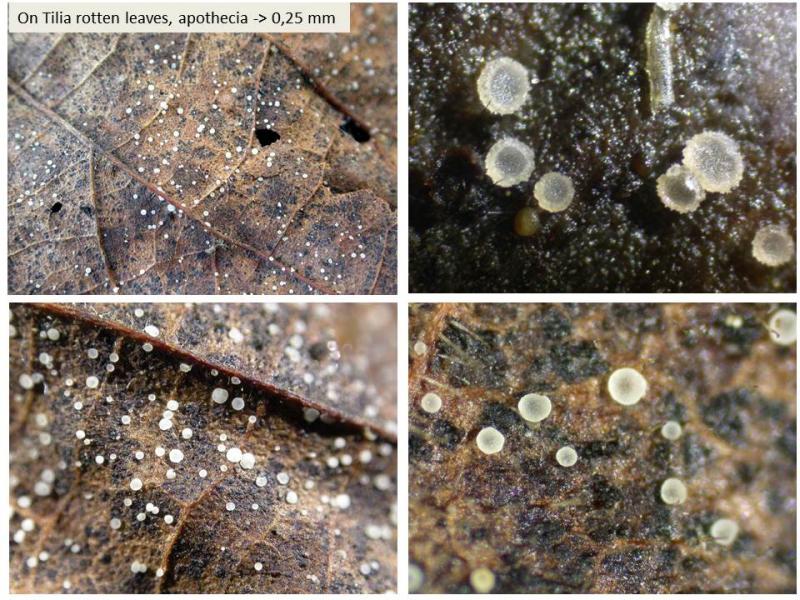
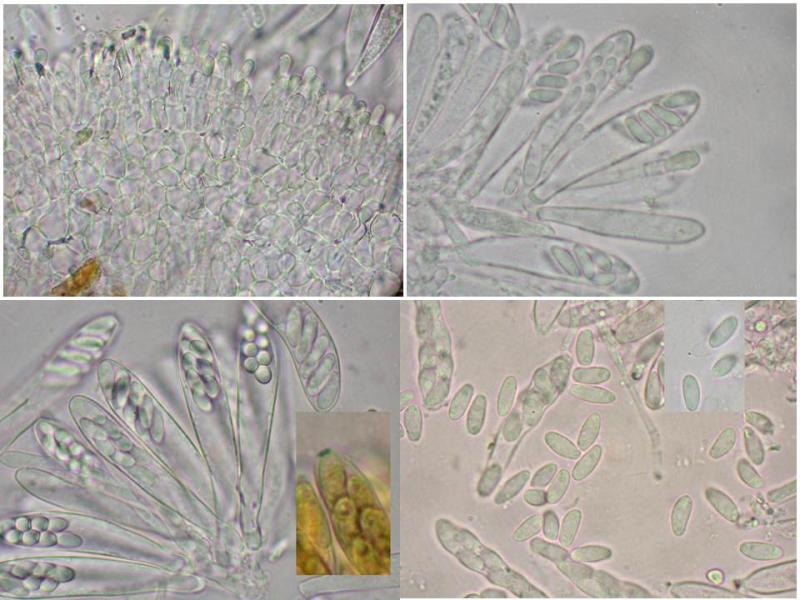

I don't have a real idea. Did you observe hairs? Macroscopically the apos look as there wood be some. Arendholz has a Pezizella pilosa (=Hyaloscypha puberula = Calycellina punctata ) that could fit according to his description but not absolutelly to those of the synonyms.
Maybe others will shed a light on this.
Regards
Martin

Are the hairs smooth or warted? But even if they are warted it could be a Calycina (like C. gemmarum). Externally it looks more like a Cistella.
In 1985 I thought P. pilosa is a synonym of Calycellina populina. But this or C. punctata are certainly not your fungus.
Zotto
Hairs are not conspicuous. The last cells of ectal excipulum are up to
15(20) long x 3-4 and are often filled with a VB, as in paraphyses last
cells too. They are smooth.
In Arendholz's description, (Latin diagnose), spores are uniseriate (if I do
understand clearly) , which is not the case here. Also I do not find these apos are erumpent.
Amitiés
Michel
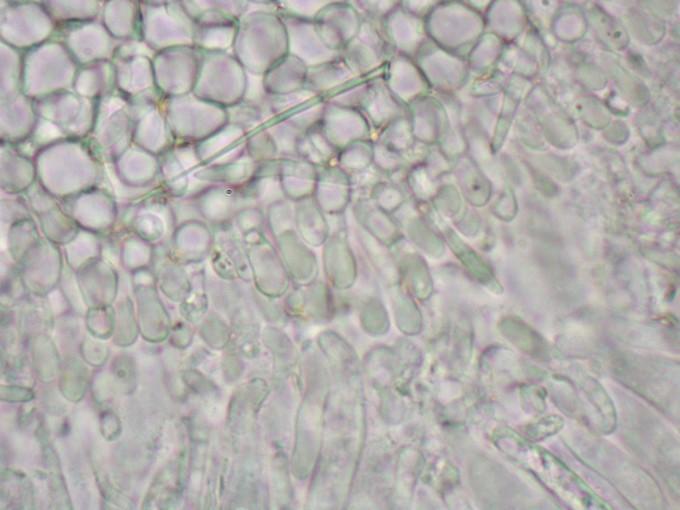
Now I found my photos of Helotium subcitrinum (?= Pezizella pilosa), which is definitely another fungus (HB 8351b).
Zotto
Arendholz describes his Pezizella pilosa in the German diagnosis as with asci oblique uniseriate to irregular and sometimes biseriate. I am sure that he refers to dead herbarium collections mostly. As for the hairs he does not mention any ornamentation. I would consider them as smooth, otherwise he would have mentionend something (cf. warty ). This species on Tilia leaves seems to be a species that needs much more collections.
Best regards
Martin
The copy I have of Arendoltz thesis does not enable me to consider properly the plate for P. pilosa. But I do not think it contains either spore drawings ?
This work is interesting for the description and notes he gives on a good deal of folicolous species.
Michel