
06-05-2026 17:23
Thomas Læssøehttps://svampe.databasen.org/observations/10594257
06-05-2026 11:25
 Castillo Joseba
Me mandan el material seco de Galicia (España) re
28-04-2026 20:07
 Lothar Krieglsteiner
... on twig in the air at standing Ceratonia siliq
05-05-2026 22:40
Gernot FriebesHi,I believe this is a Plagiostoma growing on a Sa
04-05-2026 18:13
 Stephen Martin Mifsud
ID request for what seems to be a true aquatic fun
04-05-2026 16:39
Stephen Martin Mifsud
ID request: This specimen was collected in Malta o
28-07-2011 18:31
 Alex Akulov
Dear FriendsToday I made the pdf file of Velenovsk
04-05-2026 09:50
Castillo Joseba
Me mandan el material seco de Galicia,(España) re
02-05-2026 12:42
Alain BRISSARDBonjour à tousJeuidi 30 avril dernier on m'a remi
Possible Hydropisphaeria on Rubus fruticosus
Peter Thompson,
22-06-2013 23:15
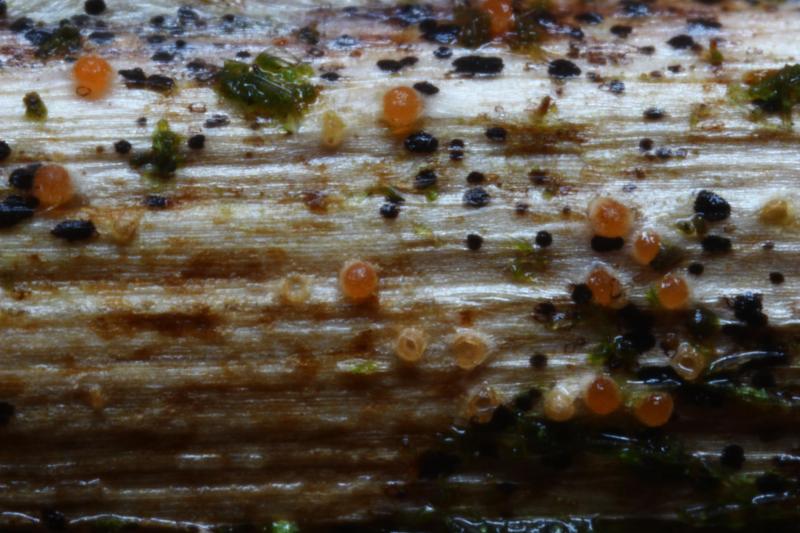
I recently found some orange spheres, which are erumpent through the epidermis of dead stems of Rubus fruticosus.
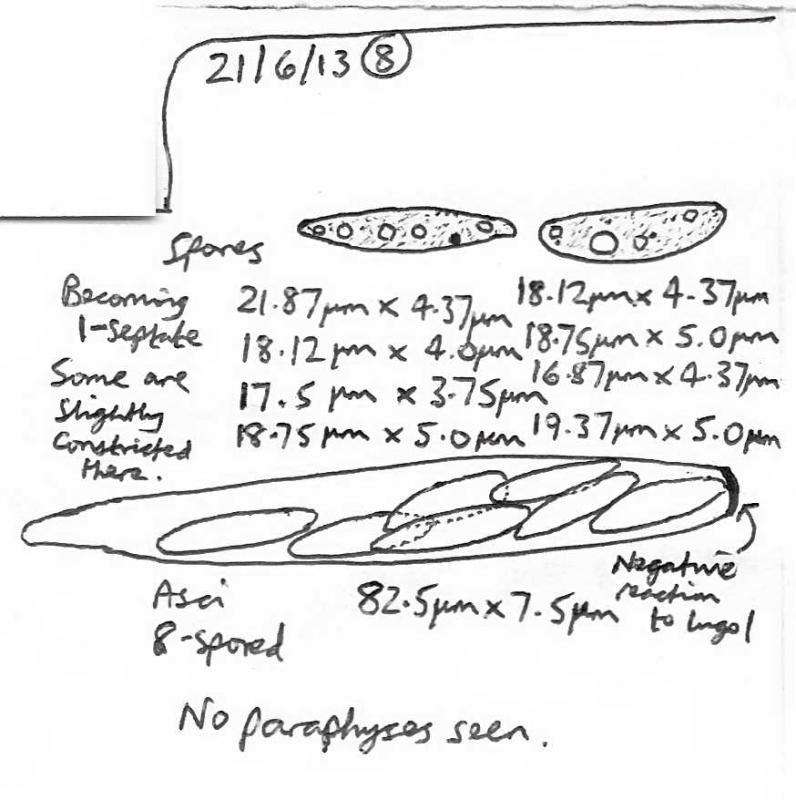
I have attached a photograph of the fruit bodies and a sketch of the microscopy. I notice that the spores and asci in my sample are very similar to Christian Lechat's 2nd microscopy image for Hydropisphaeria arenula in the database.
As H. arenula has yellowish brown perithecia, this species would be ruled out, along with the granular H. erubescens on leaves of Ilex and H. peziza with shorter spores.
I wonder if anyone knows about a species which grows on Rubus?
Thank you,
Best Wishes,
Peter.
Christian Lechat,
23-06-2013 06:26

Re : Possible Hydropisphaeria on Rubus fruticosus
Hi Peter,
Hydropisphaera is possible, but are you sure that your fungus is erumpent?
Are the ascospores smooth or spinulose? Do ascomata change of color in 3%KOH or lactic acid? Are ascomata cupulate when dry? what is the thickness of the ascomatal wall?
There are two species in the complex "arenula", one with smooth ascospores and another with spinulose ascospores. We don't know if they are the same species or not and I would be happy to examine your specimen because I need its anamorph in culture as well as molecular data to separate these species.
A lot of thanks in advance,
Regards,
Christian
Hydropisphaera is possible, but are you sure that your fungus is erumpent?
Are the ascospores smooth or spinulose? Do ascomata change of color in 3%KOH or lactic acid? Are ascomata cupulate when dry? what is the thickness of the ascomatal wall?
There are two species in the complex "arenula", one with smooth ascospores and another with spinulose ascospores. We don't know if they are the same species or not and I would be happy to examine your specimen because I need its anamorph in culture as well as molecular data to separate these species.
A lot of thanks in advance,
Regards,
Christian
Peter Thompson,
23-06-2013 19:06
Re : Possible Hydropisphaeria on Rubus fruticosus
Hello Christian,
Thank you for your reply.
I will be pleased to post the sample to you, if you email your postal address to me. There are quite a few fruit bodies.
In answer to some of your questions:
It looks as if the fruit bodies are erumpent, as the host epidermis is being torn longitudinally above them, as they break through it.
The spores appear to be smooth.
Some fruit bodies are becoming cupulate on drying.
With Best Wishes,
Peter.
Thank you for your reply.
I will be pleased to post the sample to you, if you email your postal address to me. There are quite a few fruit bodies.
In answer to some of your questions:
It looks as if the fruit bodies are erumpent, as the host epidermis is being torn longitudinally above them, as they break through it.
The spores appear to be smooth.
Some fruit bodies are becoming cupulate on drying.
With Best Wishes,
Peter.
Christian Lechat,
23-06-2013 20:36
Re : Possible Hydropisphaeria on Rubus fruticosus
Ok Peter,
I wait your sending, thank you.
My address:
Christian Lechat
Ascofrance
64, route de Chizé
F-79360 Villiers-en-Bois
France.
Regards,
Christian
I wait your sending, thank you.
My address:
Christian Lechat
Ascofrance
64, route de Chizé
F-79360 Villiers-en-Bois
France.
Regards,
Christian
Peter Thompson,
24-06-2013 15:42
Re : Possible Hydropisphaeria on Rubus fruticosus
Hello Christian,
The sample is on its way to you.
Best wishes,
Peter.
The sample is on its way to you.
Best wishes,
Peter.
Christian Lechat,
29-06-2013 18:21
Re : Possible Hydropisphaeria on Rubus fruticosus
Hi Peter,
your specimen arrived today in good order, thank you.
I examined it, the material is very abundant, it is Nectriella dacrymycella (Nyl.) Rehm
I will cultivate it because its anamorph is unknown.
Thanks again,
Christian
your specimen arrived today in good order, thank you.
I examined it, the material is very abundant, it is Nectriella dacrymycella (Nyl.) Rehm
I will cultivate it because its anamorph is unknown.
Thanks again,
Christian
Peter Thompson,
30-06-2013 00:13
Re : Possible Hydropisphaeria on Rubus fruticosus
Hello Christian,
Thank you for identifying Nectriella dacrymycella for me.
I am pleased that it is of use to you for cultivation.
It seems that most records in Britain are for it growing on Iris pseudacorus. There don't appear to be any previously for Rubus.
With Best Wishes,
Peter.
Thank you for identifying Nectriella dacrymycella for me.
I am pleased that it is of use to you for cultivation.
It seems that most records in Britain are for it growing on Iris pseudacorus. There don't appear to be any previously for Rubus.
With Best Wishes,
Peter.