
12-06-2026 14:50
 François Freléchoux
Bonjour, Voici la brève description d'une Mollis
10-06-2026 21:16
François Freléchoux
Bonsoir,Le dernier du jour, en attendant votre avi
11-06-2026 19:01
 William Slosse
Hello all,In an attempt to make a culture of a sus
11-06-2026 19:03
 Nicolas VAN VOOREN
Chers membres d'Ascofrance,Le site sera placé en

09-06-2026 18:32
Camille MertensSur morceau de roseau immergé 0,5 - 0,7 mm de dia
10-06-2026 12:54
Steve ClementsBonjour encore, Pouvez-vous m'aider, s'il vous pl
10-06-2026 21:07
François Freléchoux
Toutes les tiges de gentianes jaunes de l'an passÃ
10-06-2026 13:41
François Freléchoux
Bonjour à nouveau, Voici une trouvaille d'hier.
Este homgo lo encontré en la Sierras de Cazorla, Jaén, se que es Gibberella, pero no se cual puede ser. ¿Alguien tiene unas claves para Gibberella, o sabe cual podría ser?
Peritecios generalmente gregarios, que irrumpen de entre la corteza de Ulex parviflorus. Los peritecios son de color marrón con brillos metálicos, que en el microscopio son azul oscuro, de (268,92) 286,91 - 350,39 (368,74) µm. Me = 318,90 µm de anchura.
Ascas biseriadas, no amiloides, de (89,57) 91,35 - 113,78 (116,78) x (10,62) 12,77 - 14,72 (14,83) µm.
Me = 102,30 x 13,50 µm.
Esporas lisas, hialinas, algo curvadas, con 3 septos trasversales de; (20,26) 21,29 - 25,36 (27,38) x (6,12) 6,49 - 7,56 (8,00) µm
Q = (2,74) 2,85 - 3,65 (3,82) ; N = 33
Me = 23,23 x 7,09 µm ; Qe = 3,29
Gracias.
Saludos.
Salvador.
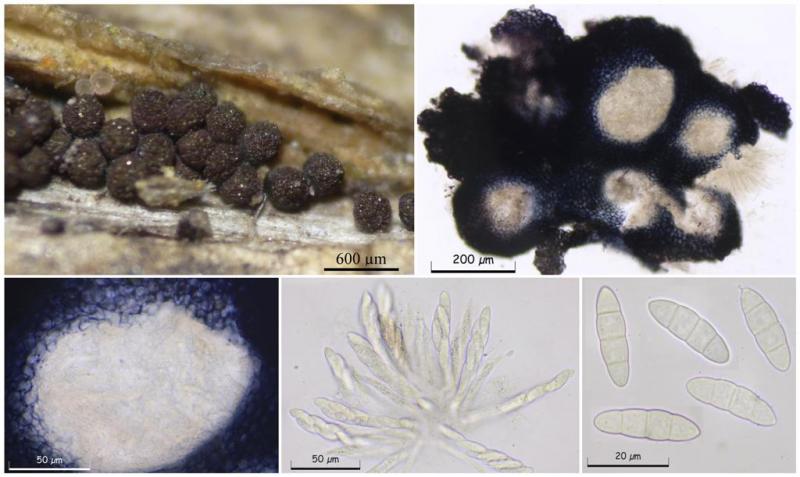
¿Tiene claves para Gibberella? si es así, le pido que me las envíe, por favor.
Yo he mirado en las claves que aparecen en MEDARDI G. (2006) Atlante fotografico degli Ascomiceti d'Italia. A.M.B. Fondazione Centro Sttudi Micologici. y me dice que G. pulicaris tiene esporas de 18-21 x 5-7 µm.
Gracias.
Saludos.
Salvador.

it is not easy to work with this genus, but compare also with Enrique Rubio's data here on ascofrance. In my opinion, after several collections of G. cyanogena and G. pulicaris, there is a difference in spore measurements: spores of G. cyanogena are smaller, often not more than 6µm broad. Length is rather variable between 21 and 31µm.
I do not really know but I think that G. pulicaris fruitbodies are always brown, like cacao, and G. cyanogena very dark brown to blackish brown.
I had a key for this genus, but unfortunately I am still working on organizing my data into an Excel list. For now I cannot find the doc (sorry for that).
regards,
björn
No te preocupes por las claves, ya me has ayudado bastante.
Saludos.
Salvador.

the genus Giberella is impossible without to know the anamorphs as you can see in the attached key.
Best regards,
Christian
 GIBBERELA-Samuels-G.-J.-H.-I.-Nirenberg-and-K.-A.-Seifert-0001.doc
Había leído algo sobre esto, pero tampoco estaba seguro. La dejaré como Gibberella aff. pulicaris.
Saludos.
Salvador.

Cordialement
Chris