
12-06-2026 14:50
 François Freléchoux
Bonjour, Voici la brève description d'une Mollis
10-06-2026 21:16
François Freléchoux
Bonsoir,Le dernier du jour, en attendant votre avi
11-06-2026 19:01
 William Slosse
Hello all,In an attempt to make a culture of a sus
11-06-2026 19:03
 Nicolas VAN VOOREN
Chers membres d'Ascofrance,Le site sera placé en

09-06-2026 18:32
Camille MertensSur morceau de roseau immergé 0,5 - 0,7 mm de dia
10-06-2026 12:54
Steve ClementsBonjour encore, Pouvez-vous m'aider, s'il vous pl
10-06-2026 21:07
François Freléchoux
Toutes les tiges de gentianes jaunes de l'an passÃ
10-06-2026 13:41
François Freléchoux
Bonjour à nouveau, Voici une trouvaille d'hier.
 Adio à tous,
Adio to all,
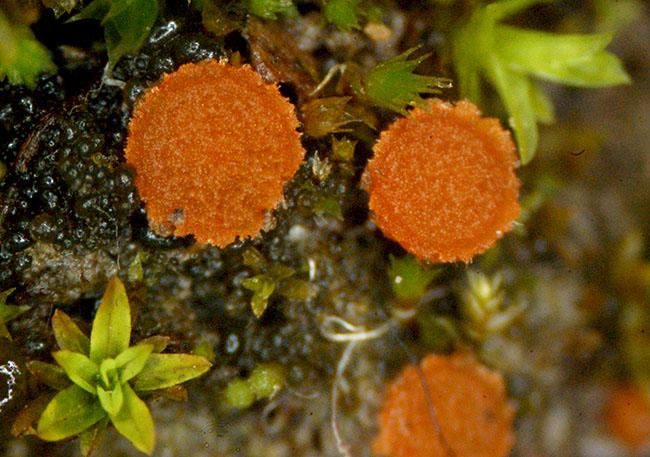
Une Lamprospora, sur sol, composé de mousses (indet.) et de morceaux d'écorces de pin décoratifs au pied d'une petite haie devant le magasin Leroy Merlin de Pau (64), le 18-01-2013.
A Lamprospora, on soil, composed by mixed mosses and pieces of decorative pine bark at the base of a small hedge in front of the store Leroy Merlin, at Pau (F – 64), at 18th january 2013.
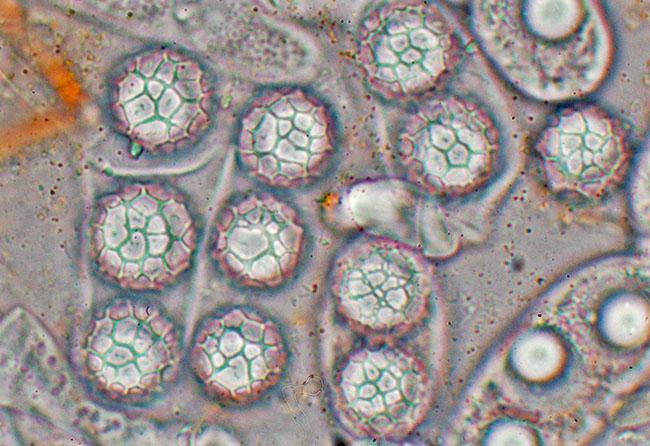
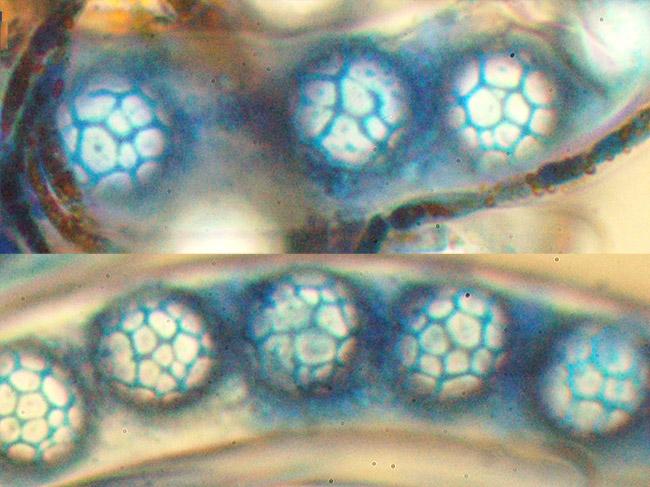
L'espèce paraît différente de L. miniata que je connais bien du muret de mon jardin, mais je ne suis pas spécialiste du genre. Il semble qu'il y ait moins de mailles, que des verrues sont parfois présentes entre les mailles mais comme L. miniata est une espèce « collective », je ne sais pas trop à quoi se référer...
The species seems to be different from L. miniata which I know well from the wall in my garden, but I'm not an expert of the genus. It seems there are fewer stitches, there are warts sometimes present between the stitches, but because L. miniata is a "collective" species, I don't know what thinking...
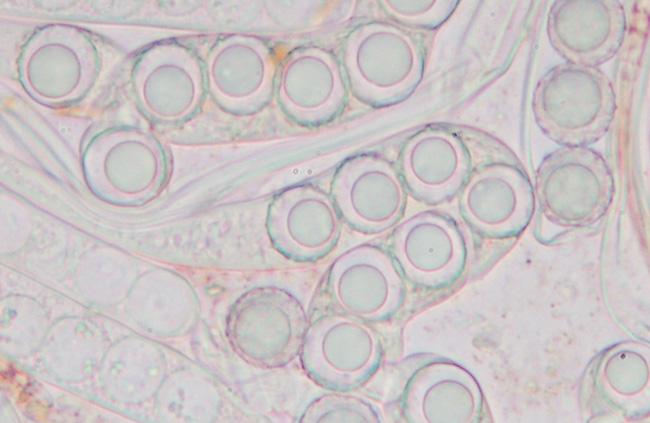
Spores : x 13,5-14,5 µm, parfaitement rondes, avec une guttule excentrée
Spores: x 13,5-14,5 µm, perfectly rounded, with an eccentric guttule
Merci de votre avis,
Thanks for your opinion,
Beñat

Bonnes photos !
C'est peut être la variété ratisbonensis . Je t'adresse en privé le doc de Benkert créant cette variété, mais je n'ai pas pris le temps de le lire entièrement . Le nom de la mousse a certainement de l'importance.
Amitiés
Michel
It certainly looks like Lamprospora miniata s.l.
The relatively small ascospores indicate var. parvispora (see Benkert 2001), which is parasitic on Barbula.
For certainty, the identification of the host moss is necessary. The moss at the lower left side of your first image is possibly a Barbula.
Do you need a PDF of the following publication?
Benkert, D. 2001. Neotypisierung von Lamprospora miniata De Not. (Ascomycetes, Pezizales) und die Problematik des ''Lamprospora miniata-Komplexes''. - Micologia 2000 47-61.?
With best regards
Jan
I have just read with interest your latest observations .
I agree with the spore size but I thought the width of their net meshes and their number through the spore diameter would rather suit var. ratisbonensis . Dieter Benkert's plates show var. parvispora spores with narower and more numerous meshes (but for some collection !)
Amitiés
Michel
I regard the pattern of the reticulum as variable within the L. miniata-complex. In my opinion, spore size and especially the host-moss are more important.
The spores of Benat's collection look quiet mature.
In my experience, the apothecia of L. miniata var. parvispora are mostly deep red-orange like in Benat's image whereas the apothecia of var. ratisbonensis are pale-orange. But this observation is bases upon only a few collections.
Benat, can you provide an image of the apothecia which shows more of the surrounding area? Maybe, with such an image it is possible to identify the acompanying mosses.
with best wishes
Jan
Two mosses are present and specimens of Lamprospora are mixed with the two mosses, so I can't say one of both is the host.
About mosses, I have take some poor photos but perhaps it is sufficient to have an idea.
Each are in dried state, humid state and under microscope, two mosses are noted m1 and m2.
Beñat
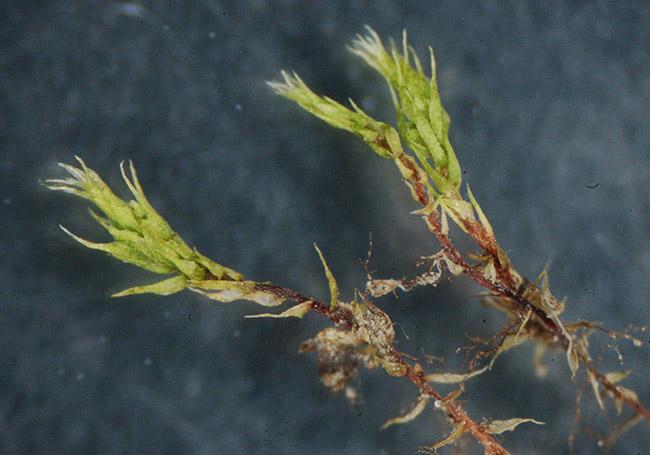
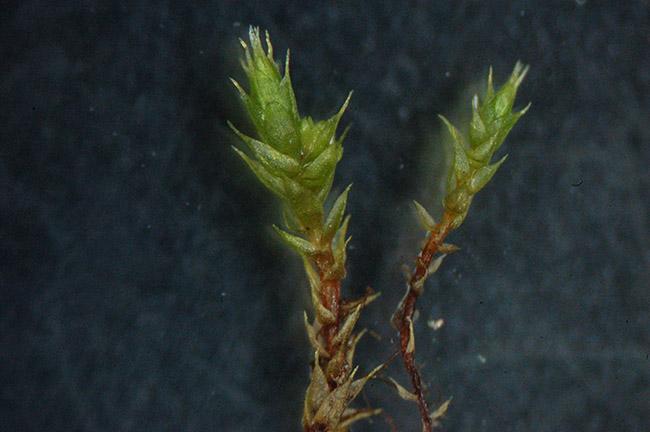
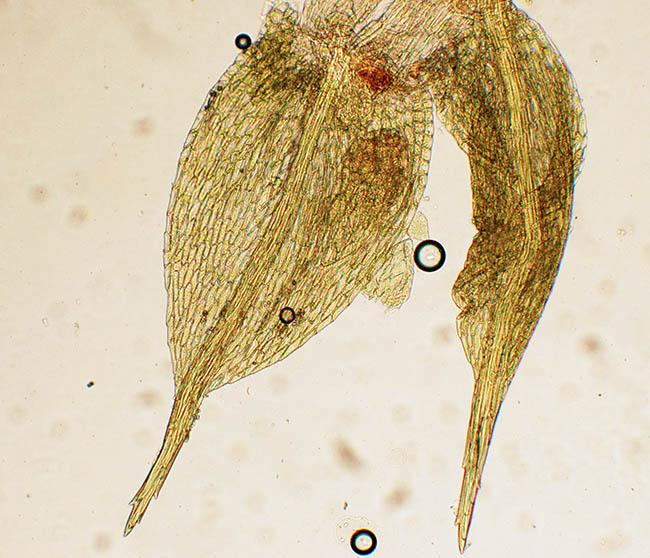
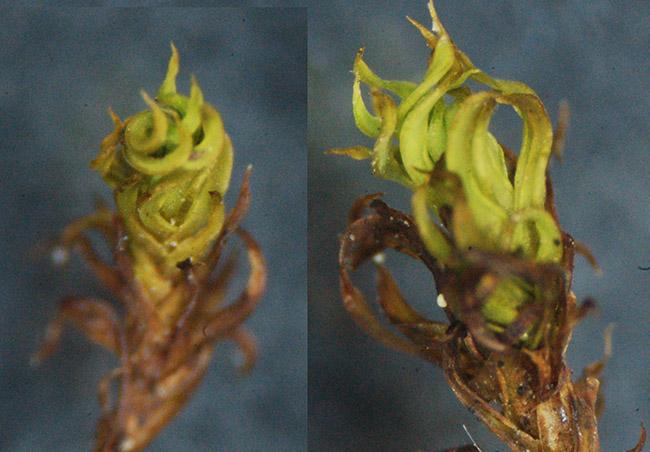
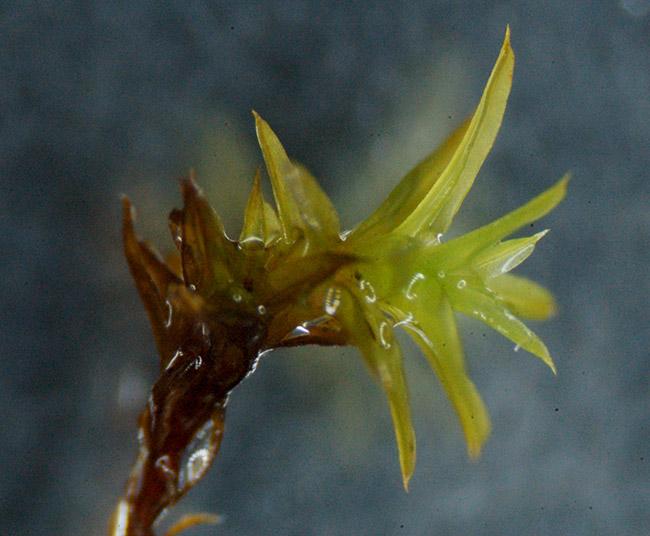
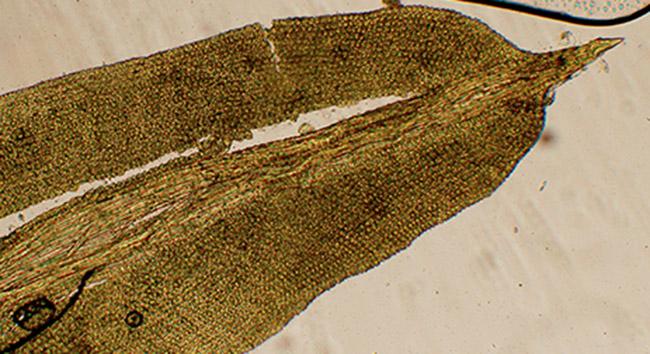
I think the upper ones are Bryum capillare Hedw. var flaccidum (Brid.) and the lower one a Barbula sp. ( perhaps Barbula unguiculata Hedw.) For the determination I used your pictures from the microscopie. The used book was: Atlas van de Nederlandse bladmossen by J. Landwehr 1966
Jacky
thanks for your nice moss images!
M1 is a Bryum, but the actual species I can't identify.
M2 is cerntainly Barbula unguiculata, the host of L. miniata var. parvispora.
So in my opinion, your Lamprospora belongs to miniata var. parvispora.
with best wishes
Jan
Quand on regarde les spores de l'espèce représentée par Beñat, on ne distingue guère que 4-6 mailles du réseau sur un diamètre. C'est peu. Dans toutes les spores représentées par Benkert, ce n'est jamais le cas sinon pour l'espèce p 60 croissant sur Phascum.
La photo de Beñat montre aussi des spores non à maturité avec quelques verrues sur le chemin futur de la côte.
Ces verrues et la taille des mailles me feraient plutôt opter pour Lamprospora feurichiana au large réseau et qui croît parmi les Bryum et Ceratodon purpureus.
Mais ce n'est qu'un avis.
Cordialement
Gilbert