
11-01-2022 16:36
 Jason Karakehian
Hi does anyone have a digital copy of Raitviir A (
20-05-2026 17:47
Margot en Geert VullingsWe found this Mollisia on dead Juncus stems mown l
22-05-2026 14:47
Gernot FriebesHi,superficial ascomata collected on bark of a liv
22-05-2026 14:44
 Lothar Krieglsteiner
in unripe condition citrine yellow, then soon fadi
22-05-2026 13:29
Gernot FriebesHi,I am curious to hear your opinion on this mater
22-05-2026 10:59
 Nicolas VAN VOOREN
Trouvé sur Phragmites, ce que je pense être un L
20-05-2026 21:49
Margot en Geert VullingsWe found this Lachnum on Juncus stems mown last ye
21-05-2026 17:01
Pierre RepellinBonjour à toutes et à tous,Je recherche l'articl
20-05-2026 20:08
 Andreas Millinger
Good evening,another quite distinctive find from M
20-05-2026 12:57
 Ingo Ibelshäuser
Hello everybody, on decayed hardwood e.g. Quercus
I have found a sample of an ascomycete which has a mixture of characteristics associated with the genera Diaporthe and Gnomonia, as follows:
Diaporthe - Growing on a woody substrate (Lonicera periclymenum) and black stromatic lines surrounding the fruit bodies.
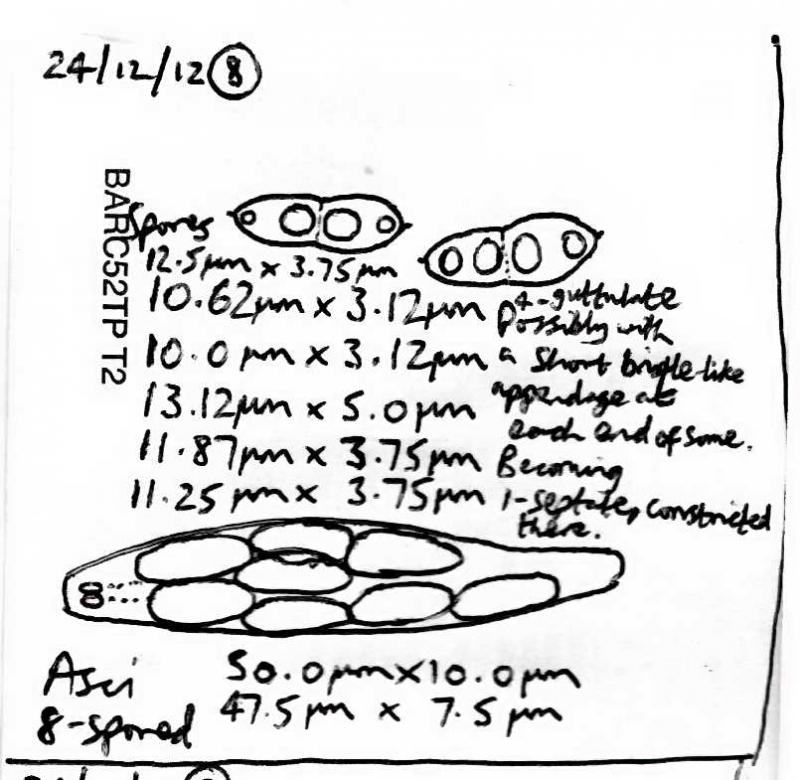
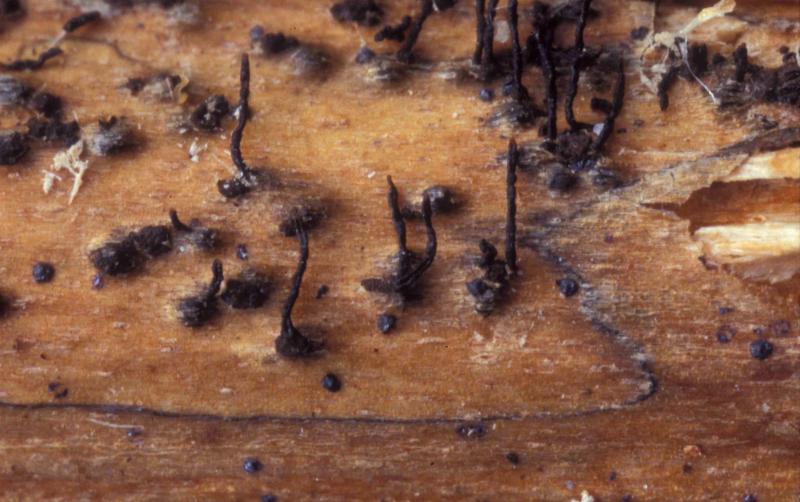
Gnomonia - Perithecia with ostiolar 'necks' extending well above the substrate and spores with short appendages at each end.
I have attached a photograph of the fruit bodies and a sketch of the microscopy.
I wonder if anyone might know the identity of the fungus.
Thank you,
Peter.

Dear Peter,
If the host is really Lonicera periclymenum, it could be interesting.
Are you sure it is Lonicera ? Could it be Hedera helix ? Because it looks like Diaporthe hederae.
Alain
Thank you for your reply.
Yes, Hedera helix was also growing at the same location. At the time, I checked for any horizontal outgrowths from the dead stems and did not find any, so convinced myself that Lonicera was more likely.
I see that the microscopy matches Diaporthe hederae very closely. I think that I must have misidentified the substrate.
Best wishes,
Peter.
Thank s for your post, it's a nice photo of Diaporthe hederae.
Alain