28-04-2026 20:07
 Lothar Krieglsteiner
... on twig in the air at standing Ceratonia siliq
04-05-2026 18:13
 Stephen Martin Mifsud
ID request for what seems to be a true aquatic fun
04-05-2026 16:39
Stephen Martin Mifsud
ID request: This specimen was collected in Malta o
04-05-2026 09:50
 Castillo Joseba
Me mandan el material seco de Galicia,(España) re
02-05-2026 12:42
Alain BRISSARDBonjour à tousJeuidi 30 avril dernier on m'a remi
02-05-2026 13:06
Pauline. PennaBonjour Please can someone help me with this id
01-05-2026 22:45
 Thierry Blondelle
Bonjour à tous, Une récolte sur bouse séchée d
14-04-2026 05:32
Ethan CrensonHi all, A few weeks back a friend pointed out som
28-04-2026 20:33
Vitus SchäfftleinHello, I found Trochila ilicina on Ilex aquifoliu
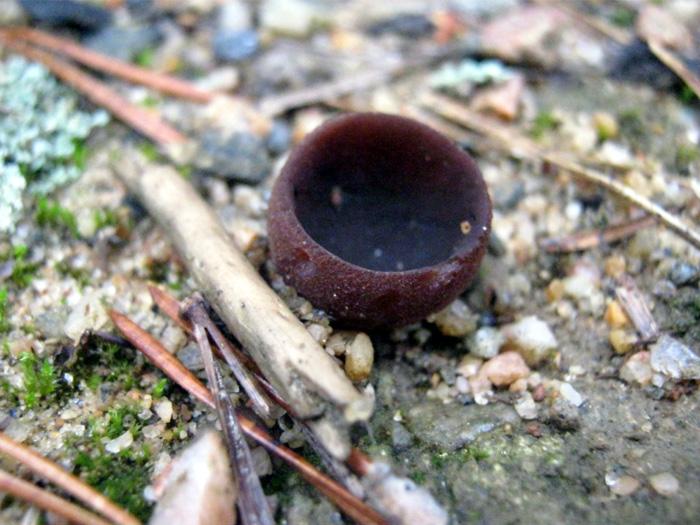
I was picking mushrooms and when returning noticed these on the way.
I did not see them on the way to woods, so they must have grown while I was there ;)
These did not reach 2 cm width.
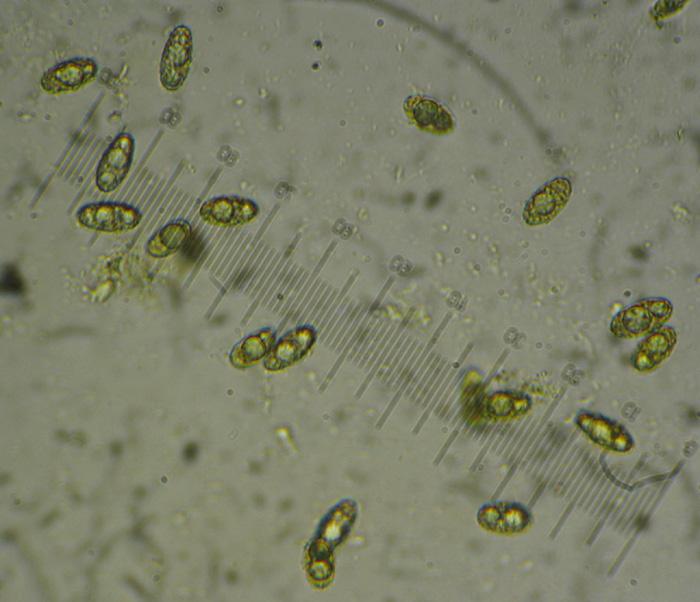
The spores are about 14-20x 8-10- and with some kind of ornamentation.
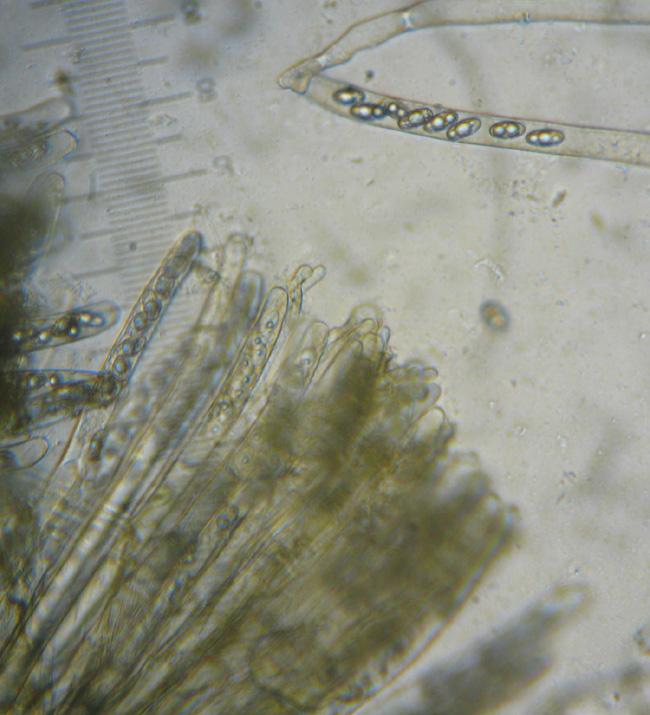
The asci are about 250-300x 11-12 and paraphyses (width about 6) are not longer than asci.
Once again Nordic Macromycetes 1 did not help me to get a determination, which I could be satisfied.
Marja
in my opinión it is a species in the P. badia group, due to the dark tones and brownish spores with tendency to be biguttulate. The asci should be unrestrictedly amyloid in Melzer.
It would be helpful to have more details about the spore ornamentation (reticulate, warty, etc.) and to check if the ascoma bleeds bluish juice when cut with a razor blade in the hymenium.
Cheers,
Ibai.
?
Peziza badia as I know is bigger, often in groups and grows much ealier, in summer. Now it is autumn here and this is much smaller and grows separately.
P. badia is a group species?
When cut, practicly no juice was bleeding.
I'm a bit busy now, but will try to get a better view to the ornamentation later.
Marja
Ps: there were 1-3 guttules in the spores and sometimes some smaller, too


Hi again,
I meant that your Peziza belongs to a group of species in the neighbourhood of Peziza badia (P. depressa, P. badiofusca, P. badioconfusa, P. saniosa, etc..) sharing a dark brown colour, paraphyses with dark content, predominantly biguttulate spores of high ornamentation, a potential ectomycorrhizal habit and non-restricted amyloid reaction of the asci in Melzer´s, as discussed by Hansen et al. (Mol. Phyl. Evol. 36:1-23, as P. depressa-Ruhlandiella clade).
This was just a small clue... I guess we need to see the spore ornamentation to be certain about the species.
Cheers,
Ibai.
?
Thank you for your comments.
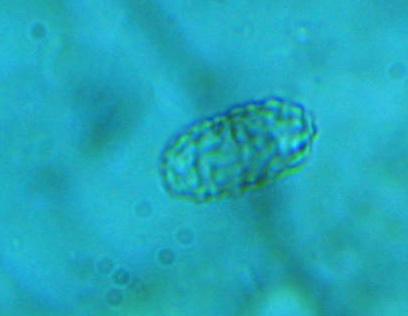
Wonders happen, the ornamentation appeared on a photo.
Hope this helps you to help me ;)
Marja
PS: I like very much P. boltonii determination. It is very close and would be new for Finland...