
28-04-2026 20:07
 Lothar Krieglsteiner
... on twig in the air at standing Ceratonia siliq
04-05-2026 18:13
 Stephen Martin Mifsud
ID request for what seems to be a true aquatic fun
04-05-2026 16:39
Stephen Martin Mifsud
ID request: This specimen was collected in Malta o
04-05-2026 09:50
 Castillo Joseba
Me mandan el material seco de Galicia,(España) re
02-05-2026 12:42
Alain BRISSARDBonjour à tousJeuidi 30 avril dernier on m'a remi
02-05-2026 13:06
Pauline. PennaBonjour Please can someone help me with this id
01-05-2026 22:45
 Thierry Blondelle
Bonjour à tous, Une récolte sur bouse séchée d
14-04-2026 05:32
Ethan CrensonHi all, A few weeks back a friend pointed out som
28-04-2026 20:33
Vitus SchäfftleinHello, I found Trochila ilicina on Ilex aquifoliu
 Dear friends:
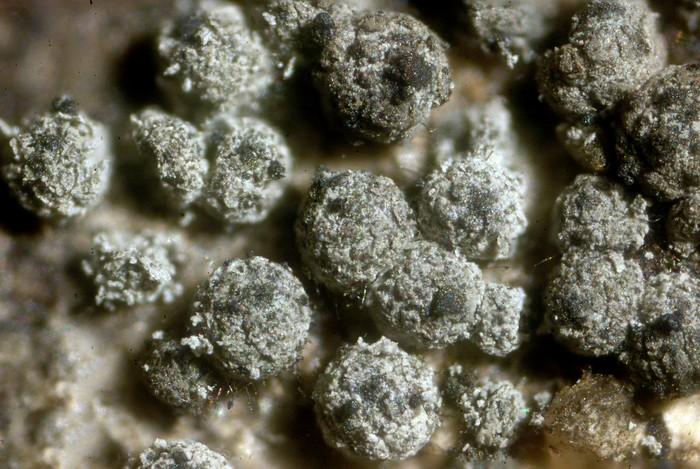
Have you some idea about this strange roundish, densely gregarious,
uniperitheciate pyrenomycete, up to 0.7-0.8 microns in diam, covered by a
conspicuous white material? It was collected on the underside of a woody piece
(perhaps Salix).
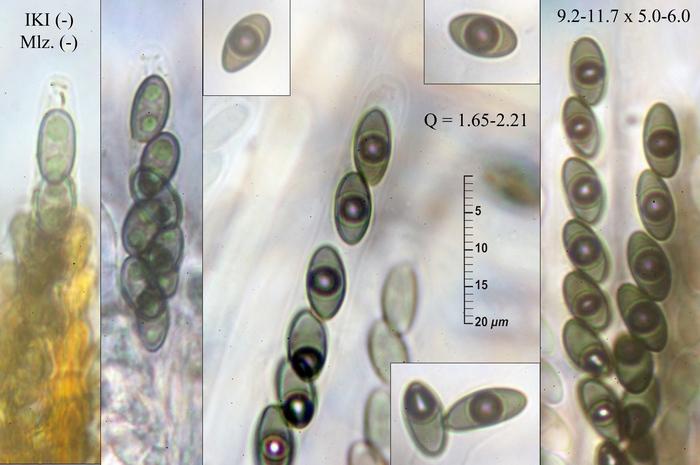
The asci have a little refringent apparatus IKI and Melzer negative and the ascospores
(2-guttulate in H2O) have any germ slit (or it is very inconspicuous).
When I began to study it, my material was very damaged and for it I cannot do a good description but I see any dark peridial setae of Coniochaeta-type
Many thanks again
Enrique

I agree with you this likely a Coniochaeta. They don't all have conspicuous setae, you should check the ostiolar region in a crush mount, you may find small setae.
Regarding a possible species name I have no idea! Maybe Andy?
Good luck!
Jacques
But the spores have not conspicuous germ-slits as the typical Coniochaeta species!
I can't to study more the perithecia because they are dead

Andy

Peter

your species reminds me somewhat of Boliniaceae, especially if you look at the spores on the left site (2guttulate, as you described). Arrangement in Asci is similar to that in C. microspora, for example. Only the apical apparatus does not fit to "Camarops". I do not know Boliniaceae very well but I think you should look there.
regards,
björn
Andy
regards,
björn
Andy
cheers