20-05-2026 17:47
Margot en Geert VullingsWe found this Mollisia on dead Juncus stems mown l
20-05-2026 21:49
Margot en Geert VullingsWe found this Lachnum on Juncus stems mown last ye
21-05-2026 17:01
Pierre RepellinBonjour à toutes et à tous,Je recherche l'articl
20-05-2026 20:08
 Andreas Millinger
Good evening,another quite distinctive find from M
20-05-2026 12:57
 Ingo Ibelshäuser
Hello everybody, on decayed hardwood e.g. Quercus
22-04-2026 20:54
 Enrique Rubio
Hi to everybody.This Pyrenopeziza grew in moist le

19-05-2026 12:55
 Hardware Tony
After checking Gminder and Otto's library I cannot
Dark on Syringa
Marja Pennanen,
22-01-2011 15:05
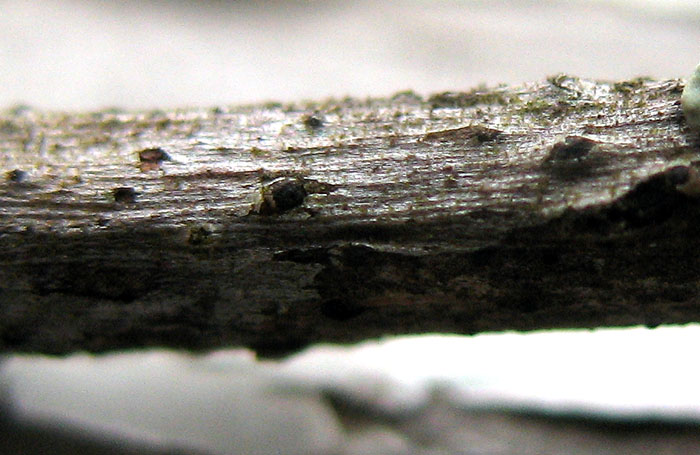
today I picked up a twig of Syringa josikaea on my yard.
There were some about 0,2 mm wide dark spots.
Marja Pennanen,
22-01-2011 15:08
Re:Dark on Syringa
I digged one, put under scope and noticed, that a very much living fungi it was :)
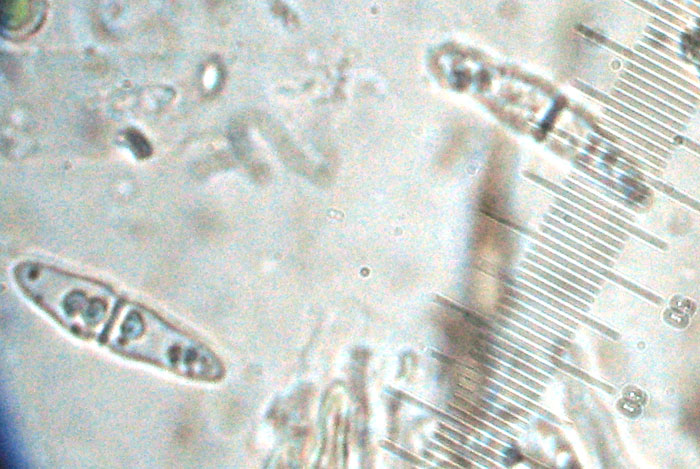
The spores were about 19-25x5-5, multiguttulate and seemed to be hyalin and one septate.
The spores were about 19-25x5-5, multiguttulate and seemed to be hyalin and one septate.
Marja Pennanen,
22-01-2011 15:09
Re:Dark on Syringa
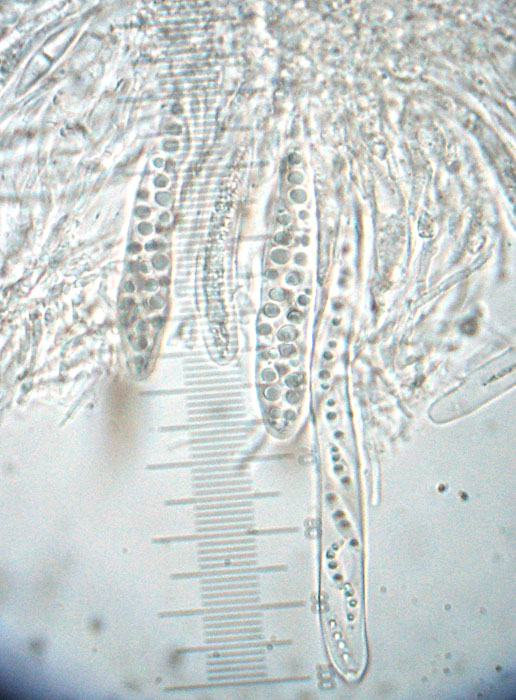
The asci were about 100-130x10-13 (-15), IKI-.
Paraphyses narrow, maybe 2 micrometers wide.
Paraphyses narrow, maybe 2 micrometers wide.
Marja Pennanen,
22-01-2011 15:11
Re:Dark on Syringa
But then I found some brown, 3 septate spores. Maybe these are mature???
Now I once again wonder, what could they be.
Marja
Now I once again wonder, what could they be.
Marja
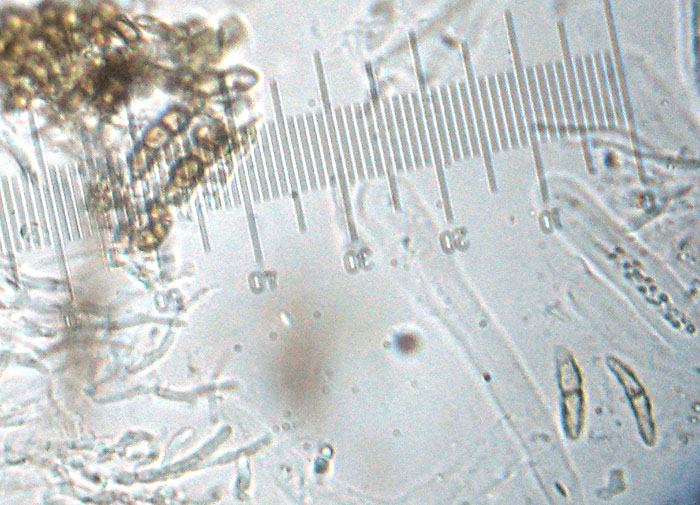
Hans-Otto Baral,
22-01-2011 17:55

Re:Dark on Syringa
Seems bitunicate and something like Lophiostoma
Zotto
Zotto
Alain GARDIENNET,
23-01-2011 08:47

Re:Dark on Syringa
Hi Marja,
I suppose perithecias are immersed but could you describe the ostiole ? Is it rounded or laterally compressed ?
As says Zotto, your fungus belongs probably at the Lophiostomataceae, perhaps a Lophiotrema, or Lophiostoma.
Alain
I suppose perithecias are immersed but could you describe the ostiole ? Is it rounded or laterally compressed ?
As says Zotto, your fungus belongs probably at the Lophiostomataceae, perhaps a Lophiotrema, or Lophiostoma.
Alain
Marja Pennanen,
23-01-2011 12:28
Re:Dark on Syringa
Dear Zotto and Alain,
thank you for your interest.
I know very little about pyremomycetes, which I suppose this is.
Should I be writing about pseudoparaphyses instead of paraphyses?
Anyway, the genus is completely new to me -whatever it then is.
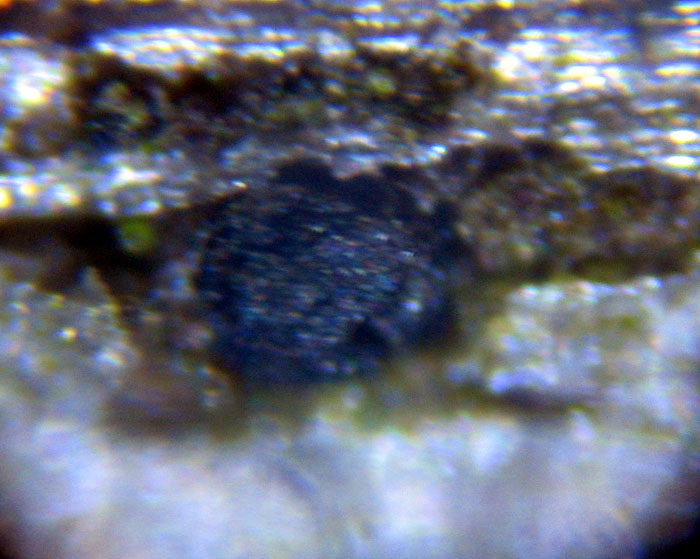
I got a very little toymicroscope and I took a closer photo of the fungus.
Hope that the aswer is there, eventhoug it is quite difficult for me to see the ostiole ;)
Best wishes: Marja
thank you for your interest.
I know very little about pyremomycetes, which I suppose this is.
Should I be writing about pseudoparaphyses instead of paraphyses?
Anyway, the genus is completely new to me -whatever it then is.
I got a very little toymicroscope and I took a closer photo of the fungus.
Hope that the aswer is there, eventhoug it is quite difficult for me to see the ostiole ;)
Best wishes: Marja