
31-05-2026 10:35
Hulda Caroline HolteHello,I collected this species growing on a rather
30-05-2026 21:12
Philippe PELLICIERSur branche de mélèze (Larix) près de la neige,
25-05-2026 16:35
 Bernard CLESSE
Bonjour à toutes et tous,J'ai trouvé récemment,
29-05-2026 15:35
daniel FERREBonjour à tous,Je voudrais votre aide pour cette
28-05-2026 16:15
James MitchellHello,Does anyone have the original publication of
28-05-2026 11:06
Thomas Læssøehttps://svampe.databasen.org/observations/10596750
23-05-2026 11:44
 Charles Grapinet
Hello, I am having trouble identifying this copro
25-05-2026 16:44
François BartholomeeusenHi forum members,During an excursion organised by
26-05-2026 21:25
Dirk GerstnerHello everyone, I'm completely stumped by this li
26-05-2026 22:44
Ethan CrensonHi all, I think I have Incrucipulum capitatum her
A dark peziza...
Martin Bemmann,
24-09-2010 23:40
 Bonsoir and good evening,
I got some collections of pezizas from a friend for determination. I am not very familiar with this genus since my forest is on acid ground (sandstone) and I do find them rarely. But she lives in a calcareous region (close by) and collects them in abundance.
I stuck up with determination right at the first specimen. I went through different keys (Hohmeyer, Nordic Macromycetes) and stranded allways at P. lividula. Which doesn't fit, at least considering shape of spores beeing not fusiform or subf. at all. My problem with those keys is that my specimen doesn't show any milk/latex. They were harvested only few days ago and kept refrigerated.
So here is what I have:
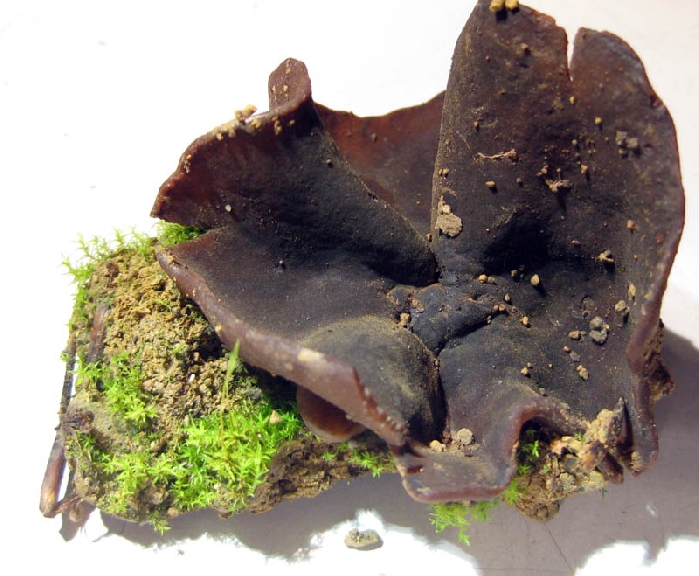
Apothecia are blackish darkbrown with a distinct purple to violaceous tint, up to 4.5 cm in dm.
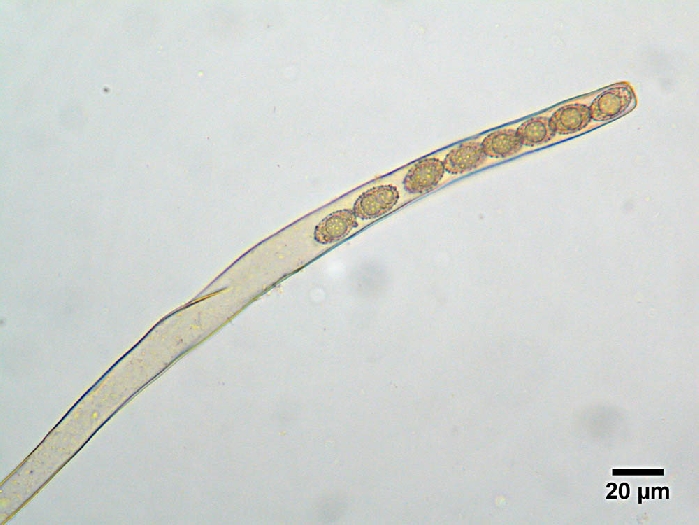
Asci are IKI+ and c. 375x15.5 µm in size.
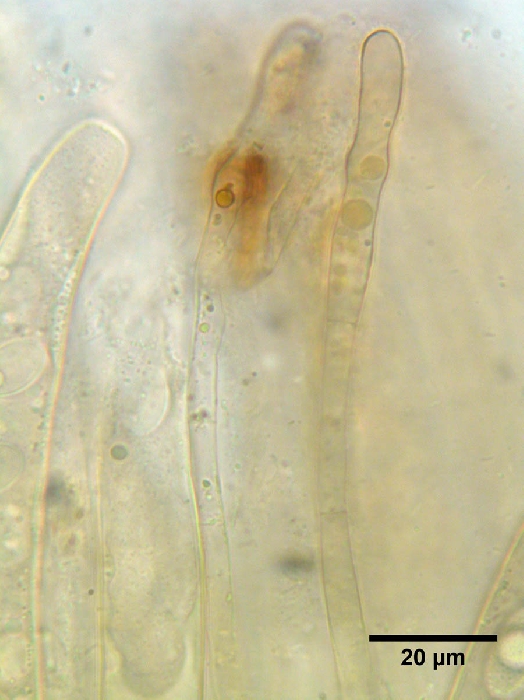
Paraphyses are septated and slightly moniliform (are they?) with a medium width of 6.5 µm, with some
yellow-brownish drops in the slightly clavate apical section.
Asci are ovoid with predominantly one oildrop and covered with an even ornamentation of rounded warts (16.6-18.1 x 9-10.5 µm).
What I have seen of the textura of the excipulum was a globulosa.
I will be happy to hear some suggestions. Maybe it is just a trivial one...
Best regards,
Martin
And now some pictures:
Martin Bemmann,
24-09-2010 23:41
Re:A dark peziza...
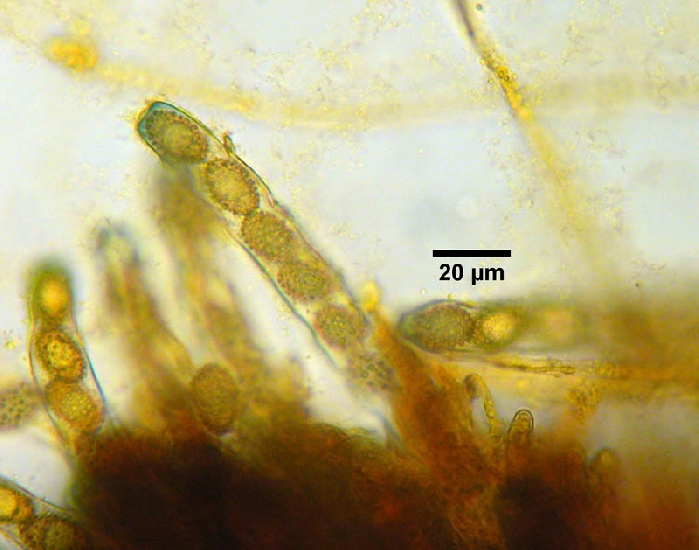
an ascus:
Martin Bemmann,
24-09-2010 23:41
Re:A dark peziza...
an ascus in Lugol:
Martin Bemmann,
24-09-2010 23:45
Re:A dark peziza...
Paraphyses:
Martin Bemmann,
24-09-2010 23:45
Re:A dark peziza...
Spores in water:
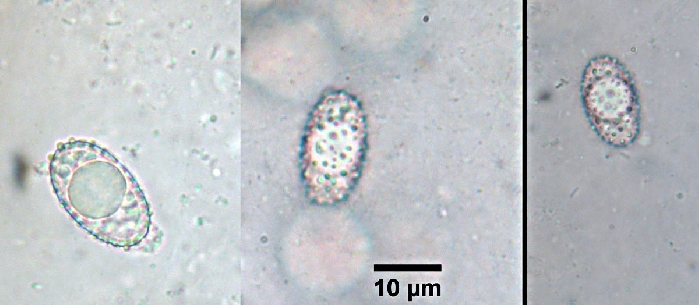
Martin Bemmann,
24-09-2010 23:45
Re:A dark peziza...
Spores in Lugol:
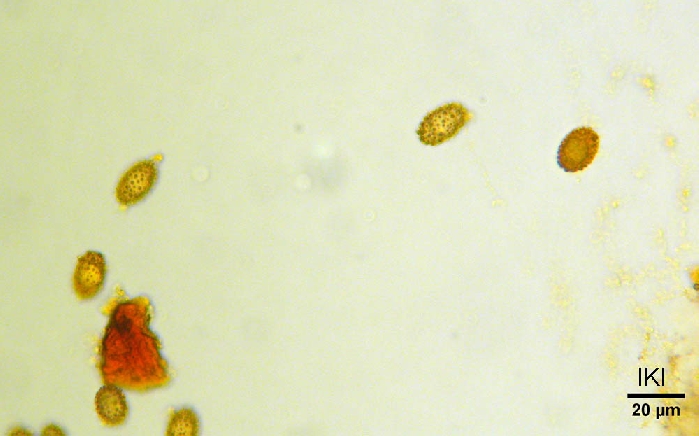
Martin Bemmann,
24-09-2010 23:46
Re:A dark peziza...
And one in CB:
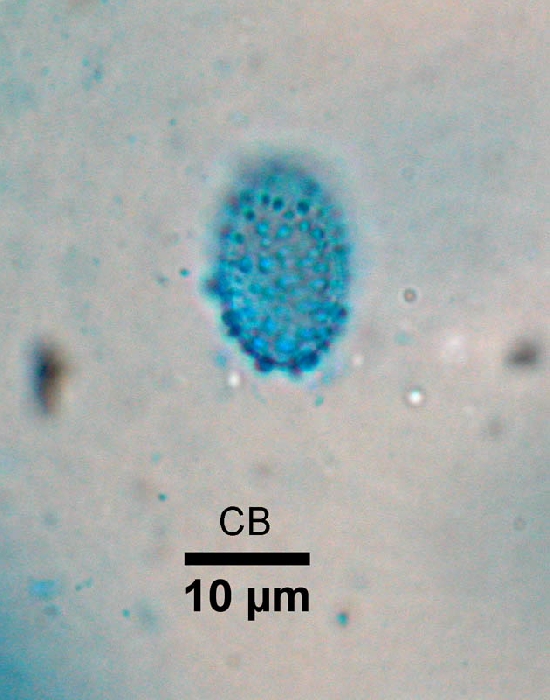
René Dougoud,
25-09-2010 07:35
Re:A dark peziza...
Cher Collègue,
Il s'agit très probablement de Peziza depressa Pers.: Fr.
La couleur de l'hyménium est assez type, brun rougeâtre. Sur le frais et les spécimens normalement hydratés, la chair exsude un liquide hyalin, assez abondant. Microscopiquement, les ascospores présentent des verrue arrondies et aussi pointues, avec une grande guttule. Les dimensions données sont correctes pour cette espèce. Le médulla est de texture intricata et l'exc. ectal t. angularis.
Cordialement
René
Il s'agit très probablement de Peziza depressa Pers.: Fr.
La couleur de l'hyménium est assez type, brun rougeâtre. Sur le frais et les spécimens normalement hydratés, la chair exsude un liquide hyalin, assez abondant. Microscopiquement, les ascospores présentent des verrue arrondies et aussi pointues, avec une grande guttule. Les dimensions données sont correctes pour cette espèce. Le médulla est de texture intricata et l'exc. ectal t. angularis.
Cordialement
René
Martin Bemmann,
25-09-2010 16:06
Re:A dark peziza...
Dear René,
thank you very much! This description fits very good to this collection.
Best regards,
Martin
thank you very much! This description fits very good to this collection.
Best regards,
Martin
Martin Bemmann,
26-09-2010 18:03
Re:A dark peziza...
Addendum:
I don't want to blame the keys I used, I have just ignored (not seen) the junction 39d in Hohmeyer's key...
Best regards,
Martin
I don't want to blame the keys I used, I have just ignored (not seen) the junction 39d in Hohmeyer's key...
Best regards,
Martin