
05-06-2026 11:02
Thomas Læssøehttps://svampe.databasen.org/observations/10596691

04-06-2026 11:36
Gernot FriebesHi,found on Vaccinium myrtillus.Asci: IKI –, 8-s
19-05-2026 10:27
Patrice TANCHAUDBonjour, récolte récente sur terre retournée i
04-06-2026 18:39
Gernot FriebesHi,I collected this species in two different locat
22-05-2026 13:29
Gernot FriebesHi,I am curious to hear your opinion on this mater
04-06-2026 10:50
 François Freléchoux
Bonjour, J'ai trouvé hier un petit asco observé
04-06-2026 07:02
François Freléchoux
Bonjour, Voici la description d'une espèce qui p
04-06-2026 13:34
Gernot FriebesHi,I am interested to hear your opinion on this Le
Hymenoscyphus on Juniperus
Marja Pennanen,
30-08-2010 09:14
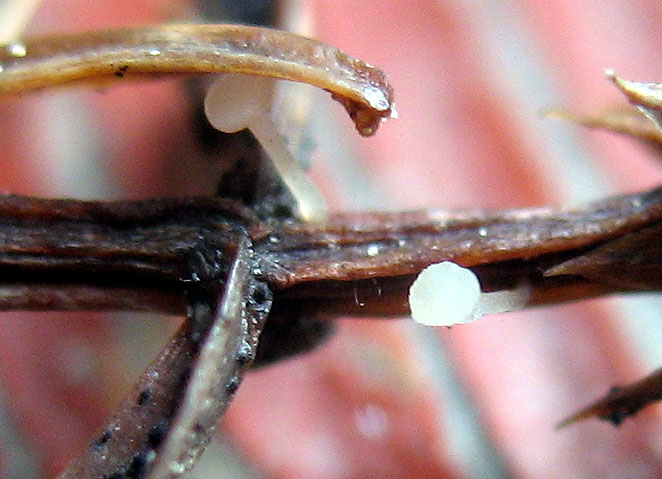
as I mentioned I found something on the needles and twigs of Juniperus, which I naturally couldn't determine.
These are about 0.3-0,7 mm wide and 1-2 mm high.
The base of the stipe may be darker.
Marja Pennanen,
30-08-2010 09:16
Re:Hymenoscyphus on Juniperus
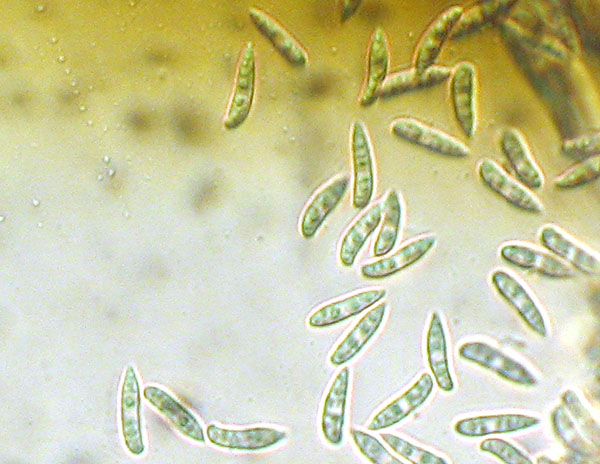
The spores are multiguttulate, 12-17x3-4 and asci 75-95x6-8, IKI+.
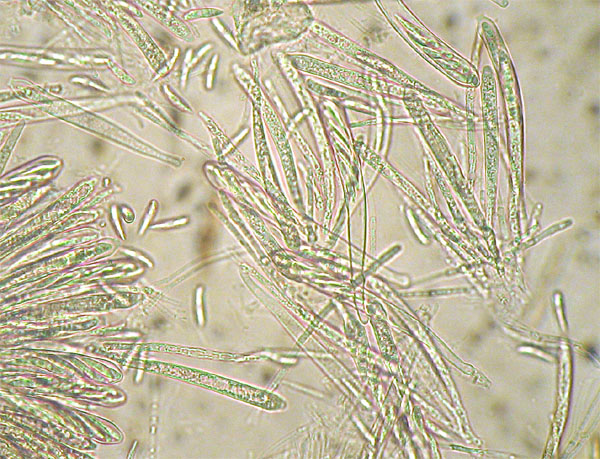
Paraphyses are septate, some with VB:s and 2-2,5 micrometers wide.
Poor photo of the shape of the spores:
Paraphyses are septate, some with VB:s and 2-2,5 micrometers wide.
Poor photo of the shape of the spores:
Marja Pennanen,
30-08-2010 09:22
Re:Hymenoscyphus on Juniperus
Another view of microscophy.
Why are these Hymenoscyphuses so hard fo me to open?
I've been able to determine lately only H. kermesinus, H. scutula, H. salicellus and H. caudatus, which are allready quite familiar to me.
Desperate Marja
Why are these Hymenoscyphuses so hard fo me to open?
I've been able to determine lately only H. kermesinus, H. scutula, H. salicellus and H. caudatus, which are allready quite familiar to me.
Desperate Marja
Hans-Otto Baral,
30-08-2010 12:41

Re:Hymenoscyphus on Juniperus
Hymenoscyphus is one of the most difficult genera. especially those with scutuloid spores are a hard nut. I do not see clear in such species like H. caudatus and even H. scutula.
Yours has quite narrow spores, and at the moment I have no suggestion, sorry. Important would be to know the croziers, actually. The ascus base is quite well seen on your photo, but should be viewed with oil immersion. I am sure you can learn that, I also must often search some time to see the feature clearly. It depends on the orientation, on the living state, on maturity etc., all this can obscure the feature. Best is to make a section and look at living cells.
Zotto
Yours has quite narrow spores, and at the moment I have no suggestion, sorry. Important would be to know the croziers, actually. The ascus base is quite well seen on your photo, but should be viewed with oil immersion. I am sure you can learn that, I also must often search some time to see the feature clearly. It depends on the orientation, on the living state, on maturity etc., all this can obscure the feature. Best is to make a section and look at living cells.
Zotto
Marja Pennanen,
30-08-2010 13:43
Re:Hymenoscyphus on Juniperus
Hello Zotto,
my problem is that I've got almoust no practical education to mycology or nothing else, too.
I've just learned myself on the way.
Just dived (fast and deep?) into it and hoped to survive ;).
Now I'm waiting in despair, when the local university needs my loaned microscope for educational purposes.
Marja
my problem is that I've got almoust no practical education to mycology or nothing else, too.
I've just learned myself on the way.
Just dived (fast and deep?) into it and hoped to survive ;).
Now I'm waiting in despair, when the local university needs my loaned microscope for educational purposes.
Marja