
04-06-2026 10:50
 François Freléchoux
Bonjour, J'ai trouvé hier un petit asco observé
04-06-2026 07:02
François Freléchoux
Bonjour, Voici la description d'une espèce qui p
04-06-2026 13:34
Gernot FriebesHi,I am interested to hear your opinion on this Le
04-06-2026 11:36
Gernot FriebesHi,found on Vaccinium myrtillus.Asci: IKI –, 8-s
22-05-2026 13:29
Gernot FriebesHi,I am curious to hear your opinion on this mater
18-10-2022 00:12
Valencia Lopez Francisco JavierHola amigos/asRecientemente encontré esta colecci
03-06-2026 19:45
 Miguel Ángel Ribes
Good afternoonI'm completely baffled by this suppo
03-06-2026 14:39
Thomas FlammerApothecia yellow, glassy-transparent, 80 - 120 ymS
acrspermum
Didier ARGAUD,
04-01-2007 14:12
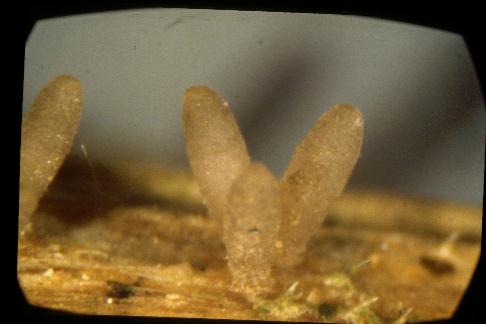
Connaissez-vous l'espèce suivante: cf photo
C'est un acrospermum mais lequel, il semble different (macroscopiquement) de compressum, que je connais déjà. La microscopie semble la même.
Substrat: herbacées mais pas sur ortie.
Est ce graminum ? ou autre?
Didier
Björn Wergen,
14-01-2007 14:21

Re:acrspermum
Dear Didier,
I know about three species in the genus Acrosperum: A. compressum, A. graminum and A. pallidulum. All three are hard to determine because they have nearly the same characteristics.
A. compressum usually grows on old stems of Urtica and is 2-4 mm high, with a grey-brown surface. Spores are about 400 µm long.
A. graminum grows on little stems of graminaceen and has smaller fruitbodies (1-2,5 mm). The color is brownish, pale-brown.
A. pallidiulum also has pale-brown fruitbodies but spores around 300µm long and grows on dead stems of "Galium". I just know this species from literature but didn't find it in nature yet.
Differences are flowing into each other and it would not surprise me, if there are only 2 species instead of three or more (I do not know about others...).
Greetings,
Kaz
I know about three species in the genus Acrosperum: A. compressum, A. graminum and A. pallidulum. All three are hard to determine because they have nearly the same characteristics.
A. compressum usually grows on old stems of Urtica and is 2-4 mm high, with a grey-brown surface. Spores are about 400 µm long.
A. graminum grows on little stems of graminaceen and has smaller fruitbodies (1-2,5 mm). The color is brownish, pale-brown.
A. pallidiulum also has pale-brown fruitbodies but spores around 300µm long and grows on dead stems of "Galium". I just know this species from literature but didn't find it in nature yet.
Differences are flowing into each other and it would not surprise me, if there are only 2 species instead of three or more (I do not know about others...).
Greetings,
Kaz
Didier ARGAUD,
14-01-2007 21:06
Re:acrospermum
Merci pour la réponse
Didier
Didier