
29-05-2026 15:35
daniel FERREBonjour à tous,Je voudrais votre aide pour cette
28-05-2026 16:15
James MitchellHello,Does anyone have the original publication of
28-05-2026 11:06
Thomas Læssøehttps://svampe.databasen.org/observations/10596750
23-05-2026 11:44
 Charles Grapinet
Hello, I am having trouble identifying this copro
25-05-2026 16:44
François BartholomeeusenHi forum members,During an excursion organised by
26-05-2026 21:25
Dirk GerstnerHello everyone, I'm completely stumped by this li
26-05-2026 22:44
Ethan CrensonHi all, I think I have Incrucipulum capitatum her
22-05-2026 14:44
 Lothar Krieglsteiner
in unripe condition citrine yellow, then soon fadi
25-05-2026 16:35
 Bernard CLESSE
Bonjour à toutes et tous,J'ai trouvé récemment,
22-05-2026 13:29
Gernot FriebesHi,I am curious to hear your opinion on this mater
Leptosphaeria (Phaeosphaeria)
Enrique Rubio,
27-11-2006 19:53
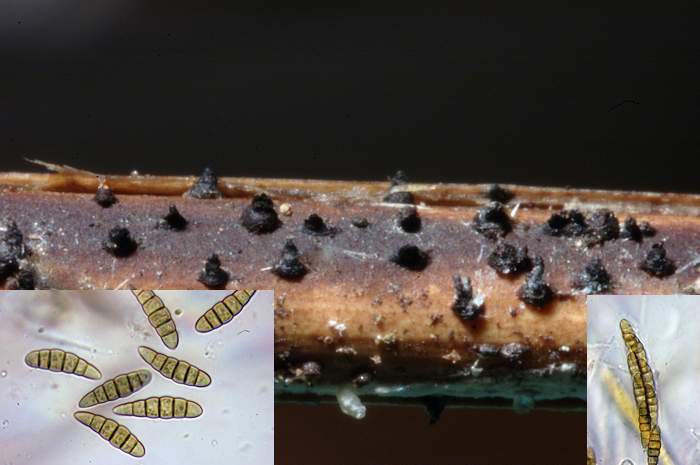
 J'aimerais connaître une opinion sur cette espèce de Leptosphaeria (Phaeosphaeria) qui croît sur des tiges d'Ammophila arenaria. Les spores, avec 5 (4) septa, mesurent 25-30 x 7.
J'ai pensé qu'il pourrait s'agir de Leptosphaeria larseniana Munk.
Merci à tous
I would like to know some opinion about this Leptosphaeria species (Phaeosphaeria) that grows on stems of Ammophila arenaria. The spores, with 5 (4) septa, measure 25-30 x 7.
Might he be Leptospharia larseniana Munk?
Thanks to all
NC NC,
27-11-2006 21:29
Re:Leptosphaeria (Phaeosphaeria)
Certaines ostioles me paraissent allongées sur la photo ? Je penserais à un Lophiostoma. caulium par exemple qui doit avoir 5 cloisons. Mais ce n'est qu'une idée vague peut-être basée sur une illusion d'optique !
Amitiés
Robert
Amitiés
Robert
NC NC,
27-11-2006 21:49
Re:Leptosphaeria (Phaeosphaeria)
Try Phaeosphaeria vagans, where spores sometimes lack vertical septa, occuring on Ammophila.
Regards,
Bernard Declercq
Regards,
Bernard Declercq
Enrique Rubio,
28-11-2006 19:18
Re:Leptosphaeria (Phaeosphaeria)
Des amis Bernard et Robert :
Mes ascomata, semiimmergés, possèdent des papilles allogées, parfois latéralement comprimés, mais dans les cellules des spores je ne vois pas des vertical septa. Est-ce que cela peut succéder dans Phaeospharia vagans ? .
Merci par votre amicale aide
Mes ascomata, semiimmergés, possèdent des papilles allogées, parfois latéralement comprimés, mais dans les cellules des spores je ne vois pas des vertical septa. Est-ce que cela peut succéder dans Phaeospharia vagans ? .
Merci par votre amicale aide
Christian Lechat,
08-12-2006 13:51

Re:Leptosphaeria (Phaeosphaeria)
Dear friends,
I think that is : Lophiostoma caudatum Fabre
Best wishes, :)
I think that is : Lophiostoma caudatum Fabre
Best wishes, :)
NC NC,
08-12-2006 18:08
Re:Leptosphaeria (Phaeosphaeria)
Dear all,
as far as Erique explained us that the ascomata have flattened ostiola, we have to look indeed in to one of following genera: Lophiostoma, Lophiotrema, Massariosphaeria. The problem here is, and taht is the reason why I sent no further comments, that species known to me are guttulate and I did not observe guttulae on the photo. I thought the L. caudatum spores are more "caudate" than what we see here but Chesters & Bell (1970) already mentioned that several forms occur which got in the past distinct names. I do not know if some more recent study gave us better insight on this "complex". So I think for the moment being that Christian gave us the right answer.
Best regards,
Bernard Declercq
as far as Erique explained us that the ascomata have flattened ostiola, we have to look indeed in to one of following genera: Lophiostoma, Lophiotrema, Massariosphaeria. The problem here is, and taht is the reason why I sent no further comments, that species known to me are guttulate and I did not observe guttulae on the photo. I thought the L. caudatum spores are more "caudate" than what we see here but Chesters & Bell (1970) already mentioned that several forms occur which got in the past distinct names. I do not know if some more recent study gave us better insight on this "complex". So I think for the moment being that Christian gave us the right answer.
Best regards,
Bernard Declercq
Enrique Rubio,
08-12-2006 19:39
Re:Leptosphaeria (Phaeosphaeria)
Merci à tous par vos commentaires. Quelques Pyrenos sont vraiment difficiles!