
19-05-2018 17:51
 Lothar Krieglsteiner
.. in the Bavarian Forest. The corticioid fungus w
18-05-2018 22:02
 Bernard CLESSE
Bonsoir à toutes et tous,Que pensez-vous de cet a
16-05-2018 15:15
Gernot FriebesHi,this fungus was collected by a friend on a dea
18-05-2018 23:03
Bernard CLESSE
Sur feuille pourrie de laîche (cf. Carex acutifor
18-05-2018 12:55
 UZUN Yasin
Could someone send me if have this literatures Ple
18-05-2018 17:56
Bernard CLESSE
Bonjour à tous et toutes,En étudiant une croûte
16-05-2018 18:01
Lothar Krieglsteiner
... unfortunately, my microscope camera broke down

16-05-2018 18:15
Thomas LæssøeThe record can be seen here https://svampe.databa
.. in the Bavarian Forest. The corticioid fungus was totally destroyed and old, but there were a lot of anamorphic spores like those in the pictures. Does somebody have an idea which fungus has such conidia (they measure about 55-65/8-9 µm(?
Best regards, Lothar
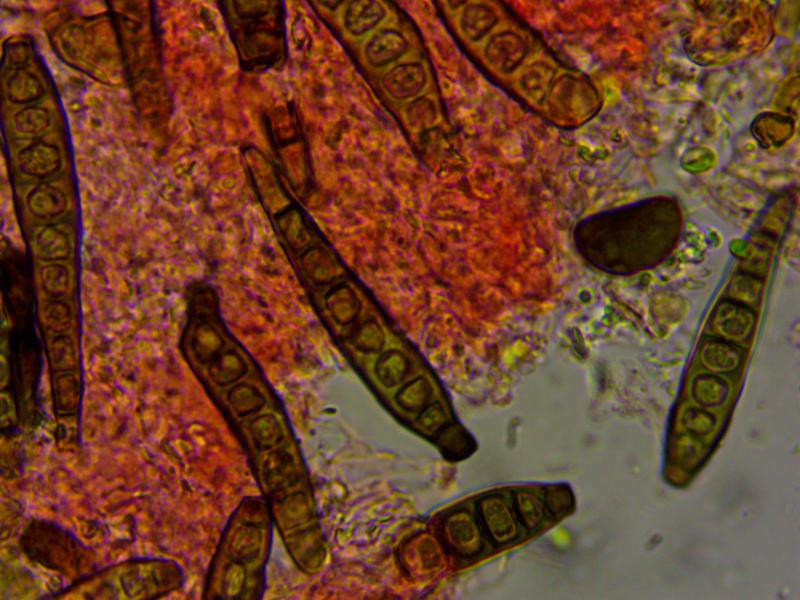
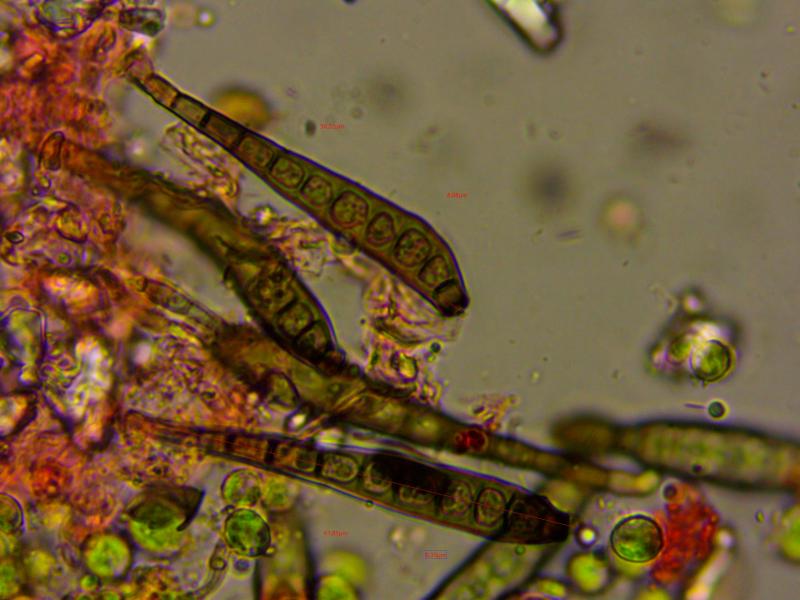

It might be worth looking at Sporidesmium coronatum. The colour and size of conidia seem right.
With Best Wishes,
Peter.
Thanks to you both for your suggestions :-)
Best regards from Lothar
Zotto
The conidia of Sporidesmium species can vary considerably in appearance.
When I considered the options, I was able to key out in Sporidesmium to S. coronatum and the photographed conidia strongly resemble those drawn by Ellis & Ellis for this species. Wood and bark would be the usual host type.
For Helminthosporium, the closest species for keying out seems to be H. solani. The conidia do look very similar, but the host Solanum tuberosum is strongly linked to this taxon.
I assume that there were no conidiophores found?
With Best Wishes,
Peter.
Hello Peter,
no - I only found the conidia. And I think your suggestion is very good. So, I name the specimen with "cf." with this name.
Thanks again very much and best regards from Germany
Lothar