05-05-2026 22:40
Gernot FriebesHi,I believe this is a Plagiostoma growing on a Sa
06-05-2026 11:25
 Castillo Joseba
Me mandan el material seco de Galicia (España) re
06-05-2026 17:23
Thomas Læssøehttps://svampe.databasen.org/observations/10594257
28-04-2026 20:07
 Lothar Krieglsteiner
... on twig in the air at standing Ceratonia siliq
04-05-2026 18:13
 Stephen Martin Mifsud
ID request for what seems to be a true aquatic fun
04-05-2026 16:39
Stephen Martin Mifsud
ID request: This specimen was collected in Malta o
28-07-2011 18:31
 Alex Akulov
Dear FriendsToday I made the pdf file of Velenovsk
04-05-2026 09:50
Castillo Joseba
Me mandan el material seco de Galicia,(España) re
Oletheriostrigula? Leptosphaerulina?
Björn Wergen,
11-01-2016 14:19
 Hi friends,
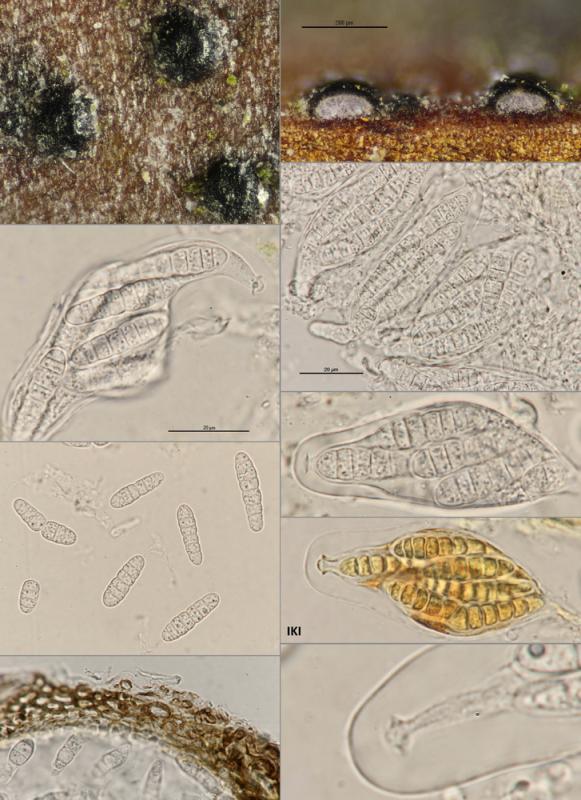
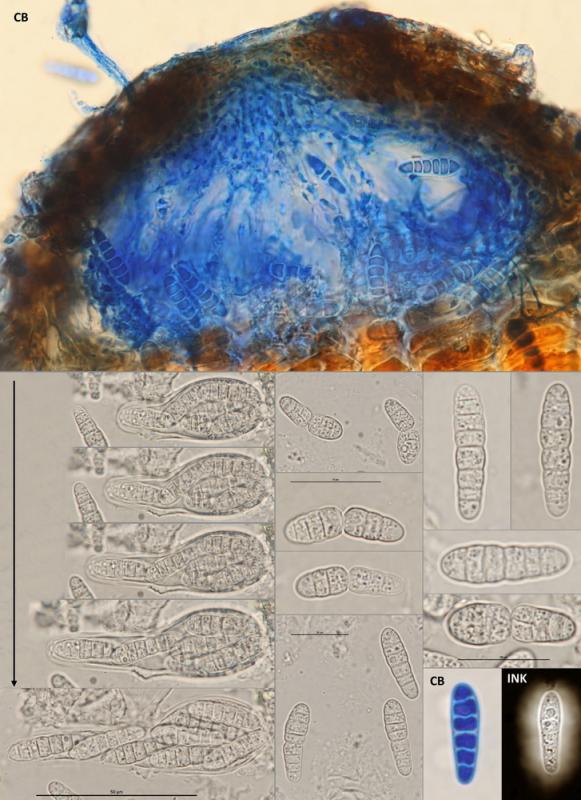
I have recently found an unkwon species growing on bark of Ulmus glabra, of which I think it could belong to Oletheriostrigula or Leptosphaerulina (?). I have also recognized similarities to Arthopyrenia, but I did not manage to find it in literature. Maybe someone else knows where it belongs to ;)
Spores are 19-30x5-7µm, with 5-7 septations, rarely with a single longitudinal septation, breaking into two part spores when fully mature, with distinct gel coat. Asci bitunicate, with a distinct apical apparatus (ring like), pyriforme / obpyriforme, thickwalled, 60x25µm. Pseudoparaphyses very short celled, ~ 3µm, very numerous. Pseudothecia wall about 15-20µm thick, near ostiolus with scleroplectenchymatous parts, else pseudoparenchymatous of globose, 2-3µm cells. Periphyses not seen.
Leptosphaerulina species mostly occur on leaves of various deciduous plants, and builds globose fruitbodies instead of hermisphaeric as here shown.
Oletheriostrigula is very similar, but is found on Cyperaceae regarding to Enrique's recolt (Cladium mariscus).
thanks for any hints,
regards,
björn